Friday, April 06, 2007

Bradford Rest Stop, I-91 North


Bradford
James Wilson, Glove Maker

Located 100 yards beyond this marker is the site where James Wilson had his home and workshop. Between 1808 and 1810 Wilson made and sold the first terrestrial and celestial gloves in North America. Born in Londonderry, N.H., in 1763, Wilson was a farmer and blacksmith who moved to Bradford in 1795. He taught himself astronomy and geography and studied wiwth Amos Doolittle in CT to learn engraving, skills he needed to make gloves. Wilson died in Bradford in 1855 at the age of 92.

Vermont Division for Historic Preservation – 1995

_/\_/\_
Thursday, April 05, 2007

North Country Hospital, Newport, Vermont

I had to hang out at North Country Hospital in Newport on Monday to wait my turn for more tests. I decided to take some photos. The hospital is small and the serious and troublesome cases are flown by helicopter or driven by ambulance to Hanover, NH. The hospital is part of the Dartmouth-Hitchcock Alliance of Dartmouth University, Hanover, NH.

Above: "Friendship", 1967 by David C Savage, Princeton, New Jersey
A generous donation to North Country Hospital.


_/\_/\_

Tuesday, April 03, 2007

Uh Oh

Well, I could always use one more snow delay (or day!):


Winter Storm Watch

URGENT - WINTER WEATHER MESSAGE
NATIONAL WEATHER SERVICE BURLINGTON VT
423 PM EDT TUE APR 3 2007

...A LATE SEASON STORM THREATENS HEAVY SNOW ACROSS VERMONT LATE WEDNESDAY INTO THURSDAY MORNING...

.A LOW PRESSURE SYSTEM WILL MOVE ACROSS THE GREAT LAKES TONIGHT INTO ONTARIO. MEANWHILE...AN ASSOCIATED WARM FRONT WILL MOVE ACROSS VERMONT WITH RAIN SHOWERS TONIGHT AND POSSIBLY SOME FREEZING RAIN IN WIND PROTECTED SHELTERED VALLEYS ALONG AND EAST OF THE GREEN MOUNTAINS OF VERMONT. ON WEDNESDAY AFTERNOON...ANOTHER LOW PRESSURE SYSTEM IS EXPECTED TO DEVELOP SOUTH OF SOUTHERN NEW ENGLAND...THEN TRACK NORTHEAST INTO THE GULF OF MAINE BY THURSDAY MORNING.

RAIN WILL BECOME STEADIER AND HEAVIER WEDNESDAY AFTERNOON...GRADUALLY
MIXING WITH AND CHANGING TO A WET SNOW IN THE HIGHER ELEVATIONS LATE...
THEN IN THE VALLEYS BY EVENING AND CONTINUE WEDNESDAY NIGHT BEFORE TAPERING TO SNOW SHOWERS THURSDAY MORNING. AT THIS TIME...IT APPEARS AS THOUGH MORE THAN 6 INCHES OF SNOW MAY FALL FROM THE WESTERN SLOPES OF THE GREEN MOUNTAINS EAST ACROSS THE REMAINDER OF VERMONT.

VTZ003-004-006>008-016-017-041000-
/O.NEW.KBTV.WS.A.0006.070404T2000Z-070405T1400Z/
ORLEANS-ESSEX-LAMOILLE-CALEDONIA-WASHINGTON-EASTERN FRANKLIN-
EASTERN CHITTENDEN- INCLUDING THE CITIES OF...NEWPORT...ISLAND POND...JOHNSON... STOWE...ST. JOHNSBURY...MONTPELIER...ENOSBURG FALLS...RICHFORD...UNDERHILL
423 PM EDT TUE APR 3 2007

...WINTER STORM WATCH IN EFFECT FROM WEDNESDAY AFTERNOON THROUGH
THURSDAY MORNING...

THE NATIONAL WEATHER SERVICE IN BURLINGTON HAS ISSUED A WINTER STORM WATCH...WHICH IS IN EFFECT FROM WEDNESDAY AFTERNOON THROUGH THURSDAY MORNING FOR NORTH CENTRAL...NORTHEAST VERMONT AND THE WESTERN SLOPES OF EASTERN FRANKLIN AND CHITTENDEN COUNTIES.

WET SNOW IS EXPECTED TO ACCUMULATE 6 OR MORE INCHES FROM WEDNESDAY EVENING THROUGH THURSDAY MORNING.

RAIN WILL MIX THEN CHANGE TO A WET SNOW...FIRST IN THE HIGHER ELEVATIONS BY MID TO LATE AFTERNOON AND IN THE VALLEYS BY EVENING. THE HEAVY WET SNOW WILL CONTINUE WEDNESDAY NIGHT BEFORE TAPERING TO SCATTERED SNOW SHOWERS THURSDAY MORNING.

THIS HEAVY WET SNOW WILL BE LIKELY CAUSE SLICK...TREACHEROUS ROAD CONDITIONS AND THE WEIGHT OF THE SNOW MAY CAUSE SOME SCATTERED POWER OUTAGES WEDNESDAY NIGHT AND EARLY THURSDAY. PLEASE PLAN ACCORDINGLY.

PLEASE STAY TUNED TO NOAA WEATHER RADIO...YOUR LOCAL MEDIA...OR GO TO WWW.WEATHER.GOV/BURLINGTON FOR FURTHER UPDATES ON THIS WEATHER SITUATION.

$

_/\_/\_

Monday, April 02, 2007

Cats Tuesday: Frankie and Daisy


Frankie was my favorite cat ever. He was so mean that my daughter Amy (my resident vet technician) refused to pill him if needed or give him his shots. The vet even refused to care for him unless he was drugged! He lived in my bedroom except for food, water and litter box. When he left my room all the other animals hid. He attacked any dog or male cat that was within sight. He left the female cats alone and tolerated them in bed at night. But Frankie loved me. I could pill him, pet him, cuddle with him and even play with him. He slept in my arms under the covers every single night for fifteen years. Yes, he bit me a few times, but he had been an orphan. So he was going to be confused at times.

One night, Amy and her dog, Daisy, were asleep in my bed with me and Frankie. Frankie woke up and saw the dog (a 90 pound (40.8 kg) dog no less!) lying across his bed. His eyes narrowed. I was in a mood so I gently shoved Frankie towards the dog. Frankie got the message! He slowly slithered toward the dog. Poor innocent Daisy. She had actually nursed some of our orphaned kittens and here I was setting her up for a sneak attack!

When Frankie got close enough to Daisy, he flew in the air and landed on Daisy hissing and growling. Poor Daisy fell off of the bed in terror. All of the racket woke up Amy and in her fright, she fell off the bed too! Amy and Daisy sputtered nasty curses at me and Frankie. Frankie, his tail high, walked back to me and curled up in my arms and fell right back asleep.

Sweet Daisy sitting on the same bed.

I still chuckle when I think of the prank that I played on Daisy and Amy. Amy still gets mad. Both Frankie and Daisy are gone now. But they will never be forgotten. They were the best.

_/\_/\_

Sugar Snow

'Nuff said.
_/\_/\_

Sunday, April 01, 2007

Otters Holding Hands

These are sea otters at the Vancouver Aquarium. I have river otters in the beaver ponds. Their personalities are similar, though. This is such a great video!

Barton Library Movie Nights

The Barton Public Library is a beautiful, peaceful and friendly place. It is not owned by the town but by public subscription. That is new to me. Dues are only $5 a year (but you are never asked to subscribe in order to use the library!).

My favorite times there are Movie Night. It began a few years ago when Jim ran his collection of old silent movies on one Saturday night a month. It was mostly Harold Lloyd and Abbot & Costello. I quickly learned to cherish these nights. Amy even went a few times and had fun! Jim and his son would provide popcorn and soda and I began to bring brownies.

Jim ran out of old movies after a year or so. Now the library plays all types of movies . . . legally. They have permission to play them to the public as long as they don't advertise the titles. Many libraries in the Kingdom do this. So on the last Friday of the month at 7 PM I am going to the movies again! Five people attended Friday night.

The library recently got a DVD projection system and now you can see better than ever (and for me, hear better than ever)! Once a month they also run a youth movie. More people attend that one. All the movies are free to the public.

Historical Marker in front of the library:

HENRY M. LELAND: Designer of Cadillac and Lincoln Cars

Born in Barton on February 16, 1843 to a hard working farm family, Henry Leland carried into his life the strength and quality of his family's work ethic adding to it his gift and love for precision. By 1890, Leland was in Detroit where he had become chief engineer at Cadillac. Known as one of the world�s foremost automobile engineers, he won the Dewar Trophy twice: 1909 for the concept of interchangeable parts; in 1914, with C.F. Kettering, for the automobile self-starter. At 74, he formed the Lincoln Motor Company to build aircraft engines for use in World War I. In 1919 he developed the Lincoln automobile. Henry Leland died March 26, 1932.

http://www.historicvermont.org/markers/

_/\_/\_

Friday, March 30, 2007

Photo Hunters: Water


Maple Sap
All photos will open in a new window when clicked.

The weekend of March 23 through March 25, 2007 was Maple Open House Weekend in Vermont. I visited the Wilwood Farm Sugarhouse in East Charleston, Vermont for these photos.

Approximately 90% of the sap of the maple tree is water. It takes approximately 40 gal (151 liters) of sap to make 1 gal (3.78 liters) of syrup. It takes a lot of energy to boil off the water in the sap. Below, you can see the steam from the evaporator in the sugar house.


The excess steam rises up this vent to the roof.

The vent opens to the rafters above. Sugar houses have a distinct roof structure that allows the steam to escape to the outdoors. The roof can be seen in the last photo.

In order to boil off the water from the sap, the wood stove is filled every 10 minutes with wood.


On the opposite end of the evaporator from the stove is a bucket (below) that captures even more pure, clean water that empties from the evaporator:


Here is the Wilwood Farm sugar house with its distinct roof. The steam was blowing to the ground on the opposite side of the house at the moment this photo was taken. When you drive in Vermont in March you quickly learn to identify where the sugar houses are making syrup from the clouds of steam pouring out of the roof vents. (The dog below is named Nikki.)


_/\_/\_

Birds Today

I now believe that spring may come. I saw four common mergansers swimming upstream on the Missisquoi River in North Troy this morning! Four males and a female. I shot the three photos below from the car window. I was worried they would fly off when I left the car, and they did. I quickly got them in flight. It's not good, but it's my first "bird in flight" photo.

Mergansers winter in northern Mexico and the Gulf of Mexico coast. They swim upstream to catch fish and have "fine tooth-like serrations along the sides of their bills which help in capturing slippery fish." (The Audubon Society Field Guide to North American Birds, Eastern Region, p. 457)

I still have not seen or heard a robin yet. But I did hear my favorites: redwing blackbirds! They make my heart soar. I know that if they are in North Troy, they have to be here in Barton readying for nesting time.

I also saw a great blue heron!
_/\_/\_

I'm On 7 Days!


I've been put onto the Seven Days blogroll! Cathy Resmer, the Online Editor, has put this blog on the 802Online sidebar and I am thrilled. I urge you to look around her blog and the other blogs and sites at 7D!

_/\_/\_

Blog Window Widget

Apparently on March 21 I inadvertently took out part of the Blog Window Widget code on my template. That is why I no longer have any "most popular posts" on the right sidebar. As soon as I have a few moments to figure out where to put the code in the template I will fix it. I don't remember where I put it before and I need to fiddle around until I figure it out. Lesson learned: keep notes. Think I'll begin to keep notes? Doubt it.
_/\_/\_

Tuesday, March 27, 2007

The Furnace and Local News

Sunday morning and night the furnace shut off again, as it has been doing more frequently. I just kept hitting reset. But Monday morning it would not reset. After a dozen tries it finally started. But the little black motor went PFFT in a puff of smoke! I tried it again. It started but would not stay on. I went to work anyhow and worried all day about my house burning down and cats being hurt. I got a headache and stomach ache from the stress. The principal let me leave when the kids left and I called the oil company. We made arrangements for them to come this morning while I was at work. Last night the downstairs stayed constant at 52° and the upstairs at 60°, so I didn't suffer.

And now it is fixed! They wrote a note to me that said it was a "flame sensor" set way too high. But I have a sinus infection now. That's OK as long as I have heat! Tonight or tomorrow night the nighttime temps are supposed to drop to 0°-10°. Now I can go away for a winter weekend (if the weather is good)! I wonder what this repair will cost.

There have been two fires locally. One was a house fire. I know nothing about it except that it was further up on my road. I heard about it at the sugar house in Charleston. The other was a barn in Irasburg and many cows died. More cows that were injured had to be shot. It is heartbreaking. I heard about this fire at the diner in Coventry.

Tomorrow night: a date! It will be so nice to get out of town. Amy and I are going to do our taxes this weekend.

_/\_/\_

Monday, March 26, 2007

Cats Tuesday: It's No Cat


A seldom seen close look at a fisher. (Photo: Mt. Washington Burke Museum)

I have seen these in the woods. We even had one try to break into the house one summer night! They are the stuff of folklore and woods legends. Don't believe everything in this article: fisher cats DO eat housecats! The fishers we see are black and very big. Like the size of a small dog.

In New England, fishers are called fisher cats. They often look like huge cats from afar (and they eat cats).

From the Caledonian Record, St. Johnsbury, VT column Hidden Worlds

Saturday March 23, 2002

A formidable predator lives amongst us, one we almost never see. I've gotten only a few close looks at fishers during my years in the Northeast Kingdom, but once seen, these powerful creatures leave a lasting impression of alert intelligence, strength, and a don't-mess-with-me attitude.

My successes have been mostly along back roads when a fisher crossed from one densely wooded tract to another. They don't tarry, although one stood its ground and glared as my car inched forward, hissed and growled before turning to gallop hump-backed into the pine woods, its gait clearly showing relationship to the smaller, more sinuous weasel. I was glad to be inside the car.


A fisher is one of the largest mustelids, a family that includes not only weasels, but martens, ferrets, otters, and the immense wolverine. Interactions with humans are rare and not of the animals' choice. Despite weasels having been kept in 1st Century European farmhouses to provide needed pest control, mustelids - especially mink, ermine, and sable - have been hunted for their lustrous pelts for at least two thousand years.

Jason's Golden Fleece may have been glowing sable fur, a valuable commodity in ancient Greece. The crowns of 17th Century Russian kings, including Czar Boris Gudunov, consisted of sable hats ornamented with jewels and gold. Over 40,000 sable pelts were once sent to Vienna in a diplomatic exchange of goods, and hundreds of thousands of pelts were traded annually in the 18th Century.

The glistening white winter coat of ermine, an animal originally from England, was used for royal capes and robes. Our local weasels turn white in winter, and while we call them ermine, they don't have the gleam of European ermine.

In some areas of North America hunters and trappers have brought mink and the marten (the continent's most valuable fur animal) close to extinction. In the late 19th Century, for example, about 120,000 marten pelts were traded each year, but by 1930, the total barely reached 800. Today mink are raised in cages to be "harvested" for their lustrous fur.

What of the fisher? Because of its reclusive nature, sparse population, and relatively coarse fur, the fisher has been largely spared the fate of its close marten relative and smaller mustelid cousins. Nevertheless it too has been hunted and extirpated in many places, although protected in others. Because its original range in northern New England is returning to the heavily forested habitat it requires, its present wide distribution appears stabilized.

Myths and tall tales revolve around fishers. They don't rob fish traps and have little to do with water, although they are capable swimmers. They don't shun trees as some have claimed, but are agile climbers; females create cavity nests high in conifers where their young are born and raised.

A fisher isn't related to cats, although "fisher-cat" is commonly heard here in the Northeast Kingdom. Fishers don't kill deer, despite an occasional hunter's claim. Yes, the animal may munch on a deer carcass, but what free-loading carnivore won't if meat is conveniently at hand?

A fisher is impressive enough without such hyperbole. Females weigh seven or eight pounds, but a truly big male, 3-1/2 feet long including the furred tail, can weigh as much as 18 pounds of solid bone and muscle. That is more than a red fox, and no sensible fox will ever tangle with a fisher's fury.

A fisher and the smaller marten are the only sizable North American predators capable of climbing trees and entering ground burrows, making them versatile hunters. The fisher is built for business, with a long heavily-muscled body, broad flat head narrowing to a pointed face, and stubby rounded ears that don't get in the way of confined spaces or fighting. Its short legs end in sharp curved claws that are capable of a lot of damage.

Still, when seen close-up, it is a handsome animal with a dense dark brown coat, lighter under the throat and grizzled with silver or gold on head and shoulders.

A fisher works a territory of 10 square miles or less, an area determined by the prey it seeks. Its scent-marked boundaries are respected by others of its kind. Despite its size and weight, it can out-climb red squirrels that figure largely in its diet. Chipmunks, snowshoe hares, mice, voles, and shrews are other staples, but fare is not restricted to them.

Reptiles, birds, insects, carrion, even berries and fruit are devoured when found. Despite its name, the only fish this mustelid is likely to eat is discovered dead on a shoreline. Its real claim to dietary fame is a fondness for porcupine and an ability to repeatedly attack the face of one of these lethargic creatures, confuse and tire it, then flip it over and rip out the throat and belly.

Out here in the wooded countryside fishers are notorious for disposing of domestic cats, commonly available because many are put out at night, an adage for which there is neither reason nor merit. Neighbors have lost "outside" cats repeatedly, and I keep hearing of others in the Kingdom whose pets have mysteriously failed to come home after a night out. One owner found the carcass of his cat torn to shreds partway up a tree - no coyote did that.

The solution, of course, is to keep cats indoors, where they thrive.

The thicker and more continuous the forest habitat for a fisher, the better. It prefers a good overhead canopy to darken and dampen the ground. Trees should be mostly coniferous (spruce, cedar, fir and white pine), with only a scattering of hardwoods. The animal occupies and defends holes and dens originally dug by other creatures, also brush piles, hollow logs and stumps, keeping several as way stations and rest stops. Winter dens can be burrows in deep snow.

In dense woodland, a fisher may travel along fallen logs, where sometimes you find bark and soft wood ripped up from their searches for insects and mice. I sat for hours in a blind near one large log, hoping to photograph a secretive fisher passing along this forest thoroughfare - an exercise in futility.

The fisher is a loner, sociable only when breeding season arrives in March and April. Mating is a short, noisy affair with the male only partly successful in quieting the female by a strong bite to her neck. After this romantic interlude they go their separate ways and stay that way.

Gestation requires almost exactly a year, but this is because of delayed implantation of the fertilized eggs, an advantage when taking into account the care of older young. Two or three (sometimes five or six) young are born in the spring, and within a week or two the female mates again while the helpless, blind young are still suckling and dependent, as they will be for almost two months.

Even after being weaned, young fishers remain with their mother until fall, when they go off on their own. With luck, they can live more than a dozen years, although eight or 10 years are more likely. Because they are remarkably disease-free, survival depends largely upon a lack of human intervention and habitat destruction.

With a leisurely mode of reproduction and extensive territory necessary to support even a single fisher, they have never been very populous, even under the most favorable conditions.

The fisher I've seen near our house may not show itself again for a long time, even though it is likely to pass this way often. It is a reclusive neighbor at best, and its crossing spot is only a fragment of a much larger territory.

Within the hour "my" fisher could scamper past the house intent on finding prey in the dim surrounding woods. But I'll never know.
------------------------------------------------------------------------
©2001 William H. Amos
Bill Amos is an author and retired biologist who lives in St. Johnsbury. He has been a frequent contributor to National Geographic.

_/\_/\_

Sunday, March 25, 2007

Puzzling Week: Getting to 100


From Car Talk Puzzler

RAY: This is mathematical in nature. I want you to get a pencil and write down the numbers, 1 to 9, inclusive, and leave enough space between them. At your disposal you have one plus sign and two minus signs. You can insert those plus and minus signs wherever you want, to make the total come out to 100. In other words, if you were to put an equal sign after the 9, you want to be able to write 100 after it.

Now I'll give you an example, you could do 12 + 345 - 67 - 89. It doesn't work, but you get the idea. You can't change the order. You can't monkey with the plus or minus signs.

You've got one plus sign and two minus signs, you can put them any place you want, and the total has to equal 100. What's the equation?

What strategies did you use to solve this?

_/\_/\_

Puzzling Week: Number Riddles


1. Grab a calculator. (You won't be able to do this one in your head.)
2. Key in the first three digits of your phone number (NOT the area code).
3. Multiply by 80
4. Add 1
5. Multiply by 250
6. Add the last 4 digits of your phone number
7. Add the last 4 digits of your phone number again.
8. Subtract 250
9. Divide number by 2

Does the answer look familiar?
Algebraically, why does this work?
Make up your own number riddle and explain algebraically why it works.

My thanks to lynnemead07!

_/\_/\_

Think It's Spring?

Clicking on photos will open their Flickr page in a new window.


Think again!
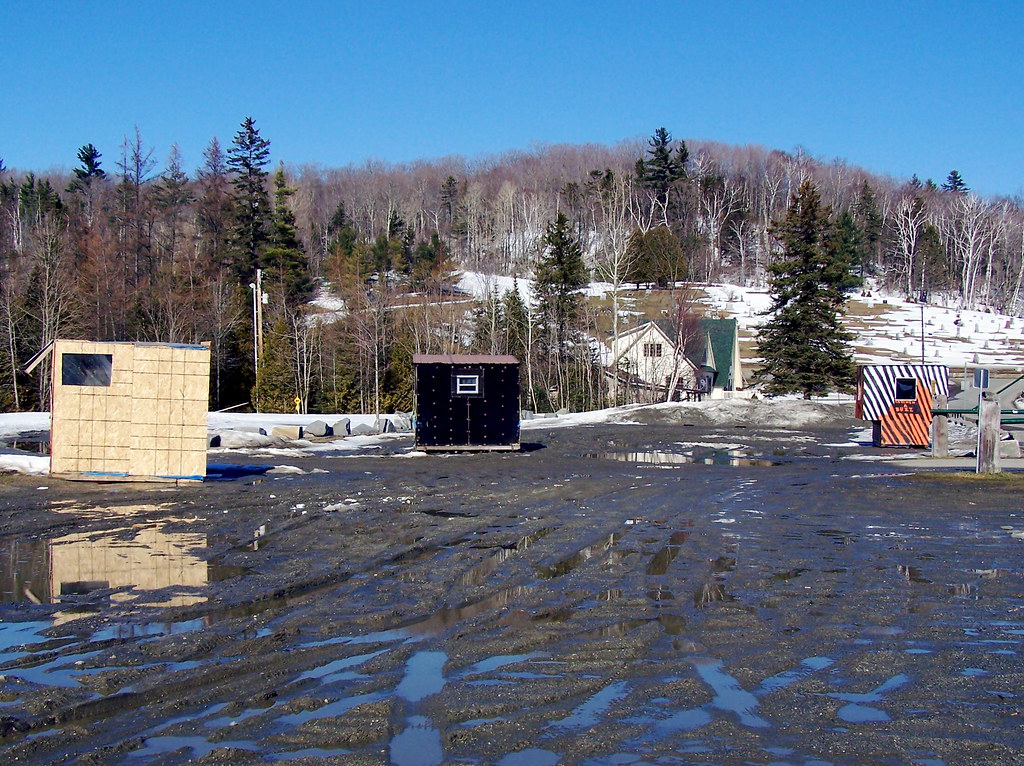
After taking the photo of the fishing shacks, I turned 90° to take
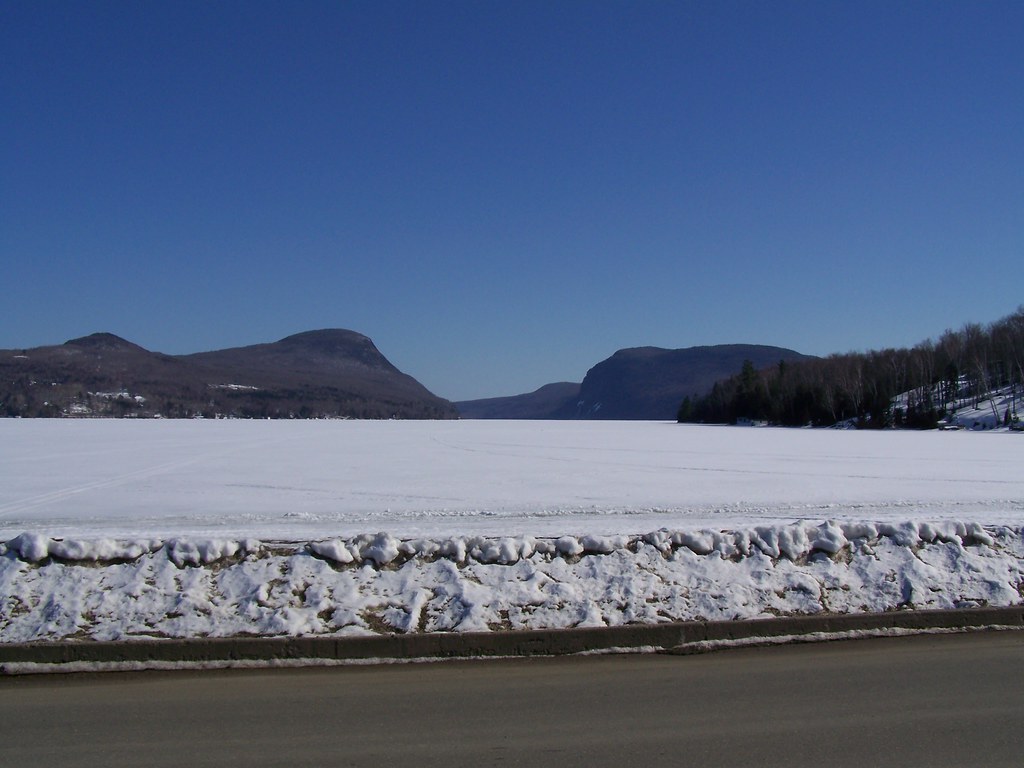
this photo of the lake from which they were removed!

This is Willoughby Lake with the Willoughby Gap. Mount Hor is on the right and Mount Pisgah is on the left. I have climbed both. :=)

_/\_/\_

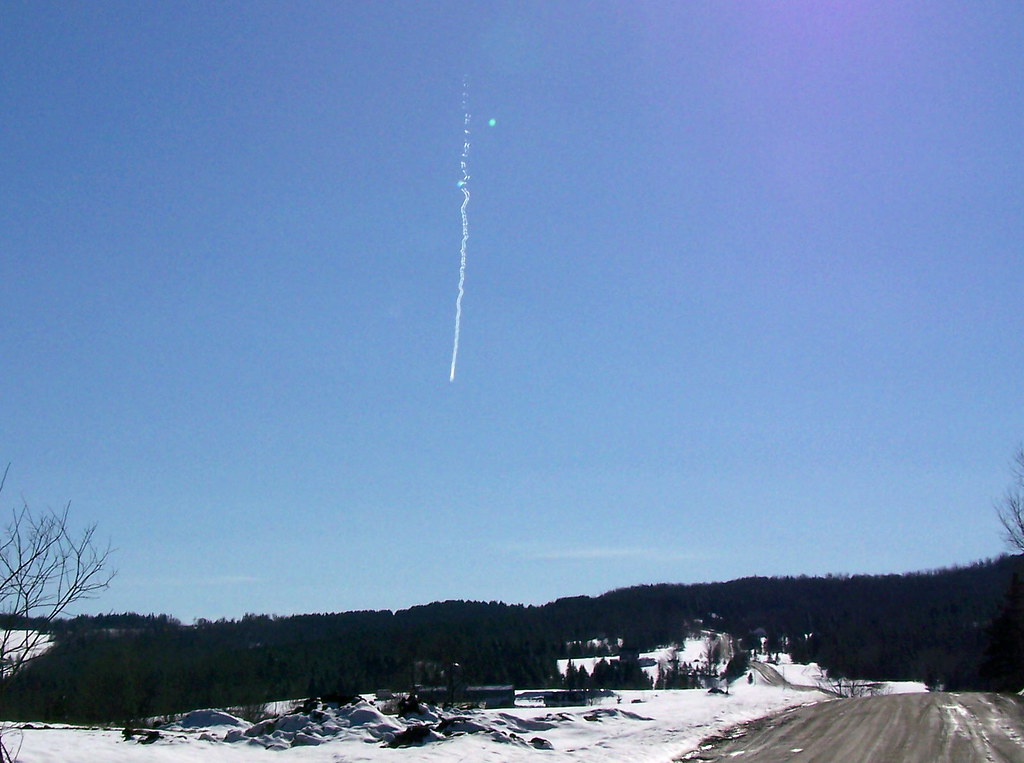
My First Contrail Photo

We never used to get any planes flying over us! But lately there are a lot. Sometimes five at once. They all come from Montreal.
_/\_/\_

Charlie

_/\_/\_

Black River, Irasburg, Vermont

Here is a small ice jam on the Black River in Irasburg. Shot yesterday, March 24, 2007 on Rt. 58 and Covered Bridge Rd.

Twitter and YouTube (or is it Comcast's Fault?)

I am computing on the porch again! It snowed last night but the sun is so warm out here that I am in heaven!

I simply have to go to an older sugarhouse for photos today. The best one is in Thetford, over an hour south of me. (Or is it? There may be one in Caledonia county, I've got to check). But I finished my ice jam movie and am uploading it. YouTube says "it may take a few minutes." HA How about 30 so far? That is way too long!

The ice jam movie: I finally stitched together a few Quicktime clips in Quicktime Pro because no transitions will work on the clips from my camera as I imported them as .mov files. I have tried file conversion, fiddling with settings, everything under the sun. And I will not get a camcorder! My camera is great even if it is cheap and simple. That's all I can handle now. So the video is not that good. And now I want to change the music (because I am listening to Hough playing piano, so I want that!).

Twitter is great, I love it except that the IM service is down and the servers are way too slow. If I could get the kids, with all their cell phones and computers, to use it, I'd be in heaven and know what's going on.

But all of this slowness could be Comcast. Ever since Adelphia left and Comcast came in, service has not been that great. Speeds vary greatly day to day and hour to hour.

It is so great to be listening to music again! Stephen Hough is playing piano now.

And I can't forget to do my housework and write up the Car Talk math problem and Lynn's number riddle and do litter boxes, and and and

_/\_/\_