Showing posts with label purple loosestrife. Show all posts

Wednesday, January 18, 2012

Scenes from a Summer’s Hike in Lyndonville

Sign at Lyndon Institute.jpg
The sign showing the beginning of the trail behind Lyndon Institute

Pond on the Hike.jpg
The pond at the beginning of the hike

Invasive Snail in the Pond.jpg
An invasive snail in the pond

Invasive Purple Loosestrife-1.jpg
Invasive Purple Loosestrife (Lythrum salicaria)

Scene at the Pond.jpg
A pond scene

White Water Lily-1.jpg
White water lily

Spotted Joe-Pye Weed (Eutrochium maculatum)-1.jpg
Spotted Joe-Pye Weed (Eutrochium maculatum)

White Cohosh (Actaea alba).jpg
White Cohosh (Actaea alba)

Examples of Squirrel and Chipmunk Middens.jpg
A squirrel or chipmunk midden

Indian Pipe (Monotropa uniflora)-1.jpg
Indian Pipe (Monotropa uniflora)

Examples of Squirrel and Chipmunk Middens-2.jpg
Another midden

Examples of Squirrel and Chipmunk Middens-6.jpg
Squirrels and/or chipmunks vertically potted dozens of pine cones along the trail and in the woods.

Examples of Squirrel and Chipmunk Middens-9.jpg
A third midden

Marsh Bellflower (Campanula aparinoides (Campanula uliginosa))-1.jpg
Marsh Bellflower (Campanula aparinoides) (Campanula uliginosa)

Burke Mountain View from Trail-2.jpg
A view of Burke Mountain

Trail Signs.jpg
Trail sign in fern forest

_/\_/\_

Tuesday, October 05, 2010

Clearing Out the Loosestrife

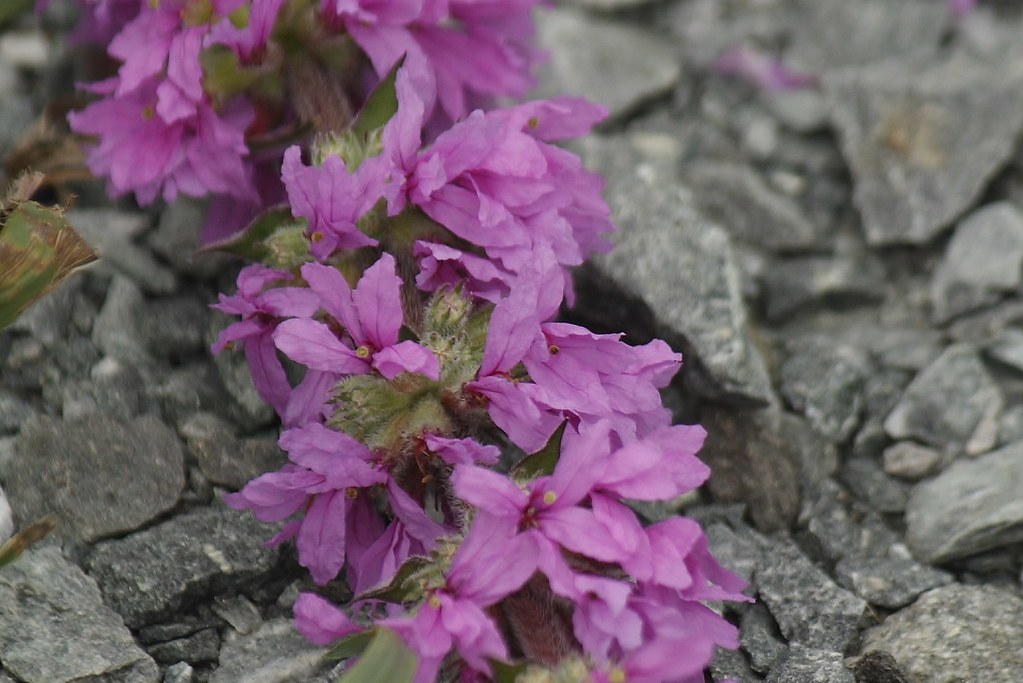
Purple loosestrife
Purple loosestrife is a very invasive plant. In fact, you are supposed to notify the State of Vermont when you get an infestation. I don't know why you are supposed to notify them, because I did, and nothing happened.

We have developed an infestation of loosestrife in the beaver bog. A large patch blossomed right across the road in July. So on July 13, after celebrating my sister's birthday, Amelia, Nate and I took large black garbage bags and knifes and cut down enough loosestrife to fill two fifty-gallon bags. You never take loosestrife to a landfill or dump because it can grow. But you can kill it by cutting it and denying it light. The seeds will rot. And if you do this every year, you can quickly get rid of it. The problem is that there is more loosestrife in the bog than I ever thought. You can't get to some areas without disturbing the habitat. And my neighbors are not interested in cleaning it up. Purple loosestrife is a beautiful flower and many people don't realize that something so beautiful can be so dangerous. It is not used for food or housing by any animal in Vermont and it chokes out native food and housing plants. I remember seeing a thousand acre bog in Michigan that was completely purple with loosestrife. It was a beautiful nightmare: gorgeous color with all life in the bog choked out.

A couple of weeks after we cut the loosestrife, we saw a young woman drive by, stop and pick more that had blossomed. We called down to her that it was invasive and she should not pick it. But she was giving a lecture that afternoon at Northwoods Stewardship Center in East Charleston on loosestrife control and needed a sample to show people. She also told us of an agency that would help us get the loosestrife in the unreachable parts of the bog. Apparently they will pay people to eradicate it. That's the government way: pay people instead of mobilizing them! Both John and I have since forgotten the name of the agency, but we will continue to cut as much down as we can every July.

Lythrum salicaria
_/\_/\_