![]() |
| My best shot after he left my house. |
| See the forest behind the bog? Is that too far for a beaver to walk?? |
| He's taking willow. |
![]() |
| My best shot after he left my house. |
| See the forest behind the bog? Is that too far for a beaver to walk?? |
| He's taking willow. |
What you would have seen when walking in from the road.
Last October the beaver from the bog had some sort of population explosion. The kids had to move out and make their own house. They chose to move across the road to our side. There is a huge culvert that drains water from a low lying grove of tamarack and apple trees. It is less than a quarter mile from the house. John noticed in October that the area was flooded. Deeply flooded. So he went to check it out. That's when he found the new beaver dam across the culvert. The new pond was about four feet deep and filling quickly. We would have a huge problem if there was a heavy rain or if the future finished dam broke. It could wash out our driveway, the culvert and the road..
John manually clears out the dam from the culvert.
He is standing on top of the new dam.
Note those 6 foot tall fence posts marking the culvert.
John spent a lot of time and effort in clearing the dam from the culvert. He did it one Sunday morning and for a few weeks after that, once a week, because the beaver kept repairing the damage. The beaver seemed to give up at that point and did not rebuild.
But after nearly six weeks of quiet, they rebuilt the dam. This time, they built it deep inside the culvert, under the road, where neither John nor his tractor could reach it. John then called the town road agent, Clem, who had installed our culvert. Clem sent the town road crew that very day. They used the town's huge backhoe and hauled out the new, heavily fortified dam. Then they installed a heavy road grate to prevent the beaver from ever entering the culvert again.
The new heavy grate blocking the culvert. Note those same fence posts from above.
Below are some photographs of the damage in the same area. We returned on a hike in December to see what was going on. The damage was quite extensive. The area was trashed (in a nice, beaver sort of way):
This is what that new beaver pond looks like now. It is drained.
The remains of a lodge that was being built behind the dam.
Many trees were only partially cut or were being considered for cutting. This tree will die.
The beaver may have been discouraged. They may even have despaired. But they were never threatened. After the town blocked the culvert, they continued to cut down trees on both sides of the road and built a new lodge where it should have been built: in the beaver bog. This is the fourth lodge across the road now. It has new canals and trails, and new log slides going into the water. I'm glad the trees, such as they were, are gone, because now the view of the bog is clearer.
The new lodge. Where it should be.
The funniest tale of these beaver has not yet been told. In January, I went for my monthly hair appointment and heard the strangest story from my hairdresser, who frequently drives by on her way into town. She was driving by one day about noon and saw by the side of the road a big beaver. He was waiting for her to drive by, looking both ways before he crossed. And what did he have in his mouth? A reflective road side marker that marks the culvert so that the town road crew does not damage it with the plows. The beaver had cut it down and was taking it home to decorate his lodge!
_/\_/\_
The beaver dam a half mile from home.
This beaver dam used to be a mill. The old millhouse is still there, as is the human dam. The beaver no maintain the dam. I walked over there in April to get photographs of spring and to see how the beaver and the bog were doing. An lodge that was in the side of the pond was destroyed, perhaps by fisher cats. There were new trees chewed and down. But otherwise, all was calm and quiet as before. I'm thinking I should drop by the town clerk office and see exactly what this area is called. I call it Dam 5 because it is the fifth dam on May Pond Brook that Amelia and I counted when we hiked the brook years ago. Dam 4 is across the road from the house and Dams 1 through 3 are upstream of Stone Flume.
Our home, 1/2 mile away, as seen from the dam.
Shortly after I took the photo of the goldenrod gall (above), I found some fresh bear scat. I finished up the photos and left soon thereafter, making sure I stayed in wide open spaces with lots of room to run to the road.
_/\_/\_
Above: The parking area for the hike past Wheeler Pond.
On July 27 we took a hike around Wheeler Pond and the to the Gnome Stairs in Barton. In all these years I had not taken this hike and Wheeler Pond is one of the most photographed areas around here. Besides my hummingbird goal this summer, I had a goal of doing more of the hikes in the area that we have never done. Because of the renovations on the house, we didn't get much hiking done.
The first problem we had on the hike was me! I left the Canon camera at home! To teach myself a lesson, I would not request that we (John, me, Amy, Nate and Wingnut) drive home for it. Instead, I used the Olympus Tough 8000 camera that I also carry with me. The quality of the photos suffered because I had forgotten all I learned about using this camera last year.
Above: The log bridge at the beginning of the hike. The trail immediately branches off to the Moose Mountain Trail (left) and the Wheeler Pond Trail (right), which goes around the pond.
Above: The first thing that John's eyes spied were these feathers from a hapless partridge that had been eaten here. He also showed me how the moose in the area used the hiking trail for their own comfort — their tracks were everywhere on the trail, which made me a bit tense.
Above: John said this was some type of wild plum. It also grows across the road in the bog at home. We have not identified it yet.
Above: the beaver dam at the opposite end of Wheeler Pond. There is also a huge lodge here that can't be seen from this angle.
Above: Indian pipe (Monotropa uniflora)
Above and below: an unidentified mushroom.
Above and below: After hiking half way around Wheeler Pond, you then follow the Wheeler Brook outlet to the Gnome Stairs. You can barely see water in the brook because there are so many boulders.
Above: more Indian Pipe and another unidentified (Amanita?) mushroom.
Above: Finally, the beauty of the Gnome Stairs. The area is called this because the water of Wheeler Brook cascades down small stair-like ledges, as if built by and for gnomes.
And look who was back with us! Wingnut! He has grown so much that he is now taller than me. Here he is, above, relaxing at the bottom of the Gnome Stairs.
Above and below: and one more unidentified mushroom! After taking months last autumn identifying forty species of mushrooms, we don't feel like identifying these three from this hike!
The Green Mountain Club (GMC) maintains a couple of camps on the side of Wheeler Pond. This is the woodshed above. Below is the privy.
Above: Canada thistle (Cirsium arvense)
Below: somebody left two sunfish hanging in a willow! Why?
It was a great hike! There is nothing I love better than hiking with my husband!
Almost nothing.
_/\_/\_
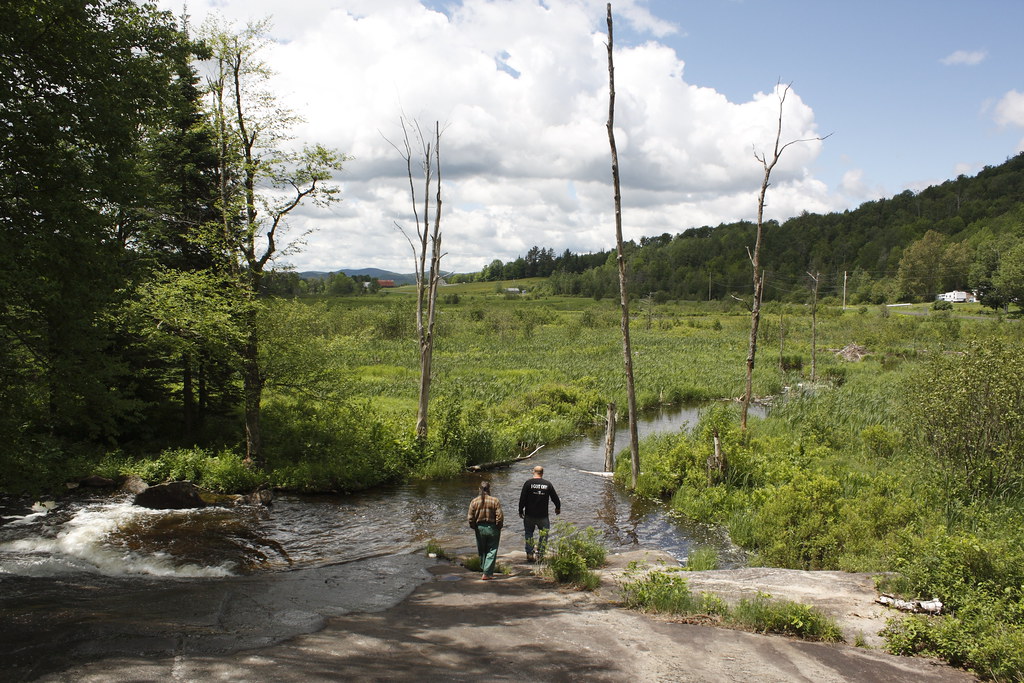
| Arthur (l) and John (r) at the bottom of the flume. Our house is the white speck on the right. |
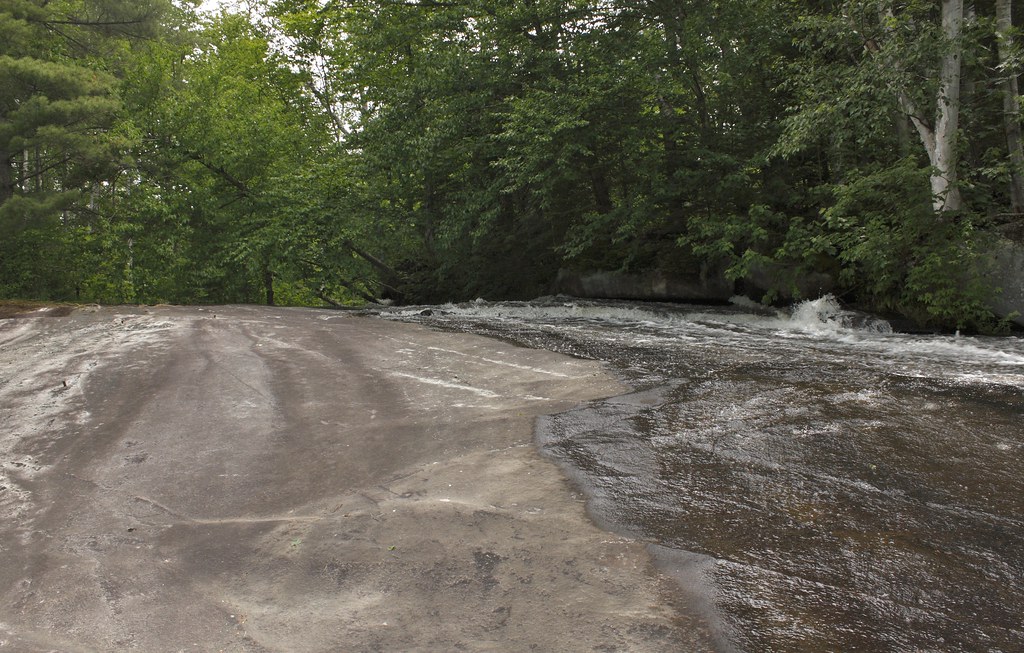
| Looking up the flume. John and Arthur were standing at the bottom of the flume in the photo above. |
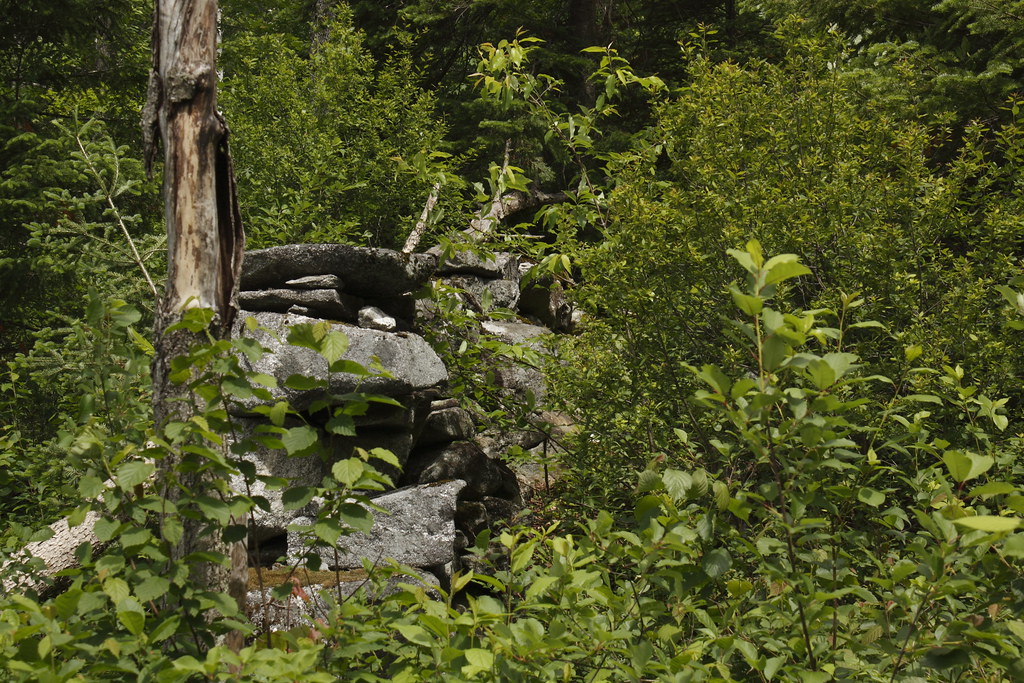
| Old stone foundation of an old mill at the flume. |
| May Brook just before it slides down the flume. |
| A dam that kids made for a swimming hole has been taken by beaver who built their own, bigger dam. |
| The swimming hole above the new beaver dam. |
| An ancient stone wall follows May Brook. |
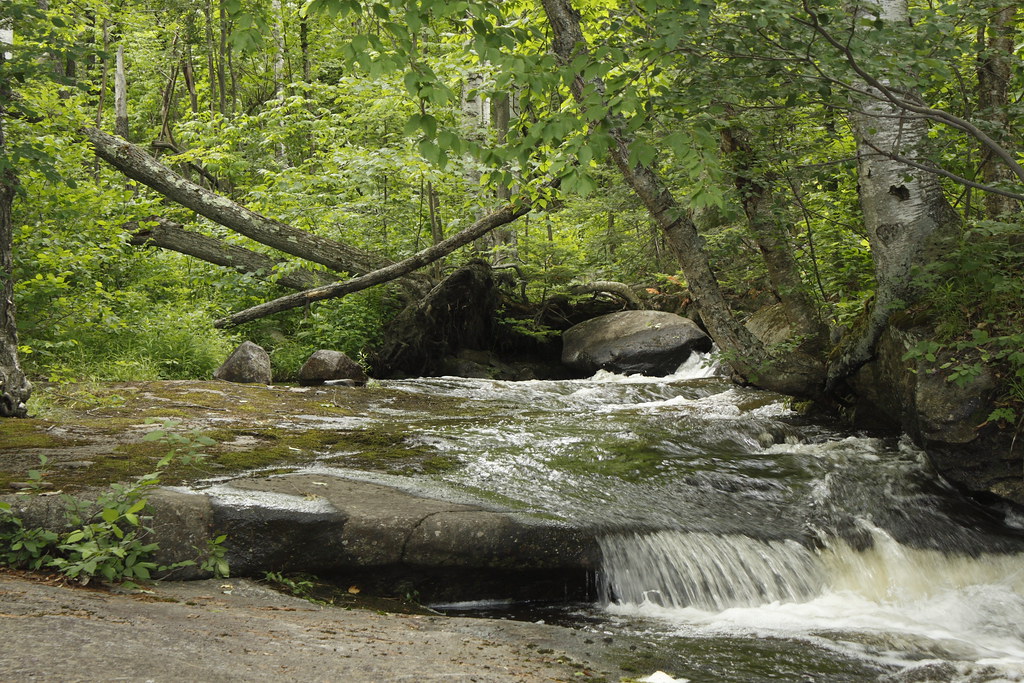
| I played with shutter speeds to get the water effect I wanted. |
| John points out something to Arthur. |
| Another waterfall. |
| A little yellow spider eats a bug. |