Showing posts with label birds. Show all posts

Tuesday, January 31, 2012

My Frustration with Birds

American Redstart (Setophaga ruticilla)-1.jpg
American Redstart (Setophaga ruticilla)

I spend a lot of time in the spring, summer and autumn stalking birds in the fields and woods. Some species, like sparrows, some finches and a few warblers are rather easy to see and capture on film. They stalk me while I stalk them (mostly because the cats are always with me and are a very good reason for the birds to stalk us). But there are other birds that defy capture. Two that obsessed me this past summer were the American Redstart (above) and the Black and White Warbler (below). They are both shy. The Redstart never seems to come out of the forest edge, so the lighting is awful. It also always kept its back to me. The Black and White Warbler was a bit shy, but the biggest problem was its speed. One second it is there, and the next it is gone. I can't predict where they will hop to from moment to moment, like I can with sparrows and other birds. I've been within five feet of a flock of Black and Whites and have never been able to raise, aim and fire quick enough. I'm pretty sure cats are OK for the Redstarts, but if I want to get a decent Black and White photo, I will have to lock the cats up. So until next season, these two photos are the only proof I have that these two warbler species live here.

Black and White Warbler (Mniotilta varia)-2.jpg
Black and White Warbler (Mniotilta varia)

_/\_/\_

Sunday, April 03, 2011

VIDEO: Chickadee Songs


Chickadee Songs
April 2, 2011

The light was lousy on Saturday when I made this video. I also had not used my Flip for over a year, so focus is lousy, too. But you can hear the beautiful chickadee song, and that was the objective of this movie. I held the Flip outside an upstairs bedroom window that is over the bird tree. I love the music of chickadees and will probably listen to this video often in the future.

_/\_/\_

Friday, April 01, 2011

April 1: A Reminder about Feeders


Black bear near our well in 2009.

It is April 1. Today is the day we are supposed to take our bird feeders down so the bears don't come and eat the feeders. They are, or will be, waking up. We know where the bears on the mountain hibernate in the winter. We know they come down to the house to see how careless we were about leaving food about (or kitties about). Click here and here for the story. We see their tracks and scat all summer long in our apple orchard, the woods and under the choke cherry trees. So bring in your feeders today.


Raccoons are a huge problem in spring, too.

But bears aren't the only problem. The raccoons destroy more of my feeders than bears do. And we have had recorded outbreaks of raccoon rabies in Orleans County in the past five years. Minks and fisher cats will be by, also (as happened to me last week when a big mink ran right by me under the feeders when I was photographing birds). So get your feeders in today!

I will be taking the feeders in as soon as they are empty. Probably tomorrow or Sunday. I put out the last of the sunflower and thistle today because of this snowstorm we are having. The redpolls were crazy happy that I filled the little thistle socks  and the chickadees were irritated at my slowness, as always. The woodpeckers are back because the others are back and the robins, doves. blue jays and red-winged blackbirds stop by to take a look now and then. It's been another great photography season with the birds and squirrels. The photos are not all posted yet, though, so you will see more!

_/\_/\_

Tuesday, November 30, 2010

Chickadees at Feeders

Black-capped-chickadee-5.jpg
Poecile atricapillus

Black-capped chickadees are very common here, winter and summer. Yet I never tire of hearing their song or watching them at the feeders. When I go out to refill the feeders they scold me and fly very close. John tells me they will land on me if they are familiar with me, so I am trying to "train" them to land on my arm.

Black-capped-chickadee-6.jpg
Posing nicely for me.

Chickadees love sunflower seeds. They will eat a bit of suet and a bit of seed, but sunflowers rule. They grab a seed and take it to a higher branch on the tree. While holding the seed in their toes, they crack the shell with their beak, eat the heart of the seed, and then return for another seed at the feeder.

Each chickadee has a favorite spot in the tree for cracking sunflower seeds. Some face one way all of the time and others face the other way. Sometimes they have little spats about who gets a favored perch on the feeder. They don't mind eating on the ground, whether it be snow-covered  or bare of snow.

I read that chickadees will die if they don't eat within twenty-four hours. They burn up a lot of energy and are small and can't eat that much for the future. Keep your feeders full so that they don't run out of food. Even in bad weather, the chickadees will come for a fill-up.

Black-capped-chickadee-9.jpg
Another lovely pose.

These particular photographs mark a turning point for me. These were shot in shutter priority. In order to be more versatile (and having bad luck with program mode in the bird tree), I thought it was past time that I learned my camera better.

Also, I am finally learning Photoshop and actually using it. These are the first photos that I edited from raw files, converted to jpeg after editing (the only edit was cropping), tagged, put the GPS data on them and uploaded to Flickr. Learning a new workflow is very uncomfortable for me, but already I have stopped yearning for my old software and am comfortable with Photoshop workflow. I now have the original raw files plus the Photoshop files for future use. I won't ever have to use old, deteriorating jpeg images in the future. I am very pleased with the results! I am also watermarking my photographs on Flickr because of rampant stealing. I forgot to mark these.


_/\_/\_

Friday, October 01, 2010

Problems with Bugs and Birds

Bristly Cutworm Moth (Lacinipolia renigera)

John and I have spent hours tonight trying to identify 1 bird, 1 moth and 1 bug. I began the evening after supper by opening photos from July 10. I am so behind in my editing! I remember July 10. I spent happy hours at the beach at Crystal Lake with the kids. They played while I read and photographed a duck family, a seagull and a jet skier. That night I went outside in the dark and photographed the moths and bugs on the house. And now, tonight, I had to identify these creatures.

The still unidentified seagull.

John was finishing installing the new doors in the sun porch as I was going through bird books and the Internet trying to identify the seagul above. I have never been able to identify a seagul from a book and so I was frustrated before I began my search. My mutterings lured John to the computer. He said how they will interbreed, which makes identification more difficult. And sure enough, the books have said how some individual seagulls are unidentifiable because of interbreeding. Yikes! And juvenile gulls (which I think this is because on a close zoom I see young pin feathers — but that could be meaningless) look different than adults. And first, second and third winter gulls all look different than adults and from each other! John sat at his computer and searched for over an hour. We both agreed that the bills and legs of gulls can help distinguish the species. But that didn't even help. After two hours, we gave up. If you know of a gull ID site, let me know! Please!

Firefly (Family Lampyridae, Genus Photuris)

The bug pictured above was next. I thought it was a beetle and instantly became agitated when no beetles at bugguide.net looked like mine. John looked at the photo and said, "Firefly!" And it was. But which species? According to bugguide, it could have been species Photuris or Photinus. The lighting on my photo is poor and many photos of Photinus look like mine, so identification was more complicated. But John and I counted stripes on the bug's back and I chose to identify my bug as Photuris. Photuris females are violent: "Females are noted to mimic the flash patterns of females of other genera of Lampyridae, especially Photinus. Males are lured in and consumed. They do this for nutrition, perhaps, and also to obtain chemical defenses from other Lampyridae (5) (6), (Eisner et al., 1997)." This identification only took half an hour! I was feeling lucky now — and I should have known better . . .

We came to the photograph of the moth that you see at the top of this post. By now, John was fully into this task with me. We knew the moth was a moth. So I searched for "brown moth with green spots" and for "black moth with green spots." I searched for "green moths." I figured from the silhouette that this was an owlet moth (and I was right!). But there are nearly 21 bizillion species of owlet moths and after a solid hour of viewing photos of owlet moths, I finally sent this photo to bugguide. I got a response within 10 minutes! This is a bristly cutworm moth! Total time spent on this moth: 2 hours.

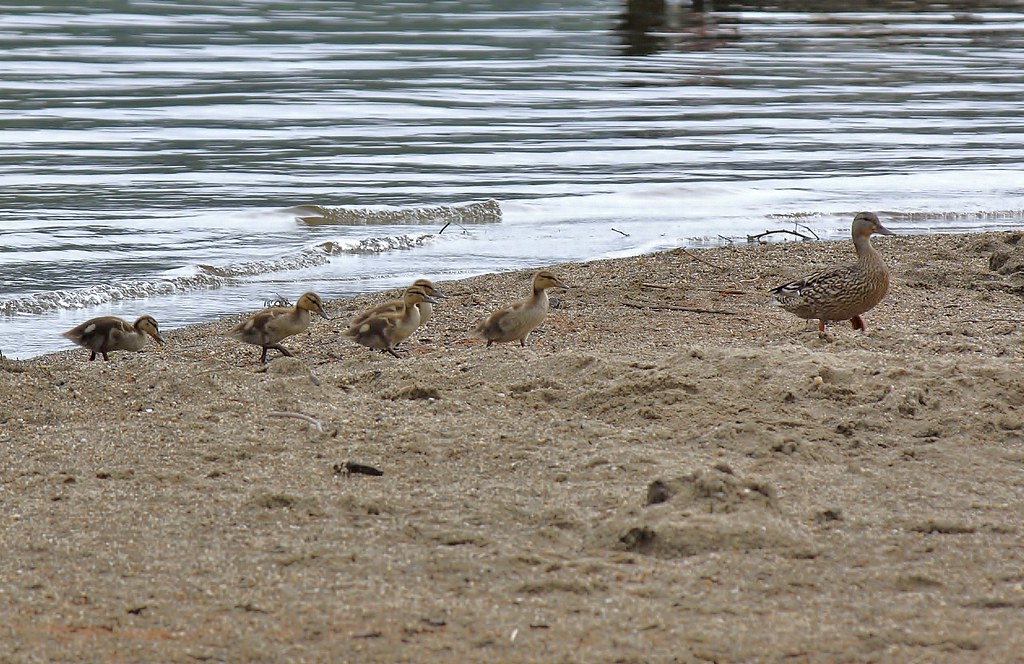
We knew two other bugs and birds instantly: a caddisfly, a family of Mallards (duh) and a curved-toothed geometer moth (one of my favorite moths). The photos are below. I also found another online site to submit photos to: the North American Moth Photographers Group. They are doing some bizarre research (which I won't discuss here), and John and I spent quite a bit of time reading and looking at the photography. I may participate with that group in the future — if I have any time left over after identifying my bugs and birds!

Mallard ducks (Anas platyrhynchos)

Curved-toothed geometer moth (Eutrapela clemataria)

Caddisfly (Trichoptera)


_/\_/\_

Sunday, February 01, 2009

Winter Weekends

We do other things in the winter besides cook and eat. The bird feeders require replenishing. Matt took these photos. Above you see the bird tree. I have added another thistle feeder sack because the redpolls are flocking by the dozens to them. Below you can see me, in my warm winter robe, leopard jammies that were a gift from my sister, and my boots, smearing all-natural, organic peanut butter on the bird tree. Today I put blobs of peanut butter on the tree instead of one huge smear. The chickadees and blue jays kept slipping off of the large area of peanut butter. Now they can safely peck away at it.
Amy spends her evenings knitting with Mouse Cat and Sophie Dog (below).

_/\_/\_

Monday, May 12, 2008

Heads or Tails: Any Tom, Dick or Harry Kingbird

I photographed this Eastern Kingbird while it was hunting insects in the beaver bog. Not a great photo, but proof that he was there! You can see more (and similar) photos of him here.

These photos will open full-sized in a new window when clicked.
To see more participants click or Heads or Tails
Thank you so much for visiting.

_/\_/\_

Monday, April 28, 2008

Heads or Tails: Memories of Bird Walks

This is a turkey vulture in flight over my head last week. Bird walks with Mr. T — in the past and hopefully long into the future — are some of my fondest memories. While he was not present when I captured this vulture (see close-up photos here of this stunning bird that only a mother could love), he is the inspiration for my bird photos and he has given me the gift of his love of birds and birding. Lately, we saw the first eastern bluebird reported in Barton Town this season. Special moments with a special person are memories to cherish.

Why is a turkey vulture called a turkey vulture? Not because they eat turkeys (they would if they came upon a dead one in the woods) and not because they are turkeys (because they are not), but because they have a body that looks like a turkey and they have the head of a vulture.

These photos will open full-sized in a new window when clicked.
To see more participants click or Heads or Tails
Thank you so much for visiting.

_/\_/\_

Sunday, January 06, 2008

Julie Zickefoose: Suet's the Big Deal?

Julie Zickefoose: Suet's the Big Deal?:
I multiply the recipe (1 cup peanut butter, 1 cup lard, 2 cups quick oats, 2 cups yellow cornmeal, 1 cup flour) times six every time I make it. So it takes a 40-oz. jar of peanut butter, plus an additional cup, about a third of a large bucket of lard, 12 cups of oats.

It takes a lot of strength to mix it as it's setting up, and we've broken a couple of wooden spoons trying. I've got my drill down and can get the big batch done in under an hour now. Sometimes I wish I didn't have to make so much, but then I look out the window and realize that it's not much effort for the beauty it brings to our doorstep.
A commenter mentions using the microwave to soften the mixture before stirring. Click the link above to see the birds enjoying this recipe.

To recap:

1 c peanut butter
1 c lard
2 c quick oats
2 c yellow cornmeal
1 c flour

Technorati Tags:

_/\_/\_

Monday, December 03, 2007

Heads or Tails: Three

Three Common Redpolls (Carduelis flammea) in today's snowstorm.

Painted Trillium (Trillium undulatum)
found this past summer at Moose Bog in Victory, Vermont


To see more Heads or Tails participants, visit Skittles
or click .
Thank you so much for visiting.


_/\_/\_

Snow Day

I woke to the alarm this morning. I had stayed up late last night because the incoming storm guaranteed a snow day. My alarm rings at 5 AM. The same moment that the principal called. I can't hear the phone upstairs (and there are no upstairs phones because Charlie has eaten over $100 of phone cords). Principal called back five minutes later. I made my three calls on the snow tree. And then the day was mine.

The graphic above (from NOAA forecast page for Barton) shows a typical winter week here. We don't always have these huge storms, but there are always snow flakes in our weather graphics. It's going to be a warmer week this week. This past weekend, the temperatures dropped below 0°F (about -18°C).

This huge red graphic is the second thing I check every winter morning. It is the NEK Roads map. NEK means Northeast Kingdom, my section of Vermont. Red is bad. I put a green dot where I live. The map is interactive. If you click on a symbol, it gives you details.

Today I found that the NEK Roads site has included a map of all of northern New England. I can't decide whether New Hampshire (the white part) does not report or whether they never have any road problems. I've driven in New Hampshire. They have road problems. Maine is being hit bad by this snowstorm, so we know why their roads are bad.

Finally, below, is NOAA's map of the predicted snow depth for Vermont by 7 AM ET Tuesday, Dec. 4. I don't believe it. It already is about one foot deep and another whollop of the storm is coming in the morning. I put a green dot on Barton (13.1" predicted, or 33.27 cm). For context: the grey on top of the pink Vermont is Québec, Canada. The grey to the right of pink Vermont is New Hampshire. The blue is partially in Vermont and partially in upstate New York. The blue below the pink is Vermont.

So what did I do today? Ate, napped, read a lot, blogged, watched soaps. I chatted with people and broke up cat fights. The most exciting thing is that I had at least five species of birds in the tree today, including a new bird to me. There were chickadees, downy woodpeckers, blue jays, white-breasted nuthatches, and the new bird — common redpolls. Watch this blog and Barton Daily Photo for the bird photos. Processing the photos on the computer took hours. Oh, and I found a lost book.

I'm thinking we'll have at least a delay tomorrow, but it's difficult to tell what the roads are like down below.
_/\_/\_

Saturday, December 01, 2007

Photo Hunters: Red

Downy woodpecker with the distinctive red stripe on its head.

Other birds today:

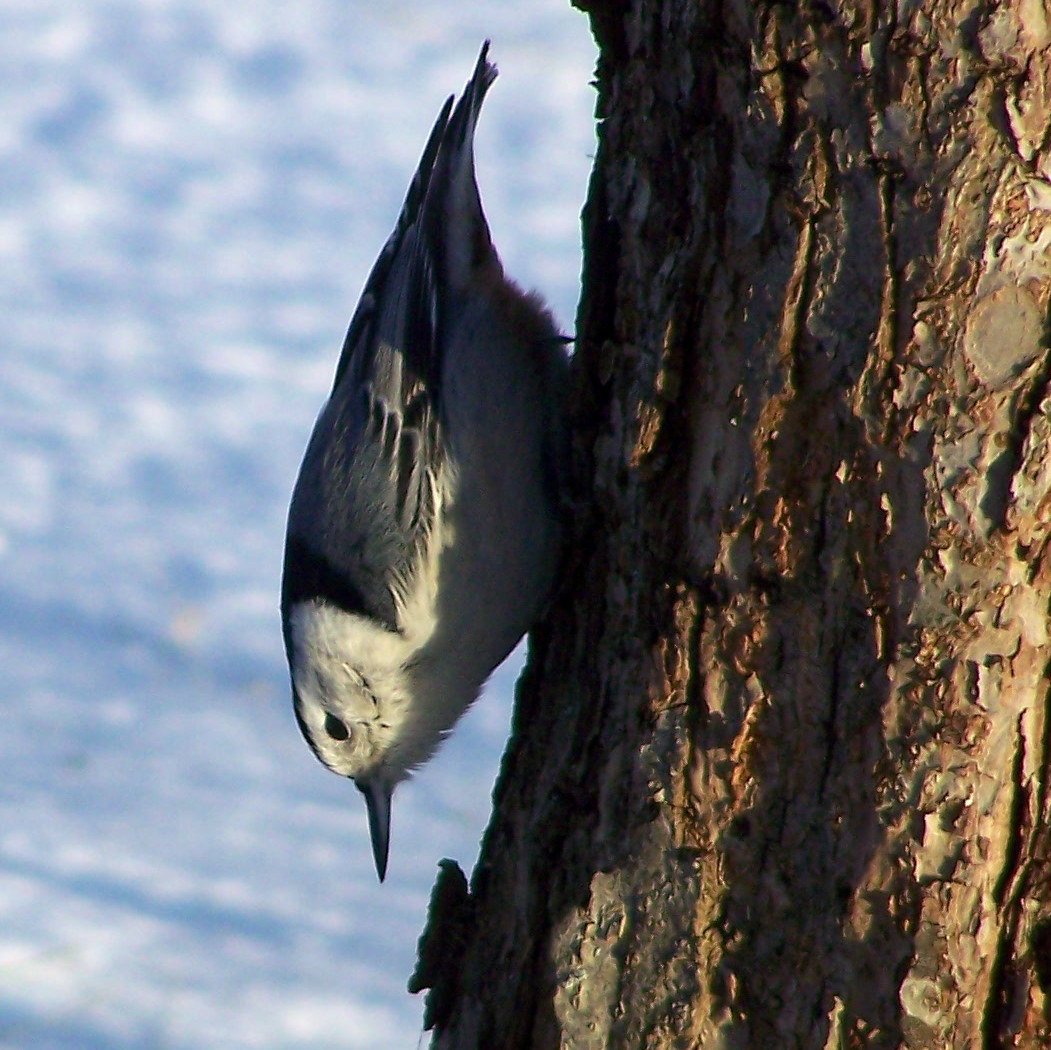
White-breasted Nuthatch. They climb down trees head first.

Black-capped Chickadees


Thank you for visiting.

Sunday, November 25, 2007

New Bird At The Feeder

I have this new bird at the feeder that likes the thistles. Does anyone know what it is? For more views of this bird, please see my Barton Daily Photo blog. Thank you for the help.

Technorati tags:

_/\_/\_

Friday, November 23, 2007

Downy Woodpecker

Picoides pubescens


Readers of my blog will need to be patient while I post bird photos now.
I can't tell you how excited I am.

Technorati tags:
_/\_/\_