Showing posts with label ants. Show all posts

Saturday, September 03, 2011

Why the Break and Spotting meeyauw on the Web

Ants Moving Eggs-13.jpg

School has opened again. That is why I haven’t posted anything recently. It’s been a crazy two weeks and I have a feeling it will be crazier very soon. I’ve been out with my camera and the cats (and gotten some pretty awesome bird shots). But I haven’t done a thing with the photographs yet. So it’s time to get back in stride and get caught up!

Back in July, John cut down a double cottonwood tree. When it fell, it was crazy with ants carrying pupae off the tree and down in a hole in the ground. They were distinctive and fascinating ants and I photographed quite a few of them and their babies-to-be. But who can identify ants? Not me. The folks at AntBlog did, though. Specifically, James Trager was asked to respond. He is a fascinating ant scientist and I am favored that he answered my question. You can find the entire post here at AntBlog.

The Irasburg Castle - 3The Irasburg Castle in 2005.

In August, Geek Mountain State picked up an old, old Irasburg Castle post that I did in September of 2005. It was nice to be blogged about, and even nicer that the post was so old. Thank you, Andrew! Andrew is a contributor to Geek Mountain State. I love him because he shares my son’s name (yes, that’s all it takes). You can find the Geek Mountain post here.

By the way, Archer Mayor, one of my favorite authors, is also a contributor. Archer’s site is at http://archermayor.com/. I can’t visit the site because my McAfee site advisor says it exhibits risky behavior. Knowing Archer, I know the site is safe, so I don’t know what the problem could be. You can go and buy his books here, though: Archer Mayor's book on amazon.comPlease. I get a small percentage of the sales. Amazon has a $10 minimum before they pay their associates and in seven years, I still haven’t made that minimum. But I’m close!

_/\_/\_

Sunday, July 19, 2009

Summer World III: Ant Lions

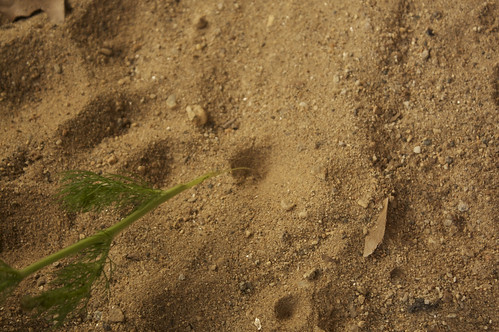
Here in this part of New Hampshire you live in sand — beautiful, soft beach sand. John showed me, quite a few weeks ago, creatures that like to live in the sand — ant lions. You can see the indentations of each ant lion home in these photos. Above, John is tickling an ant lion sand pit in order to get the ant lion to reveal itself. Some of the pits have no inhabitants, so tickling the pit is the only way to find out if it is being lived in. The ant lion thinks that the grass leaf is an ant and jumps out of the bottom of the pit to eat the ant.

Above, John has captured an ant lion. This one was really tiny and difficult to focus on with the Canon XSi. When ants walk into an ant lion's sand pit, they can't often escape. As they crawl out of the pit, the sand keeps them sliding back down until the ant lion gobbles them up.

Ant Lions (or Antlions or Doodlebugs or Doodle Bugs)
(Genus Neuroptera, Family Myrmeleontidae)
Above you can see the tiny ant lion.
It has enormous pinchers in front.

Below: I showed the sand pits to Wingnut, who promptly began feeding ants to the ant lion. It was totally fascinating to see the capture process. We noticed that about half of the ants were able to escape the pit. But half couldn't escape and were eaten. A 50% kill rate is pretty good in Nature. It is very difficult to see the escaping ant in the photo below.

After these activities (when these photos were taken), I happened to read Summer World because Bernd Heinrich's books have taught me so much about where I live. Summer World has a great section on ant lions (pages 193-194). If you live in New England (especially northern New England) you must read this book. You should read it if you live anywhere else:
". . . ant lions . . . are slow-moving predators that catch fast ants. They do this by making pits in lose, dry sand. The pits serve as traps; the ant lions hide buried in sand at the bottom of the traps with only their sharp tonglike pincers exposed; and with these pincers they grab any ant that wanders in. If an ant then starts to scramble up the steep, slippery slope of dry sand, they throw up loose sand that starts a sandslide and brings it back down and into reach.


Technorati Tags:
_/\_/\_

Thursday, June 26, 2008

Wingnut's Photos of the Day

Scout

Sophie


George

Ants on rhubarb blooms

All photos open in a new window when clicked.
_/\_/\_