Showing posts with label Caledonian Record. Show all posts

Thursday, December 27, 2007

Nin, Mount Washington Observatory cat, Retires

Amy and Wingnut bought me photos of Nin a few years ago when they took the clog rail up to the summit. I have his photo on my refrigerator. I also have a large print of one of his predecessors in my laundry room. So this article was of great interest to me:

Associated Press
MOUNT WASHINGTON, N.H. (AP) _ New Hampshire's top cat is retiring.

Nin, the black-and-white house cat who for a dozen years patrolled the Northeast's highest peak as the Mount Washington Observatory's mascot, was officially retiring Wednesday and moved off the mountain to a valley home.

Scot Henley, the nonprofit weather observatory's executive director, said Nin's failing health was the reason for the retirement. Nin suffers from a number of age related ailments, and a recent infection claimed the last of his teeth.

"He's 17 or 18 years old, so he's getting up there. We wanted to do the most humane thing for him," Henley said.

Nin, a former stray, has been popular among visitors to the summit. His photo and a short profile are included on the staff section of the observatory's Web site.

"I am the latest in a long and famous line of Observatory felines (hey - when do I get my own poster?)," the profile reads. "I like it on the summit - I get pampered and coddled, and have to do very little in return, curl up on the occasional lap and so on. I have been up here for several years now, and find it very unnerving to head down the mountain (especially since they only take me to the vet's!)."

Wednesday, Nin made a final trip down the mountain during the weekly shift change of weather observers and volunteers. Nin is moving in with friends Diane Holmes and Mike Pelchat, both rangers at Mount Washington State Park, at their home in Gorham where he will be close to his veterinarian, Henley said.

Cats have been a part of summit life for a long time. A number of cats lived at the peak when observers clocked the 231 mph wind, the fastest aboveground wind speed ever recorded, in April 1934.

The observatory isn't expected to be feline-free for long. The Conway Area Humane Society is evaluating successors for the job, said Henley. He said they are looking for a new cat who is friendly, not spooked by bad weather and has the wits to know when to come in out of a storm.

"We'll probably have a new cat sometime in late January," Henley said.
On the Net:
Technorati Tags:  

_/\_/\_

Friday, September 14, 2007

Our School Psychologist

David J. Lawson, 59, of Coaticook, Quebec, and Danville, Vt., died unexpectedly Tuesday, Sept. 4, 2007, at North Country Hospital in Newport.

Lacking family connections, he developed a brother-sister relationship with both Robin Rothman of Danville and Celine Dudemaine of Ayers Cliff, P.Q. David was a psychotherapist with Northeast Kingdom Human Services in both St. Johnsbury and Newport. Recently he had been working with troubled children in northern schools like . . . .

David wrote poetry and read omnivorously. He fended for himself starting early in his life and was somewhat of a rolling stone, deciding on a career in psychology. He put himself through all his education up through obtaining his master's in psychology and social work.

David came from a military family. As a boy he lived in North Carolina, Texas and Massachusetts, and later again in Massachusetts, Colorado, and the Albany N.Y. area. He worked a variety of jobs beginning in his teens: He ran errands, operated the telegraph, cleaned houses, managed a bar and even an art gallery. While working on his master's, he oversaw a psychiatric nursing home.

David began working with Northeast Kingdom Human Services in the mid-1980s. He tended bar a few nights a week at the Rabbit Hill Inn. His main enthusiasms were reading, studying French, which he taught himself, and talking to people wherever he went. David was particularly interested in religion and spirituality and read extensively on those subjects. He adopted Judaism as the religion most compatible with his beliefs and origins.

He practiced his French in Quebec. He became enchanted with the culture and moved to Coaticook about five years ago and was working on obtaining permanent Canadian residency.

Graveside services will be held Monday, Sept. 10, at 11 a.m. at the Danville Green Cemetery on Brainerd Street. Rabbi Tobie Wiseman of Montpelier will officiate. Anyone wishing to attend is welcome.

Contributions marked in David Lawson's memory may be directed to Northeast Kingdom Human Services, P.O. Box 368, St. Johnsbury VT 05819.

Sayles Funeral Home is assisting with arrangements.

The Caledonian-Record is a daily newspaper serving Northern Vermont and Northern New Hampshire. Visit our website updated daily at www.caledonianrecord.com


Note from the WebMaster: We request that you maintain proper credit to the Caledonian-Record Online News and to the author of the article. If you post this news article on your website we also request that you include a link to our website, which can be accomplished by using the following code:

The Caledonian-Record News 1997 - 2007 · St. Johnsbury, Vermont
http://www.caledonianrecord.com

_/\_/\_

Monday, March 26, 2007

Cats Tuesday: It's No Cat


A seldom seen close look at a fisher. (Photo: Mt. Washington Burke Museum)

I have seen these in the woods. We even had one try to break into the house one summer night! They are the stuff of folklore and woods legends. Don't believe everything in this article: fisher cats DO eat housecats! The fishers we see are black and very big. Like the size of a small dog.

In New England, fishers are called fisher cats. They often look like huge cats from afar (and they eat cats).

From the Caledonian Record, St. Johnsbury, VT column Hidden Worlds

Saturday March 23, 2002

A formidable predator lives amongst us, one we almost never see. I've gotten only a few close looks at fishers during my years in the Northeast Kingdom, but once seen, these powerful creatures leave a lasting impression of alert intelligence, strength, and a don't-mess-with-me attitude.

My successes have been mostly along back roads when a fisher crossed from one densely wooded tract to another. They don't tarry, although one stood its ground and glared as my car inched forward, hissed and growled before turning to gallop hump-backed into the pine woods, its gait clearly showing relationship to the smaller, more sinuous weasel. I was glad to be inside the car.


A fisher is one of the largest mustelids, a family that includes not only weasels, but martens, ferrets, otters, and the immense wolverine. Interactions with humans are rare and not of the animals' choice. Despite weasels having been kept in 1st Century European farmhouses to provide needed pest control, mustelids - especially mink, ermine, and sable - have been hunted for their lustrous pelts for at least two thousand years.

Jason's Golden Fleece may have been glowing sable fur, a valuable commodity in ancient Greece. The crowns of 17th Century Russian kings, including Czar Boris Gudunov, consisted of sable hats ornamented with jewels and gold. Over 40,000 sable pelts were once sent to Vienna in a diplomatic exchange of goods, and hundreds of thousands of pelts were traded annually in the 18th Century.

The glistening white winter coat of ermine, an animal originally from England, was used for royal capes and robes. Our local weasels turn white in winter, and while we call them ermine, they don't have the gleam of European ermine.

In some areas of North America hunters and trappers have brought mink and the marten (the continent's most valuable fur animal) close to extinction. In the late 19th Century, for example, about 120,000 marten pelts were traded each year, but by 1930, the total barely reached 800. Today mink are raised in cages to be "harvested" for their lustrous fur.

What of the fisher? Because of its reclusive nature, sparse population, and relatively coarse fur, the fisher has been largely spared the fate of its close marten relative and smaller mustelid cousins. Nevertheless it too has been hunted and extirpated in many places, although protected in others. Because its original range in northern New England is returning to the heavily forested habitat it requires, its present wide distribution appears stabilized.

Myths and tall tales revolve around fishers. They don't rob fish traps and have little to do with water, although they are capable swimmers. They don't shun trees as some have claimed, but are agile climbers; females create cavity nests high in conifers where their young are born and raised.

A fisher isn't related to cats, although "fisher-cat" is commonly heard here in the Northeast Kingdom. Fishers don't kill deer, despite an occasional hunter's claim. Yes, the animal may munch on a deer carcass, but what free-loading carnivore won't if meat is conveniently at hand?

A fisher is impressive enough without such hyperbole. Females weigh seven or eight pounds, but a truly big male, 3-1/2 feet long including the furred tail, can weigh as much as 18 pounds of solid bone and muscle. That is more than a red fox, and no sensible fox will ever tangle with a fisher's fury.

A fisher and the smaller marten are the only sizable North American predators capable of climbing trees and entering ground burrows, making them versatile hunters. The fisher is built for business, with a long heavily-muscled body, broad flat head narrowing to a pointed face, and stubby rounded ears that don't get in the way of confined spaces or fighting. Its short legs end in sharp curved claws that are capable of a lot of damage.

Still, when seen close-up, it is a handsome animal with a dense dark brown coat, lighter under the throat and grizzled with silver or gold on head and shoulders.

A fisher works a territory of 10 square miles or less, an area determined by the prey it seeks. Its scent-marked boundaries are respected by others of its kind. Despite its size and weight, it can out-climb red squirrels that figure largely in its diet. Chipmunks, snowshoe hares, mice, voles, and shrews are other staples, but fare is not restricted to them.

Reptiles, birds, insects, carrion, even berries and fruit are devoured when found. Despite its name, the only fish this mustelid is likely to eat is discovered dead on a shoreline. Its real claim to dietary fame is a fondness for porcupine and an ability to repeatedly attack the face of one of these lethargic creatures, confuse and tire it, then flip it over and rip out the throat and belly.

Out here in the wooded countryside fishers are notorious for disposing of domestic cats, commonly available because many are put out at night, an adage for which there is neither reason nor merit. Neighbors have lost "outside" cats repeatedly, and I keep hearing of others in the Kingdom whose pets have mysteriously failed to come home after a night out. One owner found the carcass of his cat torn to shreds partway up a tree - no coyote did that.

The solution, of course, is to keep cats indoors, where they thrive.

The thicker and more continuous the forest habitat for a fisher, the better. It prefers a good overhead canopy to darken and dampen the ground. Trees should be mostly coniferous (spruce, cedar, fir and white pine), with only a scattering of hardwoods. The animal occupies and defends holes and dens originally dug by other creatures, also brush piles, hollow logs and stumps, keeping several as way stations and rest stops. Winter dens can be burrows in deep snow.

In dense woodland, a fisher may travel along fallen logs, where sometimes you find bark and soft wood ripped up from their searches for insects and mice. I sat for hours in a blind near one large log, hoping to photograph a secretive fisher passing along this forest thoroughfare - an exercise in futility.

The fisher is a loner, sociable only when breeding season arrives in March and April. Mating is a short, noisy affair with the male only partly successful in quieting the female by a strong bite to her neck. After this romantic interlude they go their separate ways and stay that way.

Gestation requires almost exactly a year, but this is because of delayed implantation of the fertilized eggs, an advantage when taking into account the care of older young. Two or three (sometimes five or six) young are born in the spring, and within a week or two the female mates again while the helpless, blind young are still suckling and dependent, as they will be for almost two months.

Even after being weaned, young fishers remain with their mother until fall, when they go off on their own. With luck, they can live more than a dozen years, although eight or 10 years are more likely. Because they are remarkably disease-free, survival depends largely upon a lack of human intervention and habitat destruction.

With a leisurely mode of reproduction and extensive territory necessary to support even a single fisher, they have never been very populous, even under the most favorable conditions.

The fisher I've seen near our house may not show itself again for a long time, even though it is likely to pass this way often. It is a reclusive neighbor at best, and its crossing spot is only a fragment of a much larger territory.

Within the hour "my" fisher could scamper past the house intent on finding prey in the dim surrounding woods. But I'll never know.
------------------------------------------------------------------------
©2001 William H. Amos
Bill Amos is an author and retired biologist who lives in St. Johnsbury. He has been a frequent contributor to National Geographic.

_/\_/\_

Sunday, March 11, 2007

Hate And The F Word

There are two F words at school which, if spoken, will cause our students to be suspended and I'm not going to tell you which ones because you know. Coulter doesn't know (I won't create a tag for her for my blog either).

Click HERE to see whether or not your newspaper still carries Coulter's column.

If your newspaper still carries her column, please write, politely, and ask them to stop. I have included the text of my request to the Caledonian Record in St. Johnsbury. I think it explains why her behaviors cannot be condoned.
Good afternoon.

I am writing on behalf of family members and other Vermonters and as a regular reader of the Record.

Please discontinue Ann Coulter's column immediately. She is purposefully riling people up at the expense of our gay citizens. It is hostile behavior and uncalled for. We don't need any more ugly rhetoric from anyone about anyone anymore.

I would like people of all orientations/races/genders, etc. to feel safe and secure in Vermont. Unfortunately, language such as Coulter uses adds to an acceptance and an escalation of the use of this ugly language.

Please help break the cycle of this hostility.

Thank you so much for considering my request.

name
address (please do not be anonymous!)
Please do this now. This country simply cannot cope with much more hate.
Thank you.

_/\_/\_

Sunday, February 18, 2007

Collapsing Barns

A gaping hole is left in the barn owned by Denis and Claire Michaud, of Hardwick, after the roof collapsed under the weight of snow.
Caledonian Record

One of the disturbing consequences of the Valentine's Day Blizzard is collapsing barns. These cows survived but I have counted over 100 cows in the state who have died from the collapses or have been sent to slaughter because there was no place to house them when the barn was destroyed.

People with empty barns have been asked to donate space for homeless cows.

_/\_/\_

Wednesday, January 17, 2007

Got Ice??

PHOTO BY TAYLOR REED

WINTER BLUES

Someone, possibly an ice fisherman, posted this sign at the Harvey's Lake boat launch in West Barnet. Warmer-than-normal temperatures this winter have meant a dismal season for enthusiasts of outdoor activities that rely on cold. Ice fishing season starts the third Saturday in January.


This was the Caledonian Record Photo of the day on Thursday, January 11, 2007.

When I came home yesterday at 4:30 PM it was 0°F. Today at 4:30 PM it was -4°F. The high for today in North Troy was -6°F. (yes, recess was inside today!).

Somehow the low tonight is supposed to be 15°F. I wonder how/when the temperatures will rise?

Newport: National Register of Historic Places

PHOTO BY ROBIN SMITH
HISTORIC NEWPORT
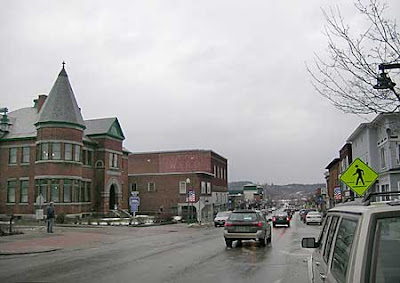
Newport City's downtown is now on the National Register of Historic Places. The city is seeking to become a designated downtown under the Vermont Downtown Program.


Newport City On National Register Of Historic Places
It Is Now Seeking Downtown Designation

BY ROBIN SMITH, Staff Writer

- NEWPORT CITY -- Newport City is now on the National Register of Historic Places.

That recognition is the first step among many to becoming a designated downtown in Vermont, and gaining the tools, expertise and funds to explore the city's untapped future.

The city's downtown coordinator, Patricia "Trish" Sears, is hosting a special gathering on Jan. 24 from 6 to 9 p.m. at the Gateway Center. Sears and a team of experts will lead a discussion of the process of becoming a designated downtown, and the benefits.

Sears wants to ask this question of everyone: "What should Newport look like in five years?"

Sears is inviting everyone who lives, works or uses the city's downtown - and that includes people from across Vermont's North Country. The meeting will be catered and child care will be provided.

The city went on the National Register in October.

The downtown district encompasses the commercial core and immediately adjacent residential neighborhoods, including 121 contributing buildings.

According to a description on the Preservation Trust of Vermont Web site, the downtown is mostly commercial with examples of domestic, institutional, fraternal, industrial and ecclesiastical structures.

Most buildings were built between the 1840s and 1955. The styles range from Greek Revival to Colonial Revival and the American International style.

The buildings show most of their original distinctive materials and features. They "reflect the growth and evolution of Newport as an important economic and social center in northern Vermont with a thriving economy based on the lumber industry, maritime activity, the railroad and tourism," the Preservation Trust notes in its newsletter.

Newport City is the last city in Vermont to go after the Downtown Designation through the Vermont Downtown Program, Sears said.

Sears has a contract with the city to create a nonprofit organization that will see the city through the changes that the downtown community pursues.

Sears came on board last fall, and has been busy connecting with the divergent groups who have an interest, sometimes competing, in the city's downtown.

The constituents of downtown are many: residents, landlords and tenants; business owners, the Chamber of Commerce and their customers; pedestrians and motorists; the city's active recreation department and the children and families who benefit; state government, the court system and all their clients; tourists and the locals who fish off the bridges; and everyone who works in the city from across the region.

Her "big picture" approach is to build on downtown's assets, not just list the city's problems.

"We need to understand that Main Street is our gateway. It's not only economic but it's community development," Sears said.

She wants to know how those that are required to live or walk in downtown to be near government services and those who serve them can find common ground with the retail community. It shouldn't be local businesses pitted against local residents, she said.

"How can we partner in taking part in the pride of our Main Street?" she said.

Her job is to open communication and connections among all the groups that use Main Street.

"I want us to be planning into the 21st century," she said.

Her inspiration is Magog, Quebec, on the north end of international Lake Memphremagog. Thirty or 40 years ago, Magog was an industrial town that hadn't tapped into the waterfront resource it now uses to attract thousands from the Montreal area. Its waterfront is accessible, with tour boats and festivals. Its downtown is alive in the summer with activity.

Goal: A Busy Downtown

"My goal is to have downtown Newport as busy as Magog on weekends," Sears said.

As a historic place recognized by the National Register of the National Park Service, downtown building owners can qualify for more assistance to maintain their distinct history.

Sears also will connect with experts who have "found" Newport City to tap their knowledge of how other communities have blossomed. She also wants to talk to those who worked in the Newport of yesteryear, on the railroad, for example.

She would also like to help promote the proposed tour boat by a local couple, which could be up and operating this summer.

Developers can make money here, and those wanting to leave a legacy behind will find ways to invest here, Sears said. She is meeting with as many people who have something to give to the city as she can, bringing them together for the city.

The meeting on Jan. 24 is the first chance for Sears, assisted by Joss Besse of the Vermont Downtown Program, to unveil what it takes to become a designated downtown.