_/\_/\_
Showing posts with label games. Show all posts
Friday, January 02, 2009
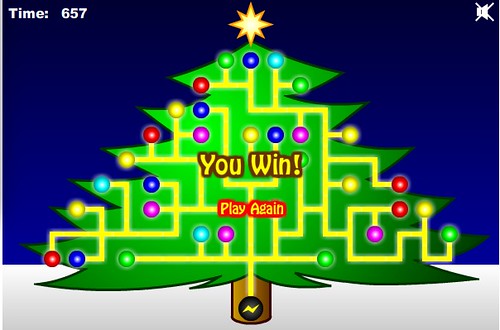
Light the Christmas Tree Game
_/\_/\_
Sunday, August 10, 2008
Sunday, May 25, 2008
Set Duel: 2nd Win!
I can't believe it — twice in one month! My time? 1:35. Not good, but good enough. Of course, I couldn't even do today's USA Today five-star Sudoku puzzle. Next Saturday, go play Set and post your time at Deb's blog!_/\_/\_
Sunday, May 11, 2008
I Won the Set Duel!
I have played Set since July of 1999 when I was introduced to it in a discrete mathematics course at Rutgers University. I played every single day. That's a lot of games. It is the first thing I do when I wake up in the morning. I have learned that a good time for my Set game is a good brain day. A bad time will be a slow brain day. Then I stumbled across the Set Weekly Challenge at Debra's deblog.com. The times of the Set players there astounded me. I wanted so badly to win the badge for a week but it seemed impossible. Until yesterday! My time of 48 seconds beat everybody (and that's saying a lot because I use a laptop with no mouse, I still play it first thing in the morning without caffeine, and my competition have had times as low as 20 seconds).I can only claim this award until next Saturday night when another player will walk off with it. I wish I could keep it in my sidebar and list the dates that I won (there may be more!). But alas, I can't. So stop by deblog — Debra is an amazing woman involved with TwitterLit, KidderLit, and BAFAB.
Technorati Tags: Set Weekly Challenge
_/\_/\_
Tuesday, January 29, 2008
Unplugged Project: Mancala, Continued
_/\_/\_
Sunday, January 27, 2008
Unplugged Project: Mancala
Cut egg cartons apart to make your own Mancala game. Paint them or cover with pretty papers and you have a custom made and worthwhile game that two people can play. I am making mine for my classroom. I have cut apart the egg cartons and will have students at school paint them with paints that the art teacher feels would work best. The only other thing I need for the games are 24 little stones for each game. I may use beans or poker chips that I have at school because stones are rather difficult to find under a few feet of snow.
What is Mancala? It is an ancient game from Africa that is mathematically significant for your children to learn. I am not even going to bother any of us with the mathematics but if you like, you can have your children talk about strategies the will increase their chances of winning. It is a rather complex game to learn, but once you learn you become addicted. I used to know how to play years ago but I had to learn all over again in order to write this post. You cannot overemphasize the importance of game playing for mathematics learning and for family relationships.If you click the Mancala Snails image above, you will be taken to an online, free version of Mancala. It is the easiest way to learn how to play. Just choose "beginner lever" and play until you begin to develop strategies. There are many variations of the game, but stick to the basics that are in Mancala Snails. The rules used there are accurate and true to the real game. It is said that Mancala is the historical precursor to chess. I know for a fact that children love to play this game because they always ask me to get one for the classroom. Now I enjoy playing the computer at Mancala Snails when I am tired and just want to relax.
Thank you for stopping by.
Next week's Project: Pipecleaner (or Twist Tie? Or Wire?)
Technorati Tags: mathematics games, Mancala, Mancala Snails, Unplugged Project, sowing games, combinatorics
_/\_/\_
Labels:
cats,
games,
mathematics,
Possum,
Puzzles,
school,
Unplugged Project
Sunday, January 20, 2008
Unplugged Project: Matchsticks Game
Toothpicks (and, not as safely, matchsticks) can be used for a vast number of mathematics games in order to develop geometric knowledge, problem-solving skills and critical thinking, meeting NCTM standards. I have embedded a Flash game in this post so that you and your family can play Matchsticks. It has a scoreboard that will keep your scores forever! So be sure to bookmark this post so that you can come back and play often. The game will open in a new window, so you may have to enable popups for this post only.Other mathematically excellent sites for toothpick games and puzzles:
Puzzle Corner: Toothpick Games
Toothpick World (with a toothpick applet to
solve the more than forty puzzles available).
Toothpick World (with a toothpick applet to
solve the more than forty puzzles available).
Thank you for stopping by.
Next week's Project: Egg Cartons
Technorati Tags: mathematics games, Matchsticks, Unplugged Project
_/\_/\_
Sunday, December 02, 2007
A Merry Binary Christmas
Every year I give my students a puzzle to make and take home. I choose puzzles that will amaze their families and friends. This year we will make these guess-the-number-cards. After you print and cut out these cards, you give them to a friend. You ask them to think of a secret number between one and fifty. Then have them give you back any card that contains that number.
You can "guess" their magic number by adding the powers of two that are on the bottom left corner of each card that they return to you. For instance: if their magic number is 17, they will return cards 1 and 16, which are in the bottom left corners. You add 1 + 16 and tell your friend that 17 was their magic number. They will be amazed! And best of all, they probably will never figure out how you guessed it.
What's the secret? In base 2, 17 is written as 1001 (base 2) because it contains one 16 (or 2^4), no 8s (or 2^3), no 4s (or 2^2), no 2s (or 2^1) and one 1 (2^0).2^4 + 2^0 = 16 + 1 = 17
You can see that their are many lessons here. I could connect this game to Egyptian and Russian Peasant multiplication. But I'm leaning towards using the Towers of Hanoi game as an extension.
The Tower of Hanoi (sometimes referred to as the Tower of Brahma or the End of the World Puzzle) was invented by the French mathematician, Edouard Lucas, in 1883. He was inspired by a legend that tells of a Hindu temple where the pyramid puzzle might have been used for the mental discipline of young priests. Legend says that at the beginning of time the priests in the temple were given a stack of 64 gold disks, each one a little smaller than the one beneath it. Their assignment was to transfer the 64 disks from one of the three poles to another, with one important provisoøa large disk could never be placed on top of a smaller one. The priests worked very efficiently, day and night. When they finished their work, the myth said, the temple would crumble into dust and the world would vanish
What does this game have to do with our number guessing cards? Read on and you shall see. The legend mentions that 64 disks are used. You can't possible play with all sixty-four disks. The game usually comes with up to seven disks. There are wooden versions with seven disks that you can buy here (the source of the Legend of the Towers of Hanoi above.) You can also play online at many sites.Solving this game with even seven disks is daunting, so suggest to your children that they use the problem solving strategy of making a simpler problem. As they solve from one to two to three and greater number of disks, they will begin to notice patterns in how to move the disks.
They may begin to notice that there are a minimum number of moves required to solve the puzzle for different numbers of disks (if not, ask them if there are different numbers of moves possible). I have made a table of the minimum number of moves required for different numbers of disks on the Hanoi game:
Do you see that this game is about the powers of two?Have your kids make a table like mine (perhaps without the algebra) if it is age appropriate. What are the differences between the minimum number of moves? Hopefully they will recognize that the differences are also powers of two and that will help them write either a recursive or general rule. They can then challenge themselves to solve the seven disk puzzle in 127 moves.
A screen shot of my favorite online implementation of the Towers of Hanoi from NLVM:
Our last activity is to figure out what the value of 2^64 is. If the monks were able to move a disk a second, day and night, without stopping, how long would it be until the world came to an end? I give everybody calculators and let them loose with it. Last night, I found a wonderful tool to help them learn and practice conversions: the unit conversion tool from NLVM. This tool is probably inappropriate for most elementary students, but it's a neat place.
Kids being kids, there is a part of them that will think it marvelous that they are part of predicting the end of the world. The problem is that unless you do it also, you will never know. You will have to provide benchmarks or checks along the way so that the kids don't become lost in these huge numbers. While researching this article, I found two different answers to this problem (I have decided not to link you to them). This doesn't speak too well to our mathematics on the Internet. So be bold and do it yourself! I calculated the correct answer. Is there any relationship between the legend and the actual age of the earth? Of the solar system? Of the universe?
(If you would like a copy of these cards in .pdf or .doc format, please e-mail me.)
Related posts:
Binary Card Tricks, Part 2
Binary Card Tricks, Part 3
Technorati tags: binary+decomposition Towers+of+Hanoi unit+conversion math+games
_/\_/\_
Sunday, May 27, 2007
Weekend Notes
While I was hanging out the window, smoking, a fat red-headed hummingbird ran into my arm! It was quite a shock because I thought it was a bee and I thought perhaps it would sting me.
At least one otter was playing and feeding in the way-back pond this evening. I haven't seen any beaver yet this season (but I haven't been watching as carefully as usual, either).
American Cribbage Congress:
I need to play more. I'll teach Wingnut this summer and we'll use this ACC site.
At least one otter was playing and feeding in the way-back pond this evening. I haven't seen any beaver yet this season (but I haven't been watching as carefully as usual, either).
American Cribbage Congress:
29 Hand - The best hand in Cribbage and a 216,580 to 1 shot. Consists of holding three 5s and a Jack, with the Jack being of a different suit than any of the three 5s. The starter card turned must then be the fourth 5 and being the same suit as the held Jack, makes the hand count 29.
I need to play more. I'll teach Wingnut this summer and we'll use this ACC site.
_/\_/\_
Thursday, February 22, 2007
Puzzling Week: Petals Around the Rose

How many polar bears do you see? 10
How many fish do you see? 8
How many plankton do you see? 74
How many polar bears do you see? 6How many fish do you see? 6
How many plankton do you see? 93
So have you figured out how it's figured out?
NCTM's Illumination site has a wonderful lesson for this puzzle.
Nope! No spoiler here!
Tradition requires me to never post the solution.
After you figure out the answers, can you derive any equations to solve this puzzle for any combination of dice tossed?
When you solve the puzzle, you deserve membership in the Polar Bear Club!

_/\_/\_
Subscribe to:
Posts (Atom)