![]() |
| Redpoll |
![]() |
| White-breasted nuthatch |
![]() |
| Redpolls |
![]() |
| Mourning dove |
![]() |
| Goose on a neighbor's farm |
![]() |
| Redpoll |
![]() |
| Chickadee |
![]() |
| Saturday's Critters at Viewing Nature with Eileen |
![]() |
| Redpoll |
![]() |
| White-breasted nuthatch |
![]() |
| Redpolls |
![]() |
| Mourning dove |
![]() |
| Goose on a neighbor's farm |
![]() |
| Redpoll |
![]() |
| Chickadee |
![]() |
| Saturday's Critters at Viewing Nature with Eileen |
Remember the five hundred redpolls that congregated at the feeders on Friday, April 1 (click here to see photos and text)? They returned on Saturday morning. I grabbed my Flip and recorded them. But John and I were talking while I filmed, so I used Flip public domain music to delete our voices. This is another lousy video but you can see that at least 200 redpolls congregated. I actually saw the cloud of them come down the mountain to the feeders and it was an exhilarating sight. They wheeled and dove in the air as they flew down.
After talking to people at the library and at church, we have decided this is the spring congregation of redpolls before they return to Canada for the summer. I can't find any information on redpoll congregation so I cannot confirm whether our conclusion is correct or not.
The Cornell Ornithology Lab writes "An abundant breeding bird of the boreal and taiga regions, the Common Redpoll is seen in North America primarily only in the winter. Even then, it generally occurs during irruptions, typically every other year." We have redpolls every winter, and I don't think that is considered an irruption. They are abundant here and every northern Vermonter, adult and child, knows about redpolls.
Cornell also says that these are Acanthis flammea. I have always thought, from my sources, that they are Carduelis flammea. You can search Cornell with the term Carduelis flammea and the results are redpolls. So now I have to find out why they have two names and which one is in current use.
_/\_/\_
I went to work after I filled the thistle socks for the redpolls earlier today. John said that very soon after I left he heard a low drumming sound that drew him to the windows. He saw at least five hundred redpolls at the feeders, in the woods, and in the air. He was stunned and grabbed my camera and started shooting. He did an awesome job with the camera. He used proper estimation procedures, the same we teach our mathematics students. He was still excited about the experience when I returned home.
The feeders are all empty now. Why were we inundated with redpolls? I think it partly was today's snowstorm. Perhaps there is also some communication between different redpoll flocks. We can't be certain of anything. But in the morning, I am going to refill the thistle socks. I want the redpolls to come back! We have video cameras that could capture the magnitude of the combined flocks.
To see the detail of these photos, click on the photo and you will open a new window to the Flickr photo page. On the top left of the photo is a drop down menu that says "Actions." Click that and select "View all sizes." View the original size. I looked at the crowds on the thistle socks and the flying birds for an hour. This is an awesome phenomenon.
_/\_/\_
I am not exaggerating when I say that we are getting over one hundred redpolls at the feeders now. It is a hoard of little birds. Redpolls love thistle seed (below). I used to put out just one thistle bag. Then two. Now we have four — two small ones and two large ones. The redpolls prefer the small bags but in a pinch (like when I refuse to refill the small bags) will use the large bags. The ground beneath the bags is an inch thick in thistle seeds. John and I are going to try to plant the thistle in the upper field this year (it is not invasive) to try to harvest our own seed for next winter instead of buying fifty pound bags of it for the birdies.
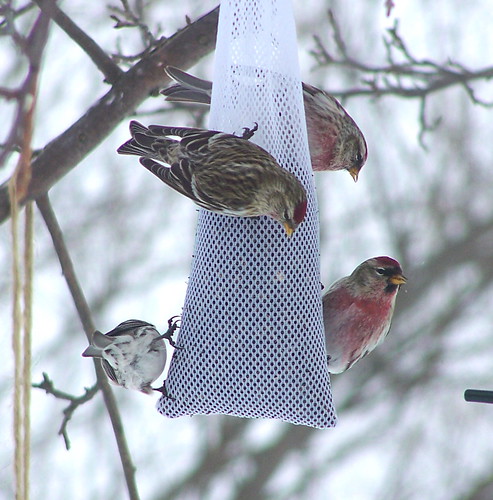
Only 3 redpolls are in this photo but up to 10 birds will alight on a thistle bag.
Redpolls are a bit skittish. If a car goes by on the road (which doesn't happen that often in the winter), they all fly off. They travel together in huge flocks. More redpolls come during snowstorms than during good weather. When I go to refill the feeders, the redpolls will remain in the tree and watch me. The chickadees will bounce around the tree and feeders, so close that I can touch them, and will scold me. But redpolls wait quietly and patiently. They chatter quite a bit to each other. Some have red patches on their heads, some don't. Some have red breasts and some don't. Some simply look like a streaked sparrow. They come slender and plump, dark brown to nearly white. In the summer, they return to Canada. I miss their friendly chatter when they leave.
_/\_/\_