Showing posts with label Jagged ambush bug. Show all posts

Saturday, September 02, 2023

From Bug Hunt to Restaurant

Jody's mating mosaic darners

Jody decided to close up her law office for a long weekend and spent Friday at Crystal Lake State Park. I picked her up after school and we came back to my house (one mile away) for more bug hunting. She got some magnificent photos on that iPhone of hers. She found these dragonflies hanging together under a branch of a pine tree. They allowed her to carry them down to where I was inspecting a leafroller larva. And as soon as Jody got to me, they flew away still coupled together. It was a memorable sight.

The darners in the tree.

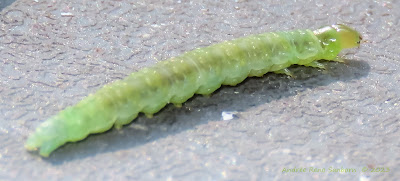
I was not as fortunate yesterday. I found my leafroller larva, some type of moth, and unrolled it. When touched with a piece of grass, it wriggled very violently. I thought I had a video of that action but I didn't press the right button. I have found more of these larvae and will be sleeving the dogwood branch where they are maturing. 

The tiny caterpillar inside the leaf that it had rolled up.

Outside of the leaf.


Other creatures that we found:


Another Swamp Milkweed Leaf Beetle (Labidomera clivicollis)

Tricolored Bumble Bee (Bombus ternarius)

Everyone's favorite crane fly: Eastern Phantom Crane Fly (Bittacomorpha clavipes)

Banded Garden Spider (Argiope trifasciata)
Its zig-zag web is barely visible at the bottom.

Banded Tussock Moth (Halysidota  tessellaris)

Genus Stictocephala
(A buffalo treehopper)

A robber fly for your nightmares:
A Hanging-Thief (Genus Diogmites)

Everyone's favorite caterpillar:
Brown-hooded Owlet (Cucullia convexipennis)

Revisiting our jagged ambush bugs at the end of the season.

They wear different colors now.
Here, the male has the brown face and the female has a yellow face.

But then . . .

😱😱😱 


Jody found bear scat full of cherry pits not 20 feet from my back door. Lucy was calm so we knew that the bear was not close by, but our wanderings were now at an end. Bears scarf down so many cherries it is totally ridiculous. And at this time of year, it seems that all my trees are cherries. They are everywhere. In fact, I have read that my Black cherry trees (Prunus serotina) are the most populous tree in New England forests. Cherry picking time is when Jody and I stay out of the woods.

We retired to Orleans to a restaurant for supper and swapped photos and stories of our day. It was a wonderful day.

_/\_/\_

Tuesday, August 15, 2023

A Fly for Supper

00:55
No audio
Best viewed full screen

Jody found her ambush bug the other day and gave me permission to post her photos. These are special photos that are not simple insect portraits. So I made a slideshow of them. She only uses her iPhone for insect photos and I am always stunned at the quality of her work. Her iPhone videos are also awesome. She also never edits her shots!

Jagged ambush bugs are fairly plentiful this time of year. Every season we have an informal contest to see who can find the first one. They are very small (less than 1/2 inch long) and well camouflaged so it is a competition of our bug eyes. This is the first year that I have won, with my shot of the ambush bug hiding in yarrow that I posted for Wordless Wednesday:


The ambush bugs lie in ambush in flowers. Their huge front legs enable them to snatch an insect out of the air as it flies by, or to grab it as it walks or crawls by. The ambush bug has piercing and sucking mouth parts, so it injects a paralyzing agent through its beak and into the other insect. I can't find information on whether this paralyzing agent also anesthetizes the insect. Because after the prey is paralyzed, the ambush bug uses that beak to slurp up the insides of the insect prey. And that knowledge made it difficult for me to look at Jody's photos the first time. But like we tell each other, everything has to eat.  

Jody identifies as a gardener and she maintains the gardens not only at her home but at church and the library. We are all enriched by her insights with insects. I am especially enriched that her knowledge of botany enhances my knowledge of insect behaviors.

Another JAB I found on August 8

University of Minnesota: Small Wonders: Jagged Ambush Bugs
Missouri Department of Conservation: Ambush Bugs
Video: Bug of the Week: Ambush Bug Catches a Bee
_/\_/\_

Sunday, November 20, 2022

My Jagged Ambush Bugs Are Yellow

Mating Jagged Ambush Bugs (Phymata
on John's finger.

I've probably put too many photos of jagged ambush bugs in this post, but that's because they are a prize when you try to photograph insects. The Twitter photographers all remind people that the season for them has opened when goldenrod blooms. Like we need a reminder? We don't. We are all waiting. They are nearly invisible to see because they are tiny, barely move, and they can change color. I've seen green, brown, and yellow. I've read of red, white, and black ones, and I'd love to find those but I doubt I ever will. I have few red wildflowers here. I seem to find the yellow ones. Jody seems to find the green ones. Why? It may be that my flowers (wild) are mostly yellow: goldenrod, black-eyed susan, fleabanes. But Jody's are cultivated flowers that are in all colors. 

Mating Jagged Ambush Bugs (Phymata
on John's finger.

I did find this about colors on the ambush beetles the article "Ambush bugs match their habitat using choice and colour change" at Functional Ecology:
In our study, we surveyed whether ambush bugs found in the wild tended to match the flower color they were found on, and if this was correlated with how often they had prey. In lab experiments, we followed up by providing ambush bugs a choice between yellow and white flowers, as well as keeping individuals on white and yellow backgrounds to see if they would change colour over time. We found that in the wild, ambush bugs were whiter on white flowers and yellower on yellow flowers, and that better matched individuals were found more often with prey. All ambush bugs in the lab preferred yellow flowers, but this preference was especially strong for individuals who were found on yellow flowers in the wild. Finally, we found the first experimental evidence for color change in this species; ambush bugs were able to become more yellow over time but not whiter, and this was exaggerated when they were kept on a yellow background.

We now know that ambush bugs use a combination of color change and choice of habitat to optimize their ability to catch unsuspecting prey. Overall, this study improves our knowledge of how background matching is achieved in organisms using a combination of complex mechanisms.

Mating Jagged Ambush Bugs (Phymata
on John's finger.

John, my late husband, would touch anything. Brave or foolhardy? I vote for brave. He held the mating pair of ambush bugs for me because they kept wandering out of the tripod-based viewfinder and he could keep them still. They will bite, but he figured they were too busy. 😉 We always called these shots bug porn.

Jagged Ambush Bugs (Phymata)

But I do photograph them in the wild without human aid. These bugs sit on flowers and wait for prey to come to them. They don't really move and hunt. So if you can see them, they can be fun to photograph for hundreds of focused shots. They use those fat front legs to hold on to prey, inject it with a venom that paralyzes it and then sucks its insides out. Ouch. 💀 Poor bugs.

Jagged Ambush Bugs (Phymata)

 The males are much smaller than the females.

Jagged Ambush Bugs (Phymata)

Some people keep ambush bugs as pets. I really have to suggest this to Jody. After all, we have raised, separately and together, flea beetles, lady beetles, moths, and butterflies. Why not some ambush bugs?  

Jagged Ambush Bugs (Phymata)

Try to find some ambush bugs next summer. Or assassin bugs (but they run after prey so are more difficult to shoot). They are related. Or not. Entomologists disagree, but are usually in the same family. There are at least two species in Phymata that cannot be differentiated in photos. 

Photo Sunday at Norah Clark

 _/\_/\_

Tuesday, October 04, 2022

Insects on Jerusalem Artichokes

Jagged Ambush Bug (Phymata)

Every bug hunter I know keeps their eyes out for Jagged ambush bugs in late summer when the goldenrod blooms. They are so bizarre! They even have different appearances, like chameleons, depending on what the plant they settle into for their ambush. I've seen them bright yellow like black-eyed susans. Jody and I were very surprised to find this on a Jerusalem artichoke leaf.

Asian Lady Beetle (Harmonia axyridis)

As I prepared an earlier post about Jerusalem artichokes, I saw the different species of insects I had found on them. I thought it would be fun to collect them in one post.

Tiny unidentified wasp

Jerusalem artichokes are late bloomers. In Barton they bloom just before and after the first frosts. We've had many heavy frosts so far this October and late September. That's why I wanted to have these plants! But that is not what happened (see the article linked above).

Common Eastern Bumble Bee
(Bombus impatiens)

 Aphids (Tribe Macrosiphini)

There weren't as many insects as I had hoped to find on the artichokes. That could be a function of their height, however, which prevented me from looking at them often. And usually, I never even checked them for bugs. Because I couldn't.  🤷

_/\_/\_