Showing posts with label bread. Show all posts

Tuesday, January 10, 2023

Pane di Como

Pane di Como

I finally have this recipe figured out. I have tried it now and then over the years because I knew I would love it. But the dough was always impossibly slack. I would add more flour, but that always never worked well. Then I would forget about it for a few years, then come back to it, then have the same problems. 

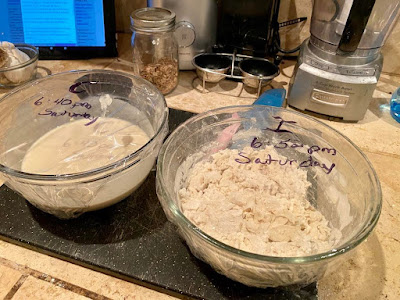
Biga for the como bread on the left

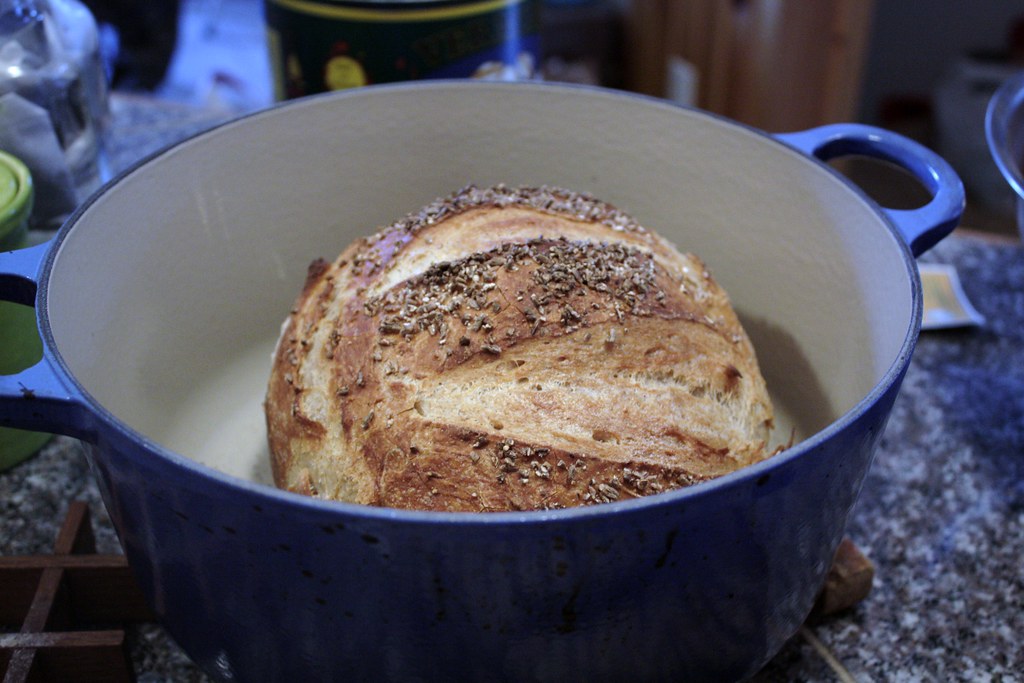
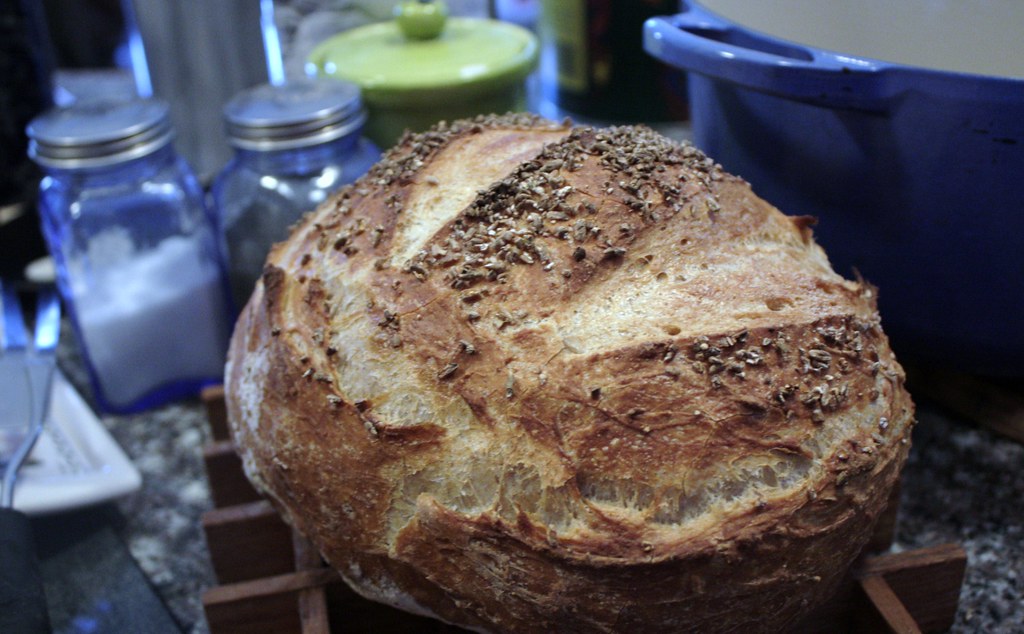
This time, I measured by volume and not by weight. The recipe took an extra full cup of flour, by volume (I did not check the weight at all). Since I added the flour at the beginning, the recipe finally worked. However, even though I used bannetons, the loaf spread too much when baking. That could be because I had the oven too low so the oven spring was not optimal. Also, the bottom crust, see below, was too thick. Next time: I will have a hotter oven and an asbestos sheet pan underneath the Le Creuset and Lodge bread ovens.

Crumb of the como bread

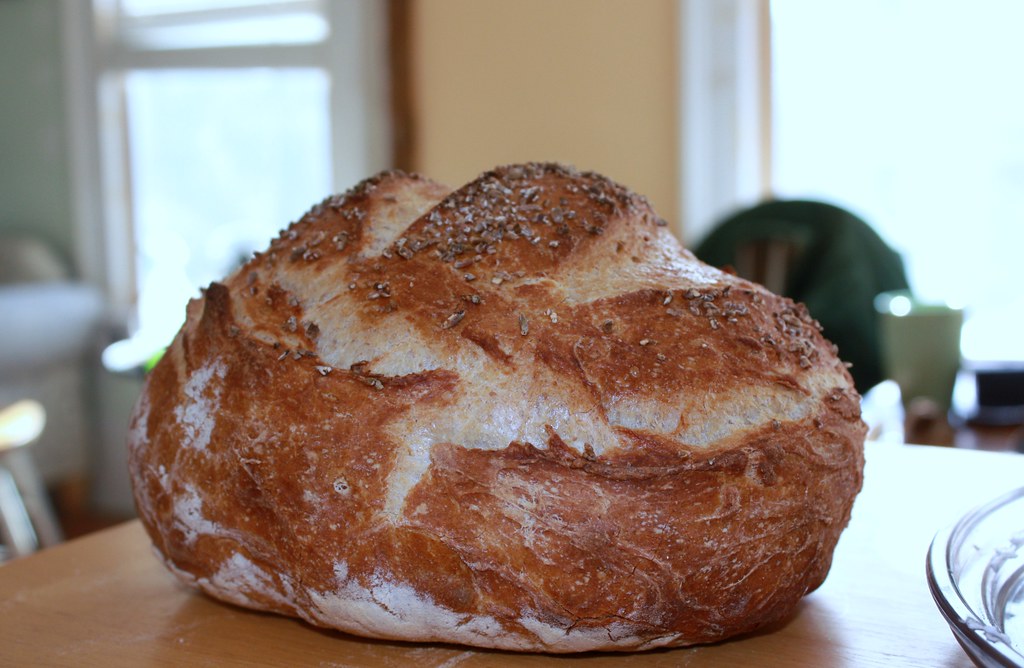
This is the bread of Como, Italy. It is a rustic hearth bread (so I keep reading). No one seems to know if it is the water in Como that makes this bread world famous. For me, it is the crackly crust and the malt that sets it apart. I love the dense crumb. 

Como, Italy at the south end of Lake Como

The recipe is from Carol Field's book The Italian Baker. In fact, it is the first recipe. Her second recipe, Pane di Como Antico, seems to be more popular, though. It is more rustic and has a higher hydration so that there are holes throughout the crumb. That is fine for some occasions but is not my personal favorite type of bread. 

Whenever I begin exploring a region's breads, I attempt to stay with authentic ingredients that are available. Field said to use Morton sea salt and malt syrup. I got the salt (salinity in different salts is important to know) but since I always have diastatic malt powder on hand, I used that (it is a 1:1 substitution). The malt aids leavening and adds sweetness and color. 

The recipe uses a biga: an overnight starter made with a tiny bit of commercial yeast. I am pondering exploring more and different bigas in the future. They're fun. They make the bread-making a two day adventure. 

Morton sea salt and KAF diastatic malt powder

Yesterday, my Andrew alerted me to a Carol Field and Julia Child broadcast on his PBS station in Washington, DC. I'm able to watch it because he shares his PBS passport with me. But I can't share the video here. In the program, Field made grassini and an unnamed loaf of wheat bread. It was delightful to watch. I learned many nuances of mixing and handling dough. Watching Field also reminded me to slow down and remain calm during the entire process. Cherish the experience!

After I perfect this loaf, I will explore Panis Quadratus, a bread also from Italy but very, very ancient. I can't wait!

As an Amazon Associate, I earn from qualifying purchases.
_/\_/\_

Monday, December 26, 2022

The Bread


Le Creuset recipe
Extremely crusty and good. The bread itself? Nothing special.

I bake bread regularly. Lately, though, I've been doing American sandwich loaves and seem to have lost my rhythm with the artisan loaves that I love. I have spent two days making four loaves of two recipes of bread for the bread ovens I have.  There have been a lot of errors!

Le Creuset embossed on bottom crust.

Day 1 errors: I thought I had mis-mixed the dough without fat. It rose well, though, and felt great. But it wasn't the recipe (I thought), so I tossed it. Then I checked the recipe. It was correct! Oh, I was so upset with myself!

I then made two separate batches because the amount of dough almost overwhelmed my Kitchenaid. Therefore, the doughs were different, and one was more hydrated than the other. Upset, again!

Scoring the tops of the loaves before baking was another sudden challenge. I could not find my bread lamé, so I used a serrated knife. I disliked what I did.

I had also used bannetons and bread stencils. I didn't flour the bannetons well so the pattern was not clear. I over-oiled the stencils so that their impressions never were defined at all. I have some ideas on which recipes the stencils would work best with though. This recipe may have been too wet.

I couldn't compare the two finished loaves because the doughs had been so different. But the Le Creuset loaf seemed to have more oven lift than the Lodge. I was not impressed with the taste of the bread. The crust was fantastic. The crust sang for several minutes out of the oven, longer than I have ever heard. It was as flaky as the best pastry would be. 

The Le Creuset oven is less than half of the weight of the Lodge, and that is most helpful when you are disabled. I did not mind the branding on the bottom at all. Several reviewers were indignant about it. It reminded me of old pie tins way way back in time that we used to use. 

A crumb that I like. 

Day 2: fewer errors. I used a British cob (English for boule) recipe that John always loved. It whips up in a minute and you can raise it in the house or in the fridge for fermentation. It also has a lot of butter in it, which is probably why people love the recipe so much. The dough is heavy, so it is easier to shape and slash the loaves before baking. 

Cob dough rising.

Cob dough is doubled now.

I didn't use any bannetons with these loaves. I knew from years of experience that the dough does well without it. I may use one next time for the texturing. Below is one loaf in the Le Creuset oven.

Cob in the Le Creuset oven.

Lodge oven on the left, Le Creuset on the right.
Both loaded with rising cob dough.

I texted Amelia about my missing lamé and she knew where it was. Unfortunately, the razor was dull and I had no others, so I used a serrated knife plus the dull blade and mangled the slashes. Another big upset!

Baked cobs with mangled slashes.

I prefer the taste of these cobs. The crust is entirely different than the large boules from the day before. That has to be a consequence of the added butter. The crust does sing when out of the oven. The crumb is soft like I prefer lately. It's a wonderful toast and sandwich bread. I did not like the oven lift from the Lodge oven.

When Amelia comes today, she'll be taking three loaves of bread home! That will make room for me to make more. Bread is my therapy and helped me move through Christmas. Now I can make more for the community.

_/\_/\_

Saturday, December 24, 2022

Christmas Eve

Lucy said, "No thanks. I can hold it."

It was a tense day yesterday with this storm, but it all ended well. There was pouring rain all day, and the temperature reached 41°F (5°C). The state told us all to stay off of the roads after 4PM because a flash freeze was coming. I guess we all did. Businesses closed and no traffic came down my road at all. Amelia reported a heavy snow squall about 7 PM in Orleans. It got here soon after and was a whiteout. We never lost power. Currently, at 10:30 AM, it is 7°F (-14°C) with a windchill of -7°F (-22°C). It feels normal again.

Dough for two loaves

Lodge Combo Cooker (bread oven)

Le Creuset Bread Oven

I have bread rising. My children jointly gave me an early Christmas gift of a Le Creuset bread oven. I will bake one loaf in that and one in my Lodge Combo Cooker. The Lodge is also advertised as a bread oven and reviewers say the bread results are identical but that the Le Creuset oven is a work of art, which it is. It is one of the loveliest things I have ever owned.  I also plan to do at least one pie and a meatloaf. Those will depend on my knees, but so far so good. 

The cats and Lucy are quietly napping as the Festival of Nine Lessons and Carols streams from St. Michael's College on Vermont Public Radio's classical station.

As for church tonight? There is an accommodation for us who cannot get out at night—we can Zoom in. I give thanks every day for computer technology.

Grandkitty Remy relaxes on Christmas Eve
at home in Washington, DC
Since Remy takes down every tree ever put up,
Andrew now just has a wreath on the wall.


_/\_/\_

Saturday, September 17, 2022

My Simple Photo a Day Project

09.17.2022 Bread is my therapy

While visiting blogs today, I ran across Soma, a graphic artist at Ink Torrents. On her sidebar I saw a link to her Simple 365 Photo a Day Project. She photographed a simple thing every day and captioned each. Soma chose black & white for her photos. I'm going to do as I feel when I feel it. The photos will most likely all be from my phone. They will show the comfort of simple things. I'm changing it to a Photo a Day project because I am starting so late in the year.

As each day goes to the next, I want to move the old photos to a new tab on the blog. I'll see how that designing and formatting go, but that's the plan. 

Yesterday my first shot was of a loaf of King Arthur Flour sandwich bread that I have been making lately. Click the link for the recipe. If a recipe is involved, I will link to it in the sidebar. Unfortunately, I don't know how to make it open in a new window or tab, so just right-click it for a new window or tab.

Thank you, Soma.

_/\_/\_

Monday, March 08, 2010

My First Le Crueset Loaf Goes to New Haven

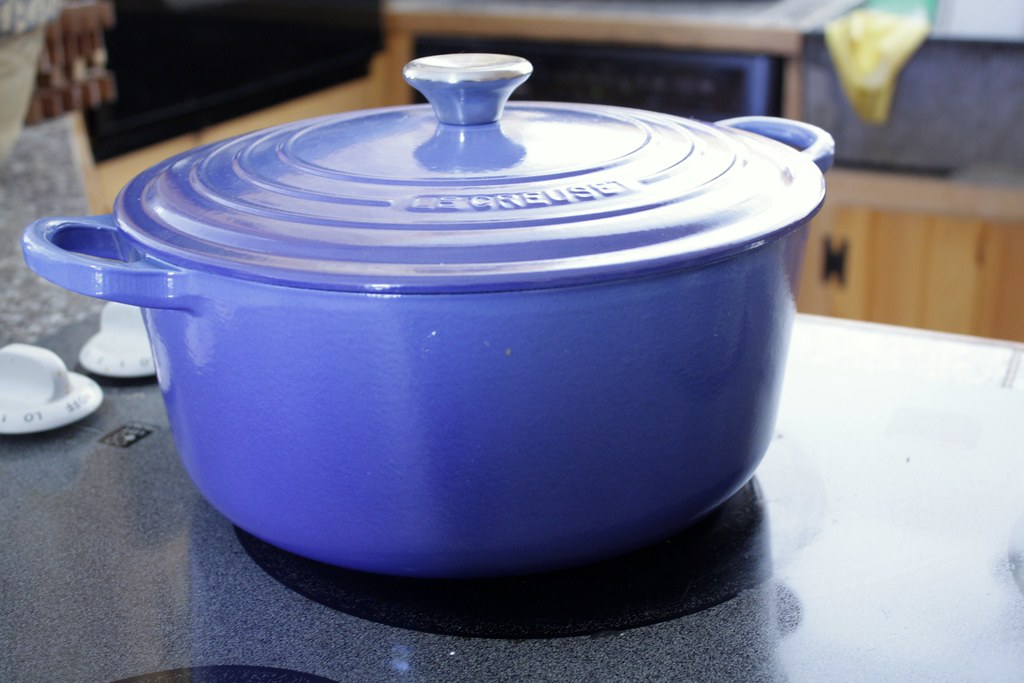
I used our new Le Creuset cast iron pot to make a loaf of artisan bread on Friday night. I followed the directions from the Artisan Bread in Five Minutes a Day blog. I used the recipe for Light Wheat Bread from the book Artisan Bread in Five Minutes a Day: The Discovery That Revolutionizes Home Baking. The loaf is too brown because I forgot to turn the oven temperature down to 450° after I took the lid off of the pot after 20 minutes of baking. I used 2 lbs of dough for this loaf. Next time I will try all 3 lbs of dough in the pot because while this loaf was a good size, I would like it bigger for when John and I have guests.

Above, you see the completed loaf on my kitchen counter.
It's looking good!

Above is the same loaf of bread on Anna's kitchen counter. It's looking even better! They are very impressed with my new skills. So I'm very pleased. In the future, I am also going to try baking loaves in my cloche (a closed clay pot that I have and have not used in years). They say the crust is even better in a cloche.

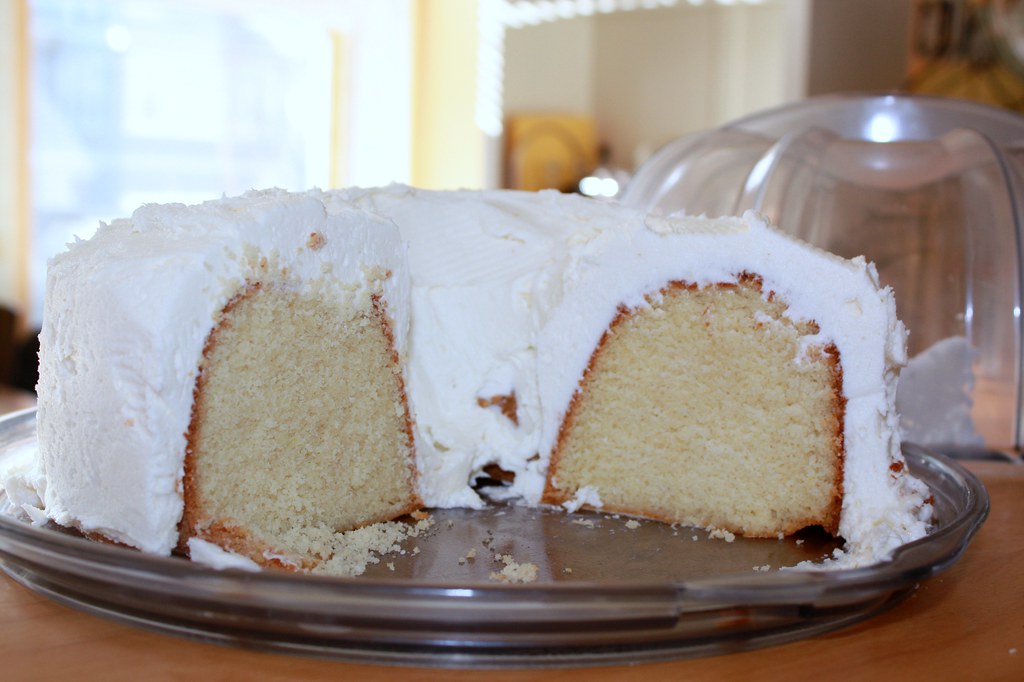
We also took this iced bundt cake for them. I have posted the recipe here. This cake can be dry, so be sure not to over bake. I like the recipe because of the extracts that it uses. I have used vanilla and almond (1 1/2 t. each) and I have also done the recipe as printed. I think you could use any combination of flavorings that you would like. The cake is very sweet. It is so sweet that I cannot eat it on an empty stomach or my blood sugar crashes! I can't have this cake for breakfast! But it sure is good. And of course, I used the bundt pan that John and I found in the dump!


Technorati Tags: Del.icio.us Tags: Flickr Tags:
diigo it
_/\_/\_

Saturday, March 06, 2010

A Week of Riches

My son Andrew and I are night owls. We chat a lot in the middle of the night — trading recipes and talking about his sisters (I hear the girls' ears perking up now!). Andrew has been making a lot of artisan bread in his Le Creuset cast iron pots. We don't have one. So Andrew bought us one and it came this week! I have dough almost ready to bake now and I can't wait to see if I can make it as successfully as Andrew does. I even ordered the high heat proof handle from Le Creuset on the night he bought us the pot, and you can see that John has put it on in this photo. Later this weekend I may post Andrew's iPhone photos of his kitchen in Washington, DC. His Silence of the Lambs Kitchen!

But for now, here are the links for the artisan bread recipes for baking in cast iron pots:
John also got us an inexpensive, study cast iron pot that looks just like this one but was $40 cheaper at WalMart!

diigo it
_/\_/\_

Sunday, February 21, 2010

Making Malt Powder: Fail!

In my post Making Bread, I explained that malt powder is used in some bread recipes. I didn't have any when I made my English Granary Loaves (shown in the photo above), so I decided to make my own malt powder with wheat berries that I had on hand.

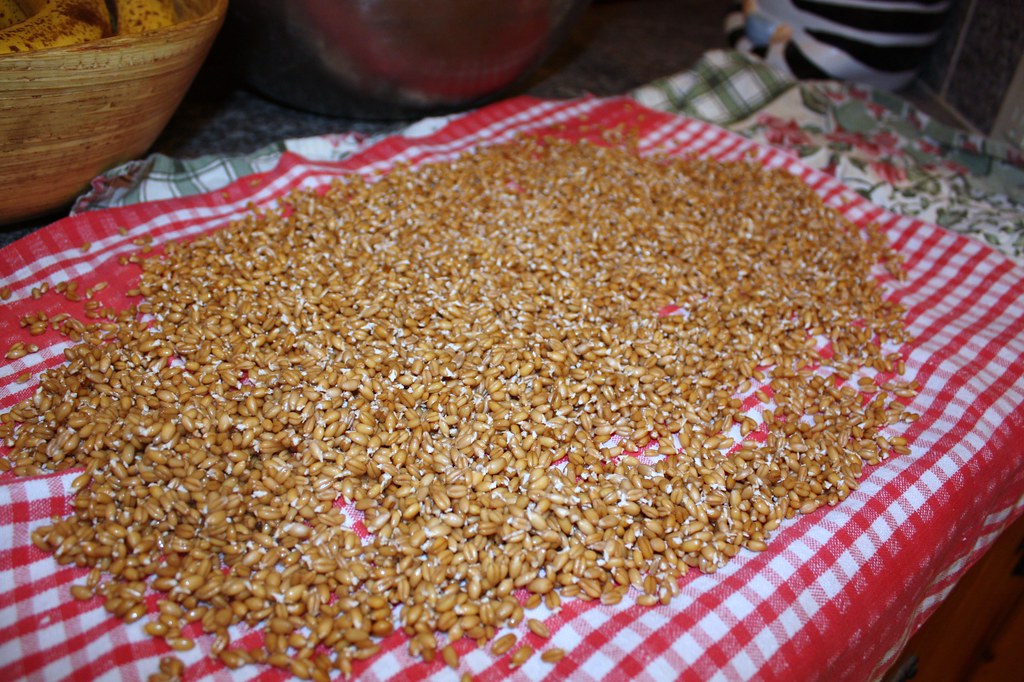
Following instructions found at jugalbandi blog, I soaked my wheat berries in water for 24 hours (shown above). Then I drained them and put them in a dry bowl and covered the bowl with plastic wrap. They remained in this bowl for another 24 hours and the wheat berries sprouted.

In the photo above you see how I am drying the sprouted wheat on a towel for one hour. In the photograph below, you can see the sprouted berries more clearly.

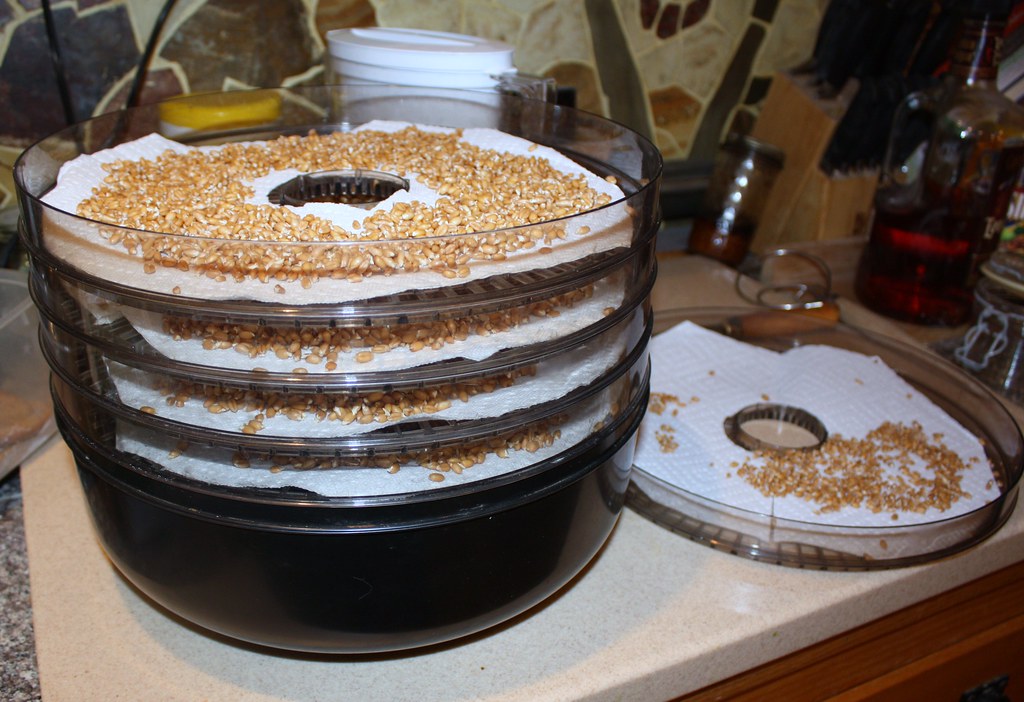
After drying on the towel, John and I loaded the berries in the dehydrator for another 24 hours. John carefully tore paper towels to fit the shape of the trays of the dehydrator because the berries are so small. We monitored the temperature inside the dehydrator so that it never was warmer than 130°F. This ensures that the enzymes in the malt powder are still alive.

We were finally able to grind the berries into a flour. I don't have a wheat grinder so we used my Cuisinart Mini Food Prep. The flour is very coarse and gritty.

The malt powder is now stored in the refrigerator until I need it again. I am really wondering if we made a true malt powder or simply sprouted wheat flour. We'll find out the next time I make English Granary bread.

My final analysis: I won't bother doing this again. I'm going to pay for the malt powder at King Arthur Flour. It's only $4. The process of making your own malt powder takes several days and a lot of time. To make it properly I need to buy a wheat grinder. That alone is too much of an expense. Now I need to return to the store to replace my wheat berries. This project was a fail!


Technorati Tags: Del.icio.us Tags: Flickr Tags:
diigo it
_/\_/\_

Saturday, February 20, 2010

Cracked Wheat

I had to show off today's bread. I tried a new cracked wheat recipe from King Arthur Flour. There are two variations for this recipe: two types of sweetener (molasses or honey) and two types of whole wheat flour (standard or white). This would be a great mathematics problem if I made it more interesting with more sweeteners and other ingredients and then ask how many different types of bread could you make with the recipe. Of course for this recipe the answer would be 2 • 2 = 4 types of bread (honey and white whole wheat, honey and standard whole wheat, molasses and white whole wheat and molasses and standard whole wheat).

I used the cornstarch wash from Artisan Bread in Five Minutes a Day: The Discovery That Revolutionizes Home Baking in order to have a prettier loaf with the cracked wheat on top. The bread is soft like comfort food and is easy to slice for sandwiches without falling apart. To see the recipe for this loaf, go to my recipe blog. This was a very popular recipe for John, who has nearly finished it off so that I need to make more in the morning!
diigo it
_/\_/\_

Tuesday, February 16, 2010

Making Bread

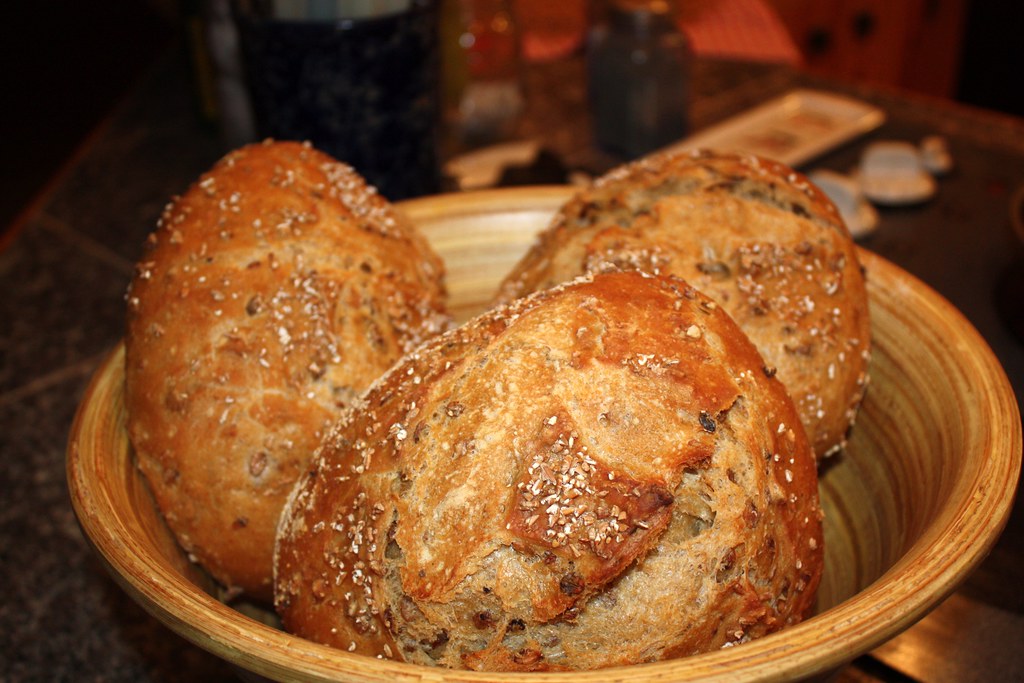
French boule loaves of rye (with the seeded top)
and European Peasant loaves.
Boule is a traditional shape of French bread
that is like a squashed ball. Boule means ball in French.


If you know me, you know I make bread. It has been a lifelong chore. Bread making was never especially enjoyable, but it was necessary — especially for my father. I started by grinding my own wheat when I was about 10 years old and making 8 loaves a week of whole grain bread for the family. (This is why I dislike whole wheat bread now.) The bread making habit stuck and I have continued to make bread all these years. I've done it manually, in bread machines, in antique bread buckets that screw to table tops, and in standing mixers.

Lately I have not liked kneading bread because of the damage in my hands from using computers too much. So when I read about the new no-knead artisan breads in the Kind Arthur Flour blog, I immediately tried the new bread making methods.

Now, besides our daily bread at home, I make the communion bread from these no-knead recipes. I also made 20 loaves for a luncheon at church for 40 people. However, only 20 people actually came to the luncheon so the unused loaves that I made were sold at $5 a loaf and $81 was sent to the UCC Haiti Relief Fund.

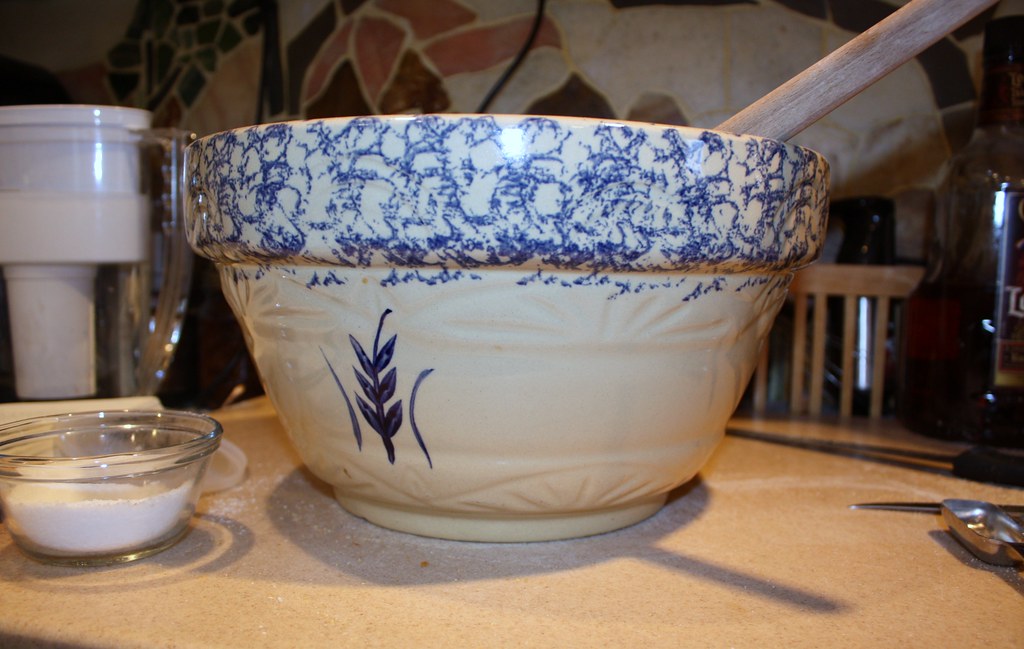
An aside: the new bread recipes from Artisan Bread in Five Minutes a Day: The Discovery That Revolutionizes Home Baking allow me to use my huge bread bowl and dough whisk. (Buy the dough whisk — it's worth the $15.) I haven't used them for years because I wouldn't knead the bread and I would use bread machines or mixers to knead it. But now I can stir the dough and let it rise in my beautiful bowl.

My bread dough bowl

My dough whisk after stirring English Granary bread dough.

The no-knead recipes from this book and from recipes from other bakers on the Internet (see also here and here for more) require new ingredients and equipment. Not much, just a bit. I am fortunate that John could make me a baking stone for the oven. It took him five minutes! He also had side less cookie sheets that I use instead of a pizza peel. I seem to require a lot of parchment paper to slide these loaves into the oven, but I'm trying to cut back on that expense. We also bought two food quality plastic containers that each hold 8 quarts to store the dough in the refrigerator. We bought them at Sam's Club. Don't get the bins from King Arthur because you pay three times the price of Sam's Club. The bins cannot be air tight because the yeast gases would make the bin explode. But to store dough in the refrigerator, the dough has to be covered or it will dry out. John solved that problem by heating a thin wire until it was red hot and then pushed it through the lids of the bins (it slipped through the plastic lids like butter). The hole is invisible but is big enough to to let yeast gases escape safely. If I ever want the bins to be air tight, I simply need to plug the tiny hole with a tooth pick.

The new ingredients are not required because of the no-knead method. They are required because the recipes are Old World, not American. They are authentic tasting recipes that are way better, I find, than the health food loaves I would make when requested. My creativity is sparked by these recipes and I look forward to creating new tastes and shapes of loaves. The textures of these breads are fascinating and the taste of the loaves is rich.

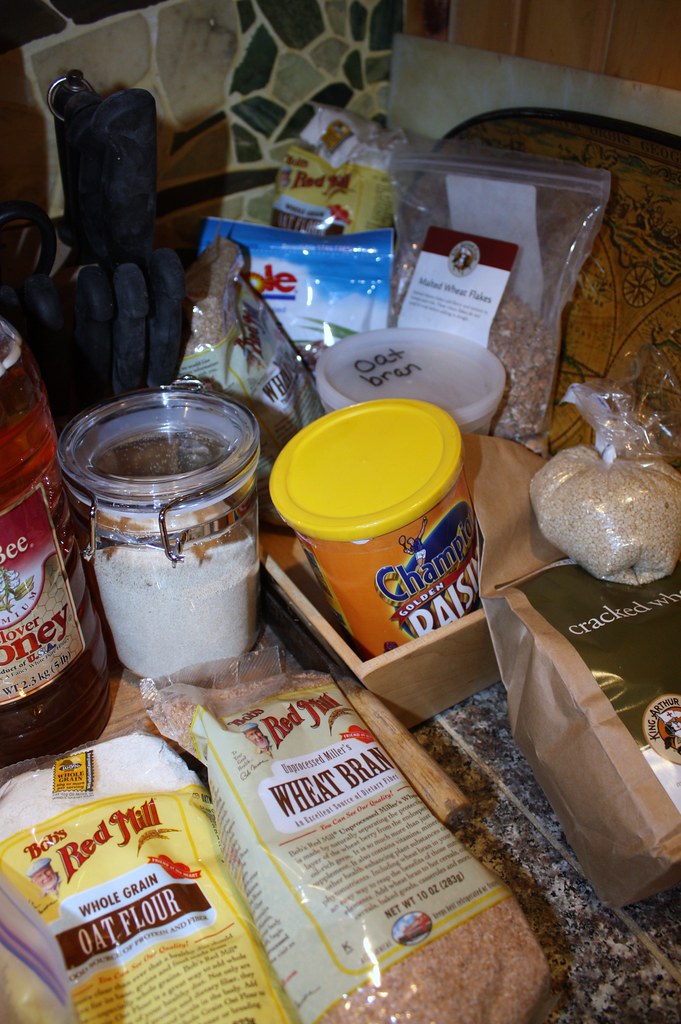
Below is a photo of one of my piles of bread gear in the kitchen:

My bread gear

In this photo are oat flour, wheat germ, wheat bran, oat bran, raw seseme seeds, wheat berries, cracked wheat, my yeast jar, raisins, dates, malted wheat flakes and other stuff. Some of these things I get at the Kearsarge Coop but they don't carry a lot of things they should carry, are very expensive and are often grouchy. The grocery stores now carry a lot of this stuff. I only had to go to King Arthur for the malted wheat flakes and the cracked wheat. I also have huge amounts of King Arthur unbleached all-purpose flour, whole wheat flour, white whole wheat flour, rye flour, and corn meal.

I should have also gotten malt powder but I forgot. So I am now making my own. I searched the Internet for a malt powder substitute and found that I could make my own malt powder with wheat berries. I happened to have some wheat berries in my bread gear, so I am processing them now for malt powder. Click this link at jugalbandi blog for directions in how to make your own malt powder.

Wheat berries soaking in water for 24 hours.

I am not entirely sure why malt powder is used in some of the bread recipes. But it is a sweetener, helps the leavening, and improves the taste, color and texture of the bread (or so I read). According to Wikipedia, "malting is a process applied to cereal grains, in which the grains are made to germinate by soaking in water[1] and are then quickly halted from germinating further by drying/heating with hot air.[2][3] Thus, malting is a combination of two processes: the sprouting process and the kiln-drying process. These latter terms are often preferred when referring to the field of brewing for batches of beer or other beverages as they provide more specific information."

When Anna visited us two weeks ago, I was in the middle of baking for the church luncheon. She went home with about 10 loaves of artisan bread. She prefers whole grain breads but I also sent home a couple of white and light wheat loaves for Aaron. They loved it all!

When John and I went to the King Arthur store this weekend, I impulsively bought the second bread book by Hertzberg and Francoise: Healthy Bread in Five Minutes a Day: 100 New Recipes Featuring Whole Grains, Fruits, Vegetables, and Gluten-Free Ingredients. Don't buy impulsively! I paid $27.50 for a book that amazon.com carries for $18.47. I am kicking myself now. Click my links here for either (or both) books and you will be having as much fun as I am baking bread.


Hertzog & Francois have a great blog at Artisan Bread in Five Minutes a Day. It has updates, new hints and tricks and corrections. The authors will personally answer any questions that you have and cannot find answers to elsewhere.

A final note . . . John is not the biggest fan of these artisan loaves. For him, I still make a wonderful traditional loaf found at http://www.kingarthurflour.com/blog/2010/01/28/sandwich-bread-fit-for-the-king/.

Technorati Tags: Del.icio.us Tags: Flickr Tags:

diigo it

_/\_/\_