Showing posts with label books. Show all posts

Monday, September 12, 2022

Monday Sparks: The Fox and I

Have you ever thought about the use of water in healing?
Baths, spas, fountains…there are numerous ways we use it.
Now, I have to use water more to heal stress.


Yup, that's me. Known for disliking green food,
my kids rolled their eyes when I tossed this quote at them.
We all need to smile more.
Plus, I can substitute any other green stuff for "kale."


Not my parenting style,
but many species do this.
More things to ponder.

From the book I am presently reading:
As an Amazon Associate, I earn from qualifying purchases.

The author suffered extreme childhood trauma.
The quotes have given me ideas to seriously consider.

Winner of The PEN/E.O. Wilson Literary Science Writing Award
Nautilus Book Awards Gold Winner
Shortlisted for the John Burroughs Medal
Finalist for the Stubbendieck Great Plains Distinguished Book Prize  
Shortlisted for a Reading the West Book Award

Friday, November 25, 2011

Review: Kindle Fire

My New Kindle Fire-1
My Fire all zipped up in a Marware case

I bought a Kindle Fire, Full Color 7" Multi-touch Display, Wi-Fi and it came last week. On Monday and Tuesday this week, I took my new Fire to an in-service with all my teacher friends and they were so polite about my "cute" little mobile device. They had iPhones and iPads.

I began thinking of buying a Kindle months ago because my friends at the library and church were raving about it. Women my age were reading in bed comfortably and in the dark with large text. And they were carrying their books around in their purses instead of lugging a large school bag full of books like I do. They were slowly convincing me that a Kindle, especially when prices dropped, would be the thing to get.

Why didn't I consider an iPad or iPhone? I could read books on either one (for $500 I could read a book on an iPad and that's ridiculous). But I need a fully functioning laptop for photography and schoolwork away from home and I don't want to spend the money on one yet. I definitely don't want a mobile phone — ever. Having a laptop and an iPad would be silly.

I was going to buy a little black and white Kindle for myself for Christmas. Then Fire was introduced. I read everything I could find about it. I got the itch and decided that I simply had to pre-order it. I've been a happy reader (and game player, e-mailer, movie and TV watcher) ever since.

My New Kindle Fire-2
My Fire in the open Marware case

I bought a pretty, red Marware jurni Kindle Fire Cover for the Fire a day after the Fire came in the mail. I don't want the screen scratched in my school bag. You can see the strap on the left side of the case that allows you to comfortably slip your left hand in the strap and hold the Fire securely when you fold the left cover to the back of the Fire. The Fire only fastens into the case in one way. If you are left-handed, you can still use this case and have the strap on the right side (but the Marware logo will be upside down when you close the case).

My New Kindle Fire-3
Some of my favorite apps, books and links on the Fire

Some of my favorite apps, books and links are the Amazon e-mail app, Daily Bread (Bible devotions) app (99¢), NRSV Bible with the Apocrypha for $10 (this was released on November 22 and has been my favorite purchase, but it has no maps. It does have a concordance). Also, I have a free Netflix app (I only subscribe to streaming movies, so this app is perfect for me), a Facebook app (by Amazon), an Amazon app, my Google contacts on the free Amazon contacts app, my current Agatha Raisin book, Google+ (via a mobile web page on the Silk browser), Pulse (free) and some other stuff. I have Weather Channel (free) and a few great games (Angry Birds, Greedy Spiders, Sudoku, and Mahjong,all free). I also bought a $6 hidden object game called The Mystery of the Crystal Portal. The only apps that have crashed have been a couple from third parties. Everything Amazon makes has worked perfectly.

My New Kindle Fire-5
The Twenty-third Psalm on the Fire

Reading on the Fire is a joy. It is backlit, which I didn't think it was going to do. I can read in the dark or in the light. It is easier for me to read on the Fire than to read text on paper with bright lighting. I can adjust the brightness of the screen and the size of the text.

For some reason, I have a copy of the New Oxford American Dictionary on my Fire. I don't know if I had gotten it earlier or if it came with the Fire. But really, Oxford! There is no table of contents or navigation in this book so you have to flip through hundreds of pages to find your word. How stupid is that?

My New Kindle Fire-6
Angry Birds splash screen

The Fire screen can be turned upside down and sideways for all applications except for some apps like Angry Birds. I never liked Angry Birds, and now I know why: playing with a mouse is lousy. Play it on a touch screen and it sings. It is also free from Amazon.

You get another great offer from Amazon with your Fire: a month of free Amazon Prime. It normally costs $80 a year. With Amazon Prime, you get to borrow books for an unlimited time, once a month, from Amazon. I borrowed Mary Roach's book Bonk from the Amazon Lending Library. You also get faster shipping with Amazon Prime, which is great but not worth $80, and “unlimited” videos. I don’t know if the video offerings are better than Netflix ($8 a month), but if they are, then it is worth $80. The lending library is definitely worth $80 to me.

Wednesday I bought the Kindle Fire PowerBolt Duo USB Car Charger with USB Cable by Kensington for $30. The battery in the Fire works for about 8 hours according to the specification sheet. I keep the charger cable by my bed so that I can charge it while I sleep. That works well  if I remember to plug it in (which I don't). This Kensington charger works in the car. It also comes with a USB cable so that I can charge the Fire on my PC and transfer data (docs and photos) from my PC to the Fire.

I do have four complaints about the Fire:

  • There is no keyboard or mouse. I know this can't be fixed, but I'm used to big keyboards and mice, so typing is difficult for me. How do you people ever text on those tiny phones?
  • The Kindle Fire needs a good camera and video camera.
  • There is no multi-tasking: I can't use my Daily Bread Bible Devotion and have the Harper Bible open at the same time and go back and forth. But I don't think any mobile device can do this. These are not desktop PCs, after all.
  • The biggest problem is that there are no Google apps available (yet) for Kindle Fire. This is a huge problem. This may be fixed soon by Amazon (according to rumors) or you can hack your Fire and fix it yourself (which I doubt I will do).

My total expenses so far are $200 for Fire, $30 for the case and $30 for the charger/cable. I have bought 2 apps and 3 books. The\ apps and books are so cheap that I haven't paid attention to the cost but perhaps I should. I absolutely recommend the Kindle Fire. It’s not for everybody, but it’s a great product. If you click any of the Amazon links in this post, you will go directly to the store and can buy your Fire from here.

_/\_/\_

Saturday, September 03, 2011

Why the Break and Spotting meeyauw on the Web

Ants Moving Eggs-13.jpg

School has opened again. That is why I haven’t posted anything recently. It’s been a crazy two weeks and I have a feeling it will be crazier very soon. I’ve been out with my camera and the cats (and gotten some pretty awesome bird shots). But I haven’t done a thing with the photographs yet. So it’s time to get back in stride and get caught up!

Back in July, John cut down a double cottonwood tree. When it fell, it was crazy with ants carrying pupae off the tree and down in a hole in the ground. They were distinctive and fascinating ants and I photographed quite a few of them and their babies-to-be. But who can identify ants? Not me. The folks at AntBlog did, though. Specifically, James Trager was asked to respond. He is a fascinating ant scientist and I am favored that he answered my question. You can find the entire post here at AntBlog.

The Irasburg Castle - 3The Irasburg Castle in 2005.

In August, Geek Mountain State picked up an old, old Irasburg Castle post that I did in September of 2005. It was nice to be blogged about, and even nicer that the post was so old. Thank you, Andrew! Andrew is a contributor to Geek Mountain State. I love him because he shares my son’s name (yes, that’s all it takes). You can find the Geek Mountain post here.

By the way, Archer Mayor, one of my favorite authors, is also a contributor. Archer’s site is at http://archermayor.com/. I can’t visit the site because my McAfee site advisor says it exhibits risky behavior. Knowing Archer, I know the site is safe, so I don’t know what the problem could be. You can go and buy his books here, though: Archer Mayor's book on amazon.comPlease. I get a small percentage of the sales. Amazon has a $10 minimum before they pay their associates and in seven years, I still haven’t made that minimum. But I’m close!

_/\_/\_

Tuesday, October 12, 2010

Honey Tree (The Orchard)

Honey Bee Tree  17

I finished reading a book yesterday — The Orchard: A Memoir. Adele Crockett Robertson wrote about the three years she farmed the family apple orchard in eastern Massachusetts during the Depression. It is a wonderful book — quiet, sad, and very New England. Robertson devotes a lot of pages to bees because bees are vitally important for growing apples. I find myself continually thinking about Robertson since I have finished the book.

On the left is a honey tree in Sutton, New Hampshire, that I photographed this past summer. This is a tall white pine tree. You can see the hive on the left side of the tree at a fair distance off the ground. With my long 250mm lens I was able to get some decent shots. If I weren’t allergic to bee stings, I would’ve tried harder for better close ups!


Honey Bee Tree  28

In the photo above, I am a bit closer. I could hear the buzzing of the thousands of bees. It was a calm buzzing, as if they were very busy and not alarmed. Below I have a cropped photo of the entrance to the hive. You can see the bees going in with pollen and you can see the worker bees working around the entrance to the hive.

Honey Bee Tree  6

Below, I tried a closer crop in order to see as much detail as possible. I think, but I may be wrong, that I see other dead insects that the worker bees are dealing with.

Honey Bee Tree  2

I not only think about Robertson frequently the past few days — I also wonder about how this hive is doing now that winter is coming. Have all of the worker bees died as Robertson describes? Will the weather turn so cold for so long that the remaining bees won’t be able to get out and relieve themselves and, therefore, survive?

You can read Robertson’s bee stories by clicking on the link here: http://www.amazon.com/Orc... When the page is loaded, search inside the book for “that first year.” You will then see a link for page 28. Click on that link and read the next two chapters. Then buy the book. If you buy it by clicking on the ad below, I get very small commission. I only recommend those books that I feel are worth reading. Think of my photographs when you read the chapters about bees. Wonder, like me, about how they are doing this winter.

flickr-badge-60 My Honey Tree Set on Flickr

_/\_/\_

Saturday, September 11, 2010

One Single Impression 133: Passing

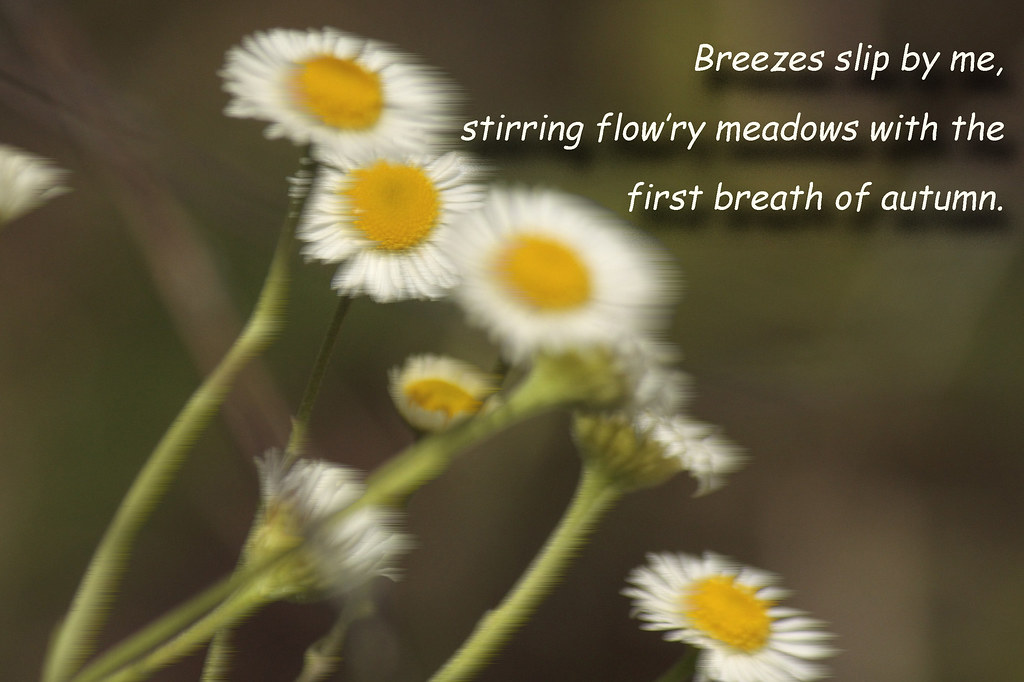
Breezes slip by me,
stirring flow'ry meadows with the
first breath of autumn.


For some reason, I got my haiku flowing this week. That hasn't happened in a long, long time. I enjoy sharing with all of you and I love doing the OSI blog with Sandy. I love writing haiku, also, but it is extremely challenging for me. One way I become inspired is by reading haiku at my leisure. I have been reading and re-reading Classic Haiku: The Greatest Japanese Poetry from Basho, Buson, Issa, Shiki, and Their Followers (Eternal Moments). It is a beautiful book that I keep by my bed.

But recently I ran across another book of haiku in the library and I enjoy it so much that I will have to buy it: Haiku: This Other World by Richard Wright. Wright is correct: haiku does create another world (at least for me).  The haiku in this book are more modern with both urban and pastoral themes. The notes and afterword in the back are comprehensive and valuable. I wanted to share this title with you in case you have missed it at the library.

Writing haiku helped Wright mourn. Wright's daughter writes in the Introduction that haiku is "a form of poetry which links seasons of the soul with nature's cycle of moods." I know that poetry, for all of us, heals and expresses our souls. I want to share a couple of my favorite Wright haiku here:

#728
Beneath pale stars,
Breathing wet on cattle horns,
A faint winter fog.

#721
As my anger ebbs,
The spring stars grow bright again
And the wind returns.

#716
With mouth gaping wide,
Swallowing strings of wild geese, —
Hungry autumn moon.

I can't share more with you. There are too many that fascinate me. Thank you for reading this rather long post. I hope you all have peaceful and beautiful week! 
Click & find more poetry!


_/\_/\_

Sunday, June 27, 2010

Macro Monday: Ebony Jewelwing

Calopteryx macula
Click the photo to view it larger in a new window.
A pair of ebony jewelwings is nearby, poised on a broad-leaved overhang of fox grape and silky dogwood, she resting her white-tipped dark wings and he his jet black ones above their burnished-metal bodies . . . fish and damselflies, jewels set in a sunlit run of the brook at midday.
from Following the Water, David M. Carroll
Click here to view more wonderful macros.


_/\_/\_

Wednesday, June 09, 2010

Turtles and Otters

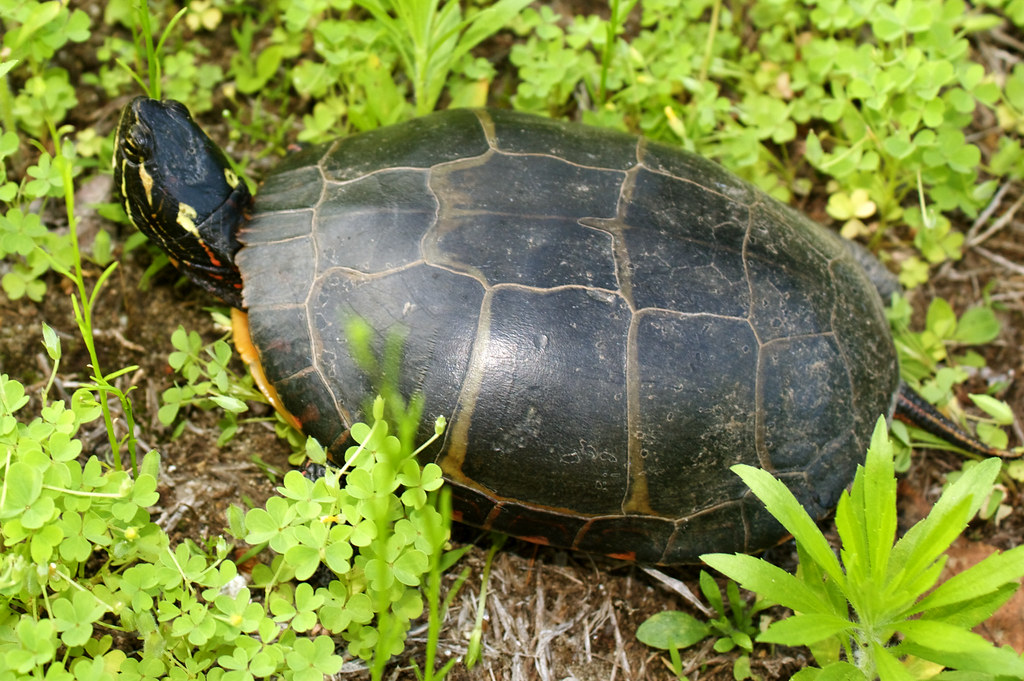
Eastern Painted Turtle

Two articles came to my attention this week and I want to share them with you.

The author of the first article, Christine Nelson, lives in central New Hampshire. I met her when I lived there and she is a lovely, observant woman who works hard in her community for Relay for Life. She often writes for the InterTown Record, a local weekly paper to which John and I subscribe. She wrote the lyrical piece that follows and has given me permission to reprint the article here with her name and e-mail address. Please drop her a line — she’d love to hear from you! Her article appears in the Tuesday, June 1, 2010 edition of the paper on page 17.

Why Did the Turtle Cross the Road?

The week while driving our roads, I have encountered a number of turtles making a move to cross the road. It occurs to me that they are not happy on the plush side of the road they are leaving. The one I saw most recently was the ever popular Eastern Painted Turtle (Chrysemys picta). The head is a deep shade of green with yellow stripes and one spot each directly behind the eye. The shell is smooth and criss-crossed with lines making uneven sections across the top. There seemed to be spots of red on the edges of the shell as well. The State of New Hampshire lists this turtle as widespread across the state, with lesser populations in the northern parts of our state. The one I saw on my road was leaving the wetland area and headed to a nice sandy patch across the street in the woods.

From my reading, and without having to “investigate further,” I deduced she was a mom looking to make a nest. She wasn’t too big, maybe about six inches in diameter, but she was making good speed in turtle inches per hour. I was concerned that she would get run over and decided to turn around and see what I could do to keep the road mortality number down and make sure she got across. To my horror, before I could turn around, a car came speeding up the road. Fortunately, the car passed right over her without crushing her. I was more determined then to help her finish her journey. I turned around, pulled just behind the determined mom-to-be, and flicked on the flashers of my car lights. I got out to watch her, remembering not to help her by touching her but just observe and protect. Me — the Turtle Police! As a car slowed down going past, I heard a child yell to the driver, “Look, Mommy, it’s a real turtle!” It’s nice to know the smaller things in life are still appreciated by the smaller humans.

I leaned against the front of my car and noticed that there were “hitchhikers” on the back of mom’s shell. They looked like slugs. I felt the urge to “scrape” them off, but I resisted. A friend stopped and asked which species I was helping along this time. We had met some 20 years ago, with me doing just that after having moved here the year before. As the momma made her way to the woods and I made my way home, I wonder if she found a comfortable nesting area and if I will encounter her youngsters in the near future.

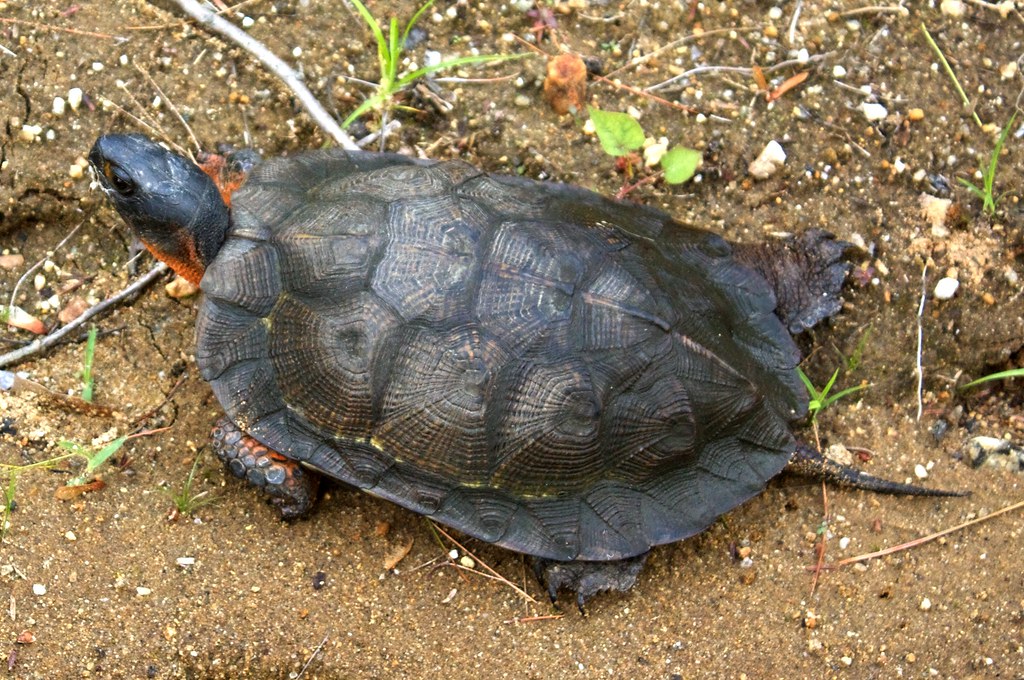
Last spring in New Hampshire, John and I each rescued turtles — he rescued an Eastern Painted Turtle like Christine did, and I saved a wood turtle (click the links to read the articles). I don’t know if it is bad form to handle the turtles that you rescue. John and I brought them home to the ponds. And the naturalist I quote below actually notches the turtles he finds in order to identify them in future years.

The photograph above is of one of the otters in our beaver bog. It was taken with my 18-55mm lens, so it is not a good photo. The next time an otter comes through here (they only pass through; they do not live here because otters and beaver do not coexist well), I will use my new lens to get real photos. I love otters. They are fun to watch. And they are cute. But there is a dark side . . .

The following excerpt is from a book I am now reading: Following the Water: A Hydromancer's Notebook by David M. Carroll. It is a poetic book about Carroll’s explorations in his bog in New Hampshire. In the very first chapter, Yearbreak, page 6:

I raise my head and look upstream. Can I be looking at a wood turtle? The shape is far enough ahead that I cannot be certain, and my disbelief that a turtle would be so exposed, up on an open, muddy mound of stream bank, surrounded by snow and ice, prevents definite recognition. But as I advance I begin to read it as a turtle, and the reading is disturbing. The angle, something in the way that so-familiar sculpted shape is settled, is sharply out of keeping with any search-image I have. Wood turtles always place themselves in harmony with their surroundings, with the configurations of the earth or stream bottom on which they have settled or over which they move. This gestalt has struck me as unfailing. Except when they are compelled to cross a road or open law, wood turtles are never out of place.

Even from some distance, as I wade, looking into the turtle’s face, I know that something is terribly wrong. Where is that light in the eyes, the light of life and reflected day that shows before the gold-ringed eyes themselves can be clearly seen? What are those shadows, dark pockets on either side of the jet black head? Where are the legs, black-scaled, with vivid flashes of red-orange skin color that should be part of the pattern? Riveted by this troubling vision, I never look away as my feet find their way over the streambed and I wade to the turtle. A profound confusion comes over me, the elation of seeing that first turtle up out of the water at the end of hibernation mingling with a reality I do not want to see. The turtle’s eyes are closed, her legs are gone.

I pick her up. Her shell is so familiar, that shadowy umber brown carapace with yellow-gold striations, like faint flecks of sunlight. Tiny notches I have made along her marginal scutes identify her. An adult female, she is one of the wood turtles I have documented along this brook, where I have been recording them in notebooks over the past twenty years. Her head does not move, there is no sign of life in her tail as I move it from side to side. A few tiny bubbles appear at her nostrils, perhaps a last flicker of life. All of her right front leg is missing and the lower half of her left front. Her right hind leg has been eaten away from the knee joint down, and her left hind leg is only a shaft of bone to where the knee joint was. How did she get up here? My crowded thoughts and questions settle out, and I realize that of course she could not have climbed up onto this mound but was left here by the otter who discovered her in her winter-hold in the stream and wrestled her onto land to work at her, force out at least a foot to eat from the fortress of her shell. There is not one tooth mark on her carapace or plastron; predators know there is no biting through the shell of a wood turtle this size.

A sense of foreboding comes over me, as it did five years ago when, at this same seasonal moment, I discovered an adult male who had lost both front legs and then a six-year-old who had been bitten through and killed. I am familiar with reports by others who study turtles of heavy losses on colonies of painted and snapping turtles by otters preying upon them during their hibernation. I found no further evidence of such predation that year, but I wonder what I will find when the wood turtles here begin their first streamside basking of this new season.

I set the turtle back down. The temperature will drop well below freezing tonight. If the least flicker of life does remain within her, it will be extinguished. A life of decades, likely more than half a century, has come to an end. Borrowed stardust is at length returned, and the flame that burned within passed on. In silence, the water flows on by.

Wood Turtle


favicon.ico Eastern Painted Turtle Set

favicon.ico Wood Turtle Set
diigo it


_/\_/\_

Wednesday, March 03, 2010

VPR News: Mosher Releases ‘Walking To Gatlinburg’

VPR News: Mosher Releases ‘Walking To Gatlinburg’


I can't wait to read this new one and to see Mosher again. His last book, On Kingdom Mountain: A Novel, was a jewel and the new book, Walking to Gatlinburg: A Novel is supposed to be his best yet. Mosher is a resident of the Northeast Kingdom in Vermont. He lives in the town next to Barton.


diigo it
_/\_/\_

Tuesday, February 16, 2010

Making Bread

French boule loaves of rye (with the seeded top)
and European Peasant loaves.
Boule is a traditional shape of French bread
that is like a squashed ball. Boule means ball in French.


If you know me, you know I make bread. It has been a lifelong chore. Bread making was never especially enjoyable, but it was necessary — especially for my father. I started by grinding my own wheat when I was about 10 years old and making 8 loaves a week of whole grain bread for the family. (This is why I dislike whole wheat bread now.) The bread making habit stuck and I have continued to make bread all these years. I've done it manually, in bread machines, in antique bread buckets that screw to table tops, and in standing mixers.

Lately I have not liked kneading bread because of the damage in my hands from using computers too much. So when I read about the new no-knead artisan breads in the Kind Arthur Flour blog, I immediately tried the new bread making methods.

Now, besides our daily bread at home, I make the communion bread from these no-knead recipes. I also made 20 loaves for a luncheon at church for 40 people. However, only 20 people actually came to the luncheon so the unused loaves that I made were sold at $5 a loaf and $81 was sent to the UCC Haiti Relief Fund.

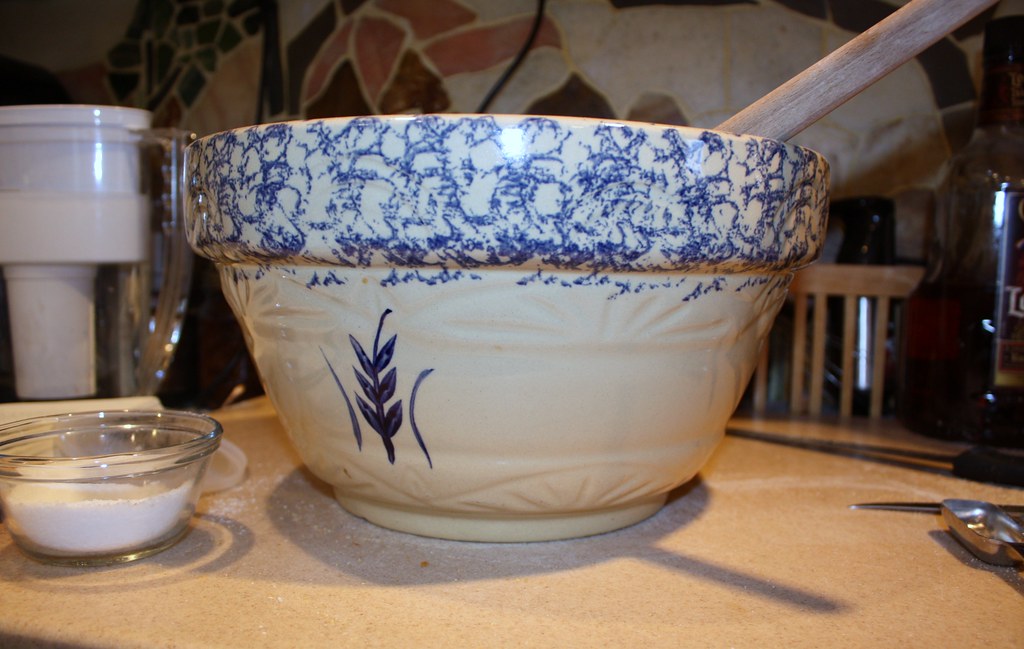
An aside: the new bread recipes from Artisan Bread in Five Minutes a Day: The Discovery That Revolutionizes Home Baking allow me to use my huge bread bowl and dough whisk. (Buy the dough whisk — it's worth the $15.) I haven't used them for years because I wouldn't knead the bread and I would use bread machines or mixers to knead it. But now I can stir the dough and let it rise in my beautiful bowl.

My bread dough bowl

My dough whisk after stirring English Granary bread dough.

The no-knead recipes from this book and from recipes from other bakers on the Internet (see also here and here for more) require new ingredients and equipment. Not much, just a bit. I am fortunate that John could make me a baking stone for the oven. It took him five minutes! He also had side less cookie sheets that I use instead of a pizza peel. I seem to require a lot of parchment paper to slide these loaves into the oven, but I'm trying to cut back on that expense. We also bought two food quality plastic containers that each hold 8 quarts to store the dough in the refrigerator. We bought them at Sam's Club. Don't get the bins from King Arthur because you pay three times the price of Sam's Club. The bins cannot be air tight because the yeast gases would make the bin explode. But to store dough in the refrigerator, the dough has to be covered or it will dry out. John solved that problem by heating a thin wire until it was red hot and then pushed it through the lids of the bins (it slipped through the plastic lids like butter). The hole is invisible but is big enough to to let yeast gases escape safely. If I ever want the bins to be air tight, I simply need to plug the tiny hole with a tooth pick.

The new ingredients are not required because of the no-knead method. They are required because the recipes are Old World, not American. They are authentic tasting recipes that are way better, I find, than the health food loaves I would make when requested. My creativity is sparked by these recipes and I look forward to creating new tastes and shapes of loaves. The textures of these breads are fascinating and the taste of the loaves is rich.

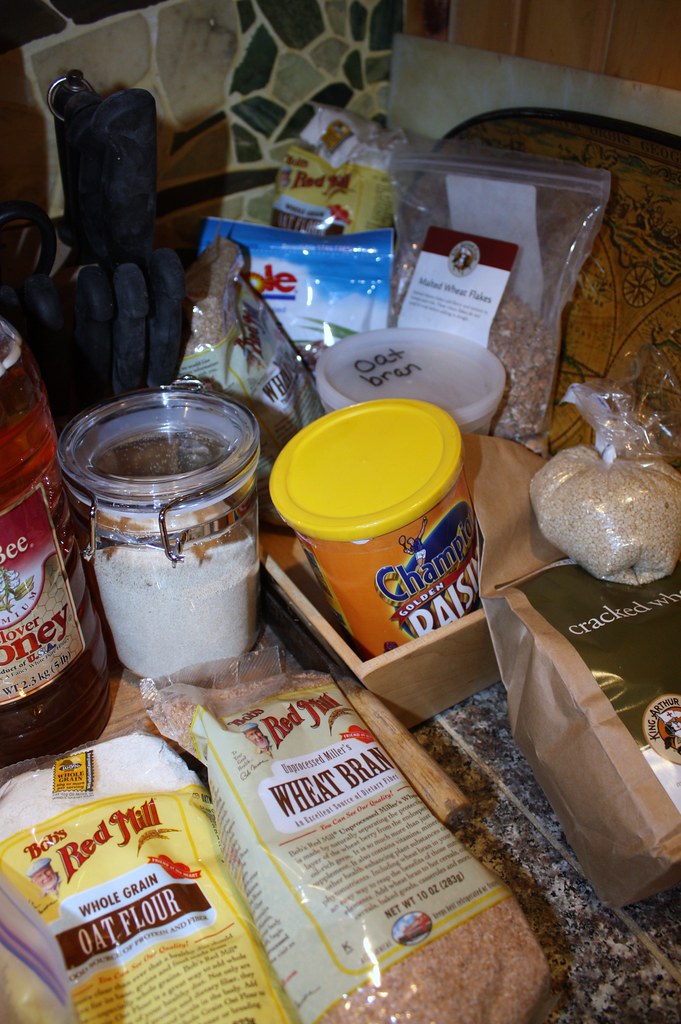
Below is a photo of one of my piles of bread gear in the kitchen:

My bread gear

In this photo are oat flour, wheat germ, wheat bran, oat bran, raw seseme seeds, wheat berries, cracked wheat, my yeast jar, raisins, dates, malted wheat flakes and other stuff. Some of these things I get at the Kearsarge Coop but they don't carry a lot of things they should carry, are very expensive and are often grouchy. The grocery stores now carry a lot of this stuff. I only had to go to King Arthur for the malted wheat flakes and the cracked wheat. I also have huge amounts of King Arthur unbleached all-purpose flour, whole wheat flour, white whole wheat flour, rye flour, and corn meal.

I should have also gotten malt powder but I forgot. So I am now making my own. I searched the Internet for a malt powder substitute and found that I could make my own malt powder with wheat berries. I happened to have some wheat berries in my bread gear, so I am processing them now for malt powder. Click this link at jugalbandi blog for directions in how to make your own malt powder.

Wheat berries soaking in water for 24 hours.

I am not entirely sure why malt powder is used in some of the bread recipes. But it is a sweetener, helps the leavening, and improves the taste, color and texture of the bread (or so I read). According to Wikipedia, "malting is a process applied to cereal grains, in which the grains are made to germinate by soaking in water[1] and are then quickly halted from germinating further by drying/heating with hot air.[2][3] Thus, malting is a combination of two processes: the sprouting process and the kiln-drying process. These latter terms are often preferred when referring to the field of brewing for batches of beer or other beverages as they provide more specific information."

When Anna visited us two weeks ago, I was in the middle of baking for the church luncheon. She went home with about 10 loaves of artisan bread. She prefers whole grain breads but I also sent home a couple of white and light wheat loaves for Aaron. They loved it all!

When John and I went to the King Arthur store this weekend, I impulsively bought the second bread book by Hertzberg and Francoise: Healthy Bread in Five Minutes a Day: 100 New Recipes Featuring Whole Grains, Fruits, Vegetables, and Gluten-Free Ingredients. Don't buy impulsively! I paid $27.50 for a book that amazon.com carries for $18.47. I am kicking myself now. Click my links here for either (or both) books and you will be having as much fun as I am baking bread.


Hertzog & Francois have a great blog at Artisan Bread in Five Minutes a Day. It has updates, new hints and tricks and corrections. The authors will personally answer any questions that you have and cannot find answers to elsewhere.

A final note . . . John is not the biggest fan of these artisan loaves. For him, I still make a wonderful traditional loaf found at http://www.kingarthurflour.com/blog/2010/01/28/sandwich-bread-fit-for-the-king/.

Technorati Tags: Del.icio.us Tags: Flickr Tags:

diigo it

_/\_/\_

Thursday, February 11, 2010

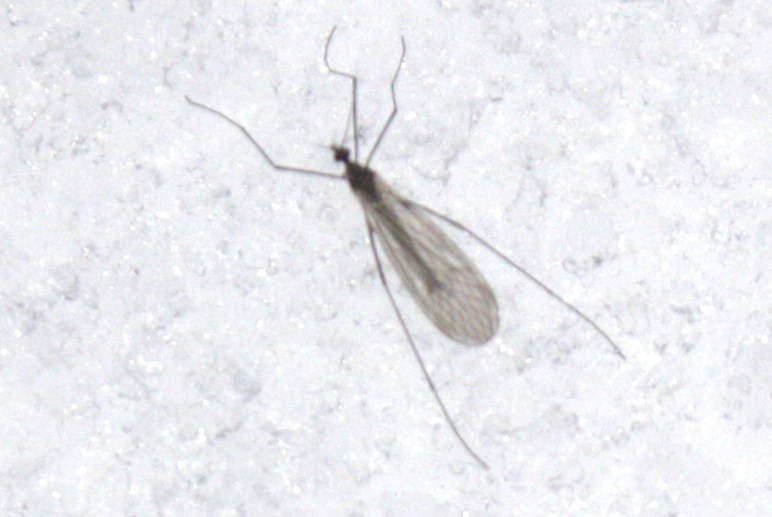
Winter Insect

Yes, they do fly in winter. I don't know what this is. It landed in front of me while I was snowshoeing. I have not submitted this guy to bugguide.net as of yet. I am waiting to see if I can figure it out its identification myself as I read Winter World: The Ingenuity of Animal Survivalby Bernd Heinrich. I have just begun the chapter on insects in winter. Heinrich is one of my favorite nature writers . . . grab the book from the link below if you live in the northern tier of the United States. Read it!


diigo it

_/\_/\_

Wednesday, September 16, 2009

Summer World VI: Digger Wasps

 Summer World: A Season of Bounty page 72:

. . . I thought I saw a light-colored piece of straw about half a foot long “flying” horizontally and then hovering in midair. That caught my attention — I looked closer and saw a black wasp that seemed identical in form to a mud dauber, and it was carrying an object. I jumped up in my excitement, and the wasp was spooked and flew off. The proof eluded me, but it dropped its “prey” onto the porch. I picked it up — definitely a long piece of dry grass!

Expecting the wasp to return, I waited. After about twenty minutes it did return, carrying another piece of grass. This time I was ready with an insect catcher net, and I snagged the wasp along with the grass it carried. The wasp was about 0.6 inch long, and the blade it was carrying was about 2.4 inches long. The wasp looked superficially almost identical to the mud dauber, but its body was black rather than black-blue and its wings were smoky-colored instead of blue-black like the mud dauber's. It was a different species of wasp, which I later identified as Isodontia mexicana. I also learned later that rather than making clay organ-pipe cavities for its nest and filling them with spiders, this wasp lines preexisting cavities with grass and fills them with paralyzed crickets or katydids.

Heinrich’s wife had first noticed the digger wasp (which is the common name for the wasp he describes) carrying a blade of grass but Heinrich, the professional biologist, had dismissed her observation: wasps don’t carry grass.  Heinrich soon learned he was in error, as we read above.

I remembered this section of Summer World: A Season of Bounty as I sat on our porch when a long, brown blade of grass flew near and then went into the tube of our folding chairs. Excited that I, too, saw the wasp, I got the camera, but found that photographing these wasps is difficult. Wingnut and I tried all summer and he finally got the shots of the wasp itself. Now I wish the tubes of the chairs were transparent and I’m thinking of asking John to make a digger wasp house of transparent tubes for next summer.

_/\_/\_

Thursday, July 30, 2009

Geekspeak I: Gender & Vocabulary

Last week I finished reading Geekspeak: A Guide to Answering the Unanswerable, Making Sense of the Insensible, and Solving the Unsolvable — or How Life + Mathematics = Happiness. This is good summer reading because the chapters are short and comprehensible. This is Science Lite. The math is Xtra Lite. And much of the content is fun.

A database of over 100 million words was created from recordings of conversations taken by researchers in the 1990s. The researchers found out that "there are certain words that act as fingerprints, showing that a conversation is between two men, or between two women." These fingerprints are the three words most frequently used by men talking to other men or women talking to other women.


When two women speak to each other, the three words that they say most often are:
she
her
said

And when two men speak to each other, the three words that they say most often are:
fucking
er
the
Nuff said?

By the way, read chapter one, "Scrabbling for Words," to learn a quick method to determine the number of words in your personal vocabulary.
_/\_/\_

Thursday, July 23, 2009

Summer World V: Woolly Aphids

I have seen these tiny fuzzy white balls floating around every summer of my life — but I never paid attention to them. One sentence in Heinrich's Summer World gave a name to these fascinating and beautiful creatures: "A cottony white fluff ball drifts by on feeble wing beats — it's the migrating form of the woolly alder aphid. I don't know where it's going, but it is of the summer's last generation from wingless parents."

This is my last Summer World post. I hope these have motivated you to buy this book and see the world about us more clearly.


Technorati Tags:
_/\_/\_

Summer World IV: Crane Flies Dance

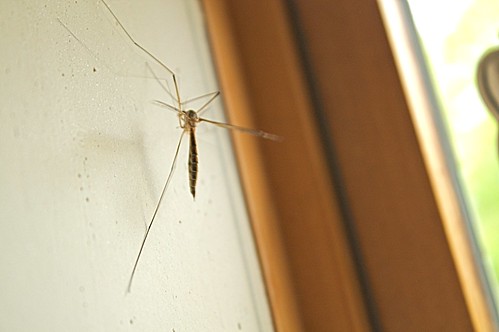
Crane fly (mosquito hawk) from June, 2007 in Barton, Vermont

Dancing crane flies in Wilmot, New Hampshire, June 2009

Do you remember the photograph above of two crane flies enjoying each other's company? There have been many crane flies in the house this summer. That is good; they eat many mosquitoes and with the rains all summer this year, we have many mosquitoes. But in Summer World, Bernd Heinrich gives the life of the crane fly poetry. It was the summer solstice in Maine, 2007. Heinrich explains that while June 21 is the beginning of summer for us, it is the middle of summer for many species of animals. And the day was so lovely that it was sufficient cause for dancing to celebrate the season. Heinrich's description of the crane fly dance describes exactly what happened in the beginning of summer with the crane flies in the bathroom:
Our outhouse is open at the front, and it faces deeply shaded sugar maple woods. The dancers — two or three dozen of them — each have six long, spindly legs. They jitterbug up and down and forward and back in a dark corner just under the roof, and they are worked up to a frenetic speed. Undoubtedly they are expert performers. They ought to be. They've probably been doing one or another version of their act for more than 225 million years, since the Triassic period. And indeed, their performance doesn't disappoint.

Most of the dancers are single, but several have partners to whom they are firmly attached — by their genitals. The members of a pair face in opposite directions, and when — more often than the singles — they come to rest, they dangle with one holding on to the ceiling with its front legs while the other dangles below.
Crane flies are relatives of mosquitoes. They are called crane flies because their legs are so long. Heinrich says that their bodies are 1/3 of an inch long yet their legs are three times longer (1 inch). And if you touch a leg, it could fall off. Dropping legs is a defense against predators. The sexes can be differentiated by the ends of their abdomens. A thicker, pointed abdomen is female and a thinner, blunted abdomen is a male.

The summer dance that Heinrich describes is mostly performed by the boys. Once a boy attracks a girl with his dance, they mate (my first photo) and then they stay together for hours. In his sample, Heinrich's male crane flies outnumbered females by 28:2.

I would so enjoy reading other local observations from other Summer World readers. I will have a couple more of my local observations in the days to come. Meanwhile, click on the book below and read it!


Technorati Tags:
_/\_/\_