Showing posts with label John. Show all posts

Sunday, November 20, 2022

My Jagged Ambush Bugs Are Yellow

Mating Jagged Ambush Bugs (Phymata
on John's finger.

I've probably put too many photos of jagged ambush bugs in this post, but that's because they are a prize when you try to photograph insects. The Twitter photographers all remind people that the season for them has opened when goldenrod blooms. Like we need a reminder? We don't. We are all waiting. They are nearly invisible to see because they are tiny, barely move, and they can change color. I've seen green, brown, and yellow. I've read of red, white, and black ones, and I'd love to find those but I doubt I ever will. I have few red wildflowers here. I seem to find the yellow ones. Jody seems to find the green ones. Why? It may be that my flowers (wild) are mostly yellow: goldenrod, black-eyed susan, fleabanes. But Jody's are cultivated flowers that are in all colors. 

Mating Jagged Ambush Bugs (Phymata
on John's finger.

I did find this about colors on the ambush beetles the article "Ambush bugs match their habitat using choice and colour change" at Functional Ecology:
In our study, we surveyed whether ambush bugs found in the wild tended to match the flower color they were found on, and if this was correlated with how often they had prey. In lab experiments, we followed up by providing ambush bugs a choice between yellow and white flowers, as well as keeping individuals on white and yellow backgrounds to see if they would change colour over time. We found that in the wild, ambush bugs were whiter on white flowers and yellower on yellow flowers, and that better matched individuals were found more often with prey. All ambush bugs in the lab preferred yellow flowers, but this preference was especially strong for individuals who were found on yellow flowers in the wild. Finally, we found the first experimental evidence for color change in this species; ambush bugs were able to become more yellow over time but not whiter, and this was exaggerated when they were kept on a yellow background.

We now know that ambush bugs use a combination of color change and choice of habitat to optimize their ability to catch unsuspecting prey. Overall, this study improves our knowledge of how background matching is achieved in organisms using a combination of complex mechanisms.

Mating Jagged Ambush Bugs (Phymata
on John's finger.

John, my late husband, would touch anything. Brave or foolhardy? I vote for brave. He held the mating pair of ambush bugs for me because they kept wandering out of the tripod-based viewfinder and he could keep them still. They will bite, but he figured they were too busy. 😉 We always called these shots bug porn.

Jagged Ambush Bugs (Phymata)

But I do photograph them in the wild without human aid. These bugs sit on flowers and wait for prey to come to them. They don't really move and hunt. So if you can see them, they can be fun to photograph for hundreds of focused shots. They use those fat front legs to hold on to prey, inject it with a venom that paralyzes it and then sucks its insides out. Ouch. 💀 Poor bugs.

Jagged Ambush Bugs (Phymata)

 The males are much smaller than the females.

Jagged Ambush Bugs (Phymata)

Some people keep ambush bugs as pets. I really have to suggest this to Jody. After all, we have raised, separately and together, flea beetles, lady beetles, moths, and butterflies. Why not some ambush bugs?  

Jagged Ambush Bugs (Phymata)

Try to find some ambush bugs next summer. Or assassin bugs (but they run after prey so are more difficult to shoot). They are related. Or not. Entomologists disagree, but are usually in the same family. There are at least two species in Phymata that cannot be differentiated in photos. 

Photo Sunday at Norah Clark

 _/\_/\_

Tuesday, October 04, 2022

Insects on Jerusalem Artichokes

Jagged Ambush Bug (Phymata)

Every bug hunter I know keeps their eyes out for Jagged ambush bugs in late summer when the goldenrod blooms. They are so bizarre! They even have different appearances, like chameleons, depending on what the plant they settle into for their ambush. I've seen them bright yellow like black-eyed susans. Jody and I were very surprised to find this on a Jerusalem artichoke leaf.

Asian Lady Beetle (Harmonia axyridis)

As I prepared an earlier post about Jerusalem artichokes, I saw the different species of insects I had found on them. I thought it would be fun to collect them in one post.

Tiny unidentified wasp

Jerusalem artichokes are late bloomers. In Barton they bloom just before and after the first frosts. We've had many heavy frosts so far this October and late September. That's why I wanted to have these plants! But that is not what happened (see the article linked above).

Common Eastern Bumble Bee
(Bombus impatiens)

 Aphids (Tribe Macrosiphini)

There weren't as many insects as I had hoped to find on the artichokes. That could be a function of their height, however, which prevented me from looking at them often. And usually, I never even checked them for bugs. Because I couldn't.  🤷

_/\_/\_


The Never-ending Artichokes

Bombus impatiens on
Jerusalem Artichoke (Helianthus tuberosus)

John and I tramped around the edges of a very large marsh in Barton in 2013. John dug up three Jerusalem artichoke plants and put them in one of our large gardens near the driveway. They were native, not protected, and I thought they were cool. We could eat the bulbs and have pretty sunflowers for insect photos late in the bug hunting season. 

They flourished. Here is a photo of John with them the next summer. But there were six. John was 6'2", and they were taller than he was. My hopes for insect photos were now gone since I could not reach the blossoms. If John pulled a flower to me, the insects ran away.


I began to be concerned, then upset, as they flourished more and took over the day lily garden I had so carefully planned and planted. In a few years, the lilies disappeared and these artichokes owned the place. They also took over an adjacent milkweed garden on the side of the garage that was twice the lily garden area. 

To keep them under control, John dug many, many bulbs, processed them and froze them. My plans for enjoying their bounty disappeared when I learned I did not like the sunchokes. 

One year, they appeared out front at the front door. An entire bunch of them. A couple of years after that, they appeared near the brook in the side yard. That bunch really flourished. The photo below shows the brook artichokes this year. The thicket is so dense that Lucy goes around them instead of through them to get to the brook. 

The brook is behind there. Somewhere.

I don't turn to memories often because it hurts when your only desire is for your love to return from the dead. But this year, I was wondering how John would react to the never-ending artichokes. My frustration with him about them has disappeared and I smile and realize the story is humorous, not sad. 

The blog hops, like Happy Tuesday, have helped me recover from the worst of my grief and bring out my memories. If I can smile at this old story, I can move forward. Thank you for that gift.


Wednesday, September 28, 2022

A New Furnace

The new furnace waiting to get into the house.

I own a big 121-year-old iconic Vermont farmhouse that has been added to decade after decade. It is drafty and cold, with granite boulders as a foundation that were quarried from Barton Mountain behind the house. The original part of the house was built with no windows at all on the north side to keep out the cold! My husband was renovating the house, but he only was half done when he died.

I've had years of severe problems with the old furnace. It required $1,000-$2,000 of repairs each of the past two winters. With the cost of heating fuel the highest I can ever remember, this is causing severe hardship. This summer I was finally able to get a new furnace. The problem was that all the home heating companies here are swamped with furnace repairs and replacements, so I had to wait in line. Monday, September 26, was the day it was finally installed!

The old furnace was a combination wood and oil burner. Most people here have these, but I didn't want another one. John burned wood for 10 years here with wood harvested from our land. It was a tremendous amount of work. 

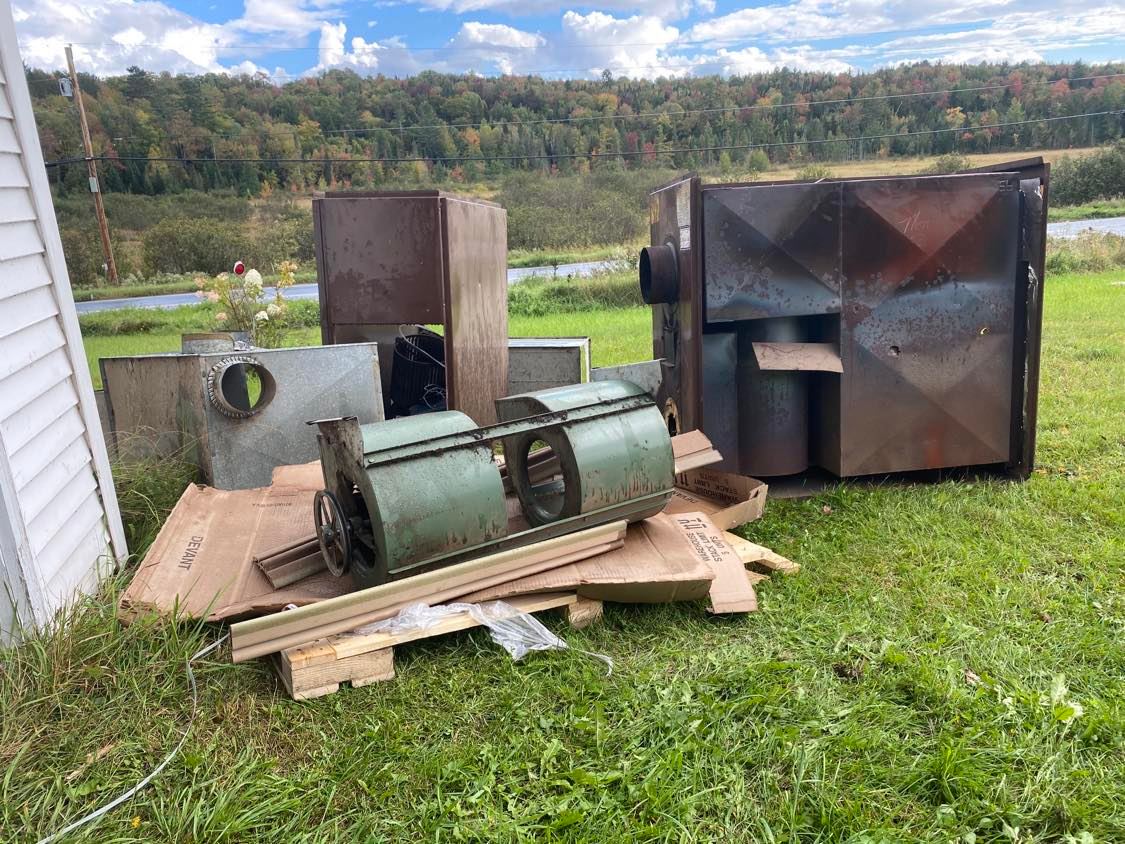
Here are photos of the old furnace that the technicians somehow managed to drag out of the cellar. It had holes rusted through it. The old cast iron fire box was in bad shape. My husband had repaired a lot of it during his life. 


It took two days for them to install the furnace, balance the heat ducts, replace some duct work, and make a new cold air intake in the kitchen. The upstairs is heated by gravity: in the old days, they cut holes in the downstairs ceiling and let the heat rise. And the last addition to the house had no heat at all until John ran a duct over to it. 

I love this furnace. It is so quiet that when I came home from school today I thought it had stopped running. There are no more roaring, cracking, or screaming sounds from the cellar. The heat is even throughout the house now. My new thermostat is digital and tells me the room temperature in real time. I'm running it cooler now, set to 65°F (18°C) all the time. I'll see if that is sufficient when it is -30°F (-34°C) this winter. Well, I'd rather not see that, but it will happen. 

I finally found my lost step stool
that belongs in the kitchen!


For Thankful Thursday, I am thankful for a stress-free winter with no worries to what I will find when I come home from school. Good riddance, old furnace!


Thankful Thursday at
Brian's Home

_/\_/\_

Tuesday, August 16, 2022

Wordless Wednesday: Our Wedding

May 29, 2010
Crystal Lake
Barton, Vermont

Photo by Aaron Kotowski

_/\_/\_


John Missed Finding a Bee

Orange-tipped Wood-digger bee
(
Anthophora terminalis)

On June 22, 2020, I found an Orange-tipped Wood-digger bee (Anthophora terminalis). You have to understand a few things to understand how much excitement this caused. John, my husband, and I found bugs both common and uncommon in Orleans County. He had great eyes and I worked the camera. We hiked our land as much as possible to find more. But he died. And now, because of arthritic knees, I haven't been able to walk about searching for bugs like we used to do. With a cane or walker and a chair, I can set myself down near promising areas and shoot. It's actually a good way to get a phenology and inventory of creatures that are in a very small area. You can find dozens if you sit long enough. But without my beloved John, it is as sad as it is comforting to go on a bug hunt.
 
The bee in the these photos settled in front of me for a brief moment and I managed to get eight shots off before it left, only two of which were usable. I knew it was not a bumble bee but had no idea what it was. I always submit my insect shots to iNaturalist, where members (community scientists and professional scientists of all kinds) identify plants and animals. When a renowned Vermont bee expert identified my bee that day, I whopped. Loudly.
 
No one before June, 2020, had found this species so far north in Vermont. I submitted the find to bugguide.net for confirmation, and it came in overnight from a world-renowned international bee expert.
 
These photos now document the first reporting of this bee in Orleans County. iNaturalist had eight other sightings in other Vermont counties that season. I am in the company of the great community scientists that I so admire. 
 

I was sad that John missed out on the excitement. He was such an enthusiastic part of these quests, and he would have been proud of this find. But despite his death, my knees, the pandemic, and the tragedy of fellow Americans suffering under racism and hate, I have learned that sometimes something wonderful like this can still happen. Sometimes, I can smile again.

Read more Nature Notes here.

_/\_/\_

Saturday, August 13, 2022

Flashback Friday on Saturday: Lucy and John

As a pup, Lucy immediately bonded with my husband, John. After all, he was the fun person because he worked outside in the woods and fields all day. She would help him with sticks, guard him from things that could come out of the woods, and just have a grand time. Here, they are going into the woods . . . I forget why after nine years. John passed six months before the pandemic and lockdown. Lucy and I are still adjusting to our loss. We will be okay because we have each other and Nell. My children are invaluable, as is my job, in healing. The memories are both sad and sweet. Flashback Friday will be a way for me to finally talk about these memories.

Lucy is 1 year old.
August 1, 2013

Click here for more Flashback Friday

_/\_/\_

Sunday, August 07, 2022

Photo Sunday: Mechanical

Our cider press, made by John in 2015. He used ironwood from our land for the sides and "feet" and birch for the slats. He left the ironwood in its natural state because it's tough wood and I love it like this. I can't remember where he got the mechanical parts. It’s a work of art, and it made all of our cider when he tended the orchard. I am keeping this forever despite several offers to "take it off my hands."


Click for more Photo Sunday


_/\_/\_

Monday, March 26, 2012

Beavers on the Move

Clearing Out a New Beaver Dam  (1 of 9).jpg
What you would have seen when walking in from the road.

Last October the beaver from the bog had some sort of population explosion. The kids had to move out and make their own house. They chose to move across the road to our side. There is a huge culvert that drains water from a low lying grove of tamarack and apple trees. It is less than a quarter mile from the house. John noticed in October that the area was flooded. Deeply flooded. So he went to check it out. That's when he found the new beaver dam across the culvert. The new pond was about four feet deep and filling quickly. We would have a huge problem if there was a heavy rain or if the future finished dam broke. It could wash out our driveway, the culvert and the road..

Clearing Out a New Beaver Dam  (8 of 9).jpg
John manually clears out the dam from the culvert.
He is standing on top of the new dam.
Note those 6 foot tall fence posts marking the culvert.

Clearing Out a New Beaver Dam  (6 of 9).jpg
The new beaver pond.

John spent a lot of time and effort in clearing the dam from the culvert. He did it one Sunday morning and for a few weeks after that, once a week, because the beaver kept repairing the damage. The beaver seemed to give up at that point and did not rebuild.

But after nearly six weeks of quiet, they rebuilt the dam. This time, they built it deep inside the culvert, under the road, where neither John nor his tractor could reach it. John then called the town road agent, Clem, who had installed our culvert. Clem sent the town road crew that very day. They used the town's huge backhoe and hauled out the new, heavily fortified dam. Then they installed a heavy road grate to prevent the beaver from ever entering the culvert again.

The Remains of the Dam (2 of 6).jpg
The new heavy grate blocking the culvert. Note those same fence posts from above.

Below are some photographs of the damage in the same area. We returned on a hike in December to see what was going on. The damage was quite extensive. The area was trashed (in a nice, beaver sort of way):

The Remains of the Dam (1 of 6).jpg

The Remains of the Dam (4 of 6).jpg
This is what that new beaver pond looks like now. It is drained.

The Remains of the Dam (3 of 6).jpg
The remains of a lodge that was being built behind the dam.

The Remains of the Dam (5 of 6).jpg
Many trees were only partially cut or were being considered for cutting. This tree will die.

The beaver may have been discouraged. They may even have despaired. But they were never threatened. After the town blocked the culvert, they continued to cut down trees on both sides of the road and built a new lodge where it should have been built: in the beaver bog. This is the fourth lodge across the road now. It has new canals and trails, and new log slides going into the water. I'm glad the trees, such as they were, are gone, because now the view of the bog is clearer.

The New Lodge (1 of 1).jpg
The new lodge. Where it should be.

The funniest tale of these beaver has not yet been told. In January, I went for my monthly hair appointment and heard the strangest story from my hairdresser, who frequently drives by on her way into town. She was driving by one day about noon and saw by the side of the road a big beaver. He was waiting for her to drive by, looking both ways before he crossed. And what did he have in his mouth? A reflective road side marker that marks the culvert so that the town road crew does not damage it with the plows. The beaver had cut it down and was taking it home to decorate his lodge!

_/\_/\_

Thursday, March 01, 2012

Hiking the ROW Part 3

John, Oscar and Buddy Hiking on Barton Mountain-10.jpg
Buddy and Oscar will follow John to the end of the earth.

Unidentified Fungus-4.jpgAn unidentified fungus.

Porcupine Quills at the bottom of the cliff-1.jpg
Porcupine quills at the bottom of the cliffs.
John thinks the porkie may have fallen off of the cliff (and survived)
because of the number of quills that were there.

Views of the bottom tier of the cliffs-1.jpg
The very bottom of the cliffs.

Oscar Poses-5.jpg
Oscar poses for the camera.

Scarlet Waxy Cap Mushroom (Hygrophorous coccineus)-1-1.jpg
Scarlet Waxy Cap Mushroom (Hygrophorous coccineus)

Unidentified Fungus-1-1.jpg
Another unidentified fungus.

Oscar Hikes Vertically-1.jpg
Up the tree!

Insulators on the power lines-1.jpg
Insulators

Transformer on the Pole on the ROW-1.jpg
The transformer is nearly eye level because the slope of the
mountainside is so steep under the cliffs.

Well, that's all there is about this great hike. To view the other photos:
Introduction: Strangers on the mountain
Hiking the ROW: Part 1
Hiking the ROW: Part 2
Hiking the ROW: Part 3

_/\_/\_