Showing posts with label moths. Show all posts

Tuesday, November 16, 2010

Some Random Shots of Summer

Day lily
One of our day lilies

Day lily (1)
I am fascinated by the stigma

geometer moth (3)
A geometer moth

another brown geometer moth (2)
Another, different, brown geometer moth

Bumblebee on red clover (3)
Bumblebee on red clover

Flash flood damage
Five-toed raccoon track and tiny, round Zorro the Cat
tracks in the mud after a flash flood.

Little zinnia (1)
Dwarf zinnia that Ironman successfully planted

Little zinnia (3)
They bloomed continuously until the first heavy frost in September.

Carolina grasshopper (2)
A Carolina grasshopper

Yellow woolly bear caterpillar

HELP. . . Nashville warbler?
An unidentified warbler

Question Mark Butterfly (11)
Question Mark Butterfly

_/\_/\_

Sunday, November 14, 2010

Lost Larvae

As I match larvae and moths / butterflies, I have photographs of seven species for which I cannot find photographs of the larvae on the Internet. Perhaps one of you knows where a photo exists and could leave a comment and let me know. Thank you!

Name My Photo

White-spotted Sable Moth
(Anania funebris)

White-spotted Sable Moth (Anania funebris) - 4

Large Maple Spanworm Moth
(Prochoerodes lineola)

Large Maple Spanworm Moth (Prochoerodes lineola) - 31

Common Ringlet Butterfly
(Coenonympha tullia)

Common Ringlet Butterfly (13)

Bristly Cutworm Moth
(Lacinipolia renigera)

Bristly Cutworm Moth  4

Modest Sphinx Moth
(Pachysphinx modesta)

Modest Sphinx moth (3)

Unmarked Dagger Moth
(Acronicta innotata)

Unmarked Dagger Moth (6)

Dark Marbled Carpet Moth
(Dysstroma citrata)

Dark Marbled Carpet Geometer Moth (3)


_/\_/\_

Friday, October 15, 2010

Four (Sphinx?) Moths Part 2

Modest moth (2)

Remember the four moths that I had not identified awhile back? They are now identified and I was wrong about two. Two are sphinx moths, one is a dagger moth and another is a prominent moth. All four are new species in my photographic collections. I thought I should update the post so that my photographs would be properly organized and labeled.

The moth above is a Modest Sphinx moth (Pachysphinx modesta). It is called modest because it looks as if it modestly covers itself with a cape of lighter brown. You can find more information on it here at bugguide.net.

Unmarked Dagger Moth (6)

The moth above is from in the Noctuidae family (owlet moths). It is genus Acronicta (dagger moths), and species innotata or an Unmarked Dagger moth. I have a couple of other owlet moths in my collection, so I am please to be adding this. But it sure looks like a sphinx! You can read more about this pretty one here at bugguide.net.

Mottled Prominent moth - Copy

The moth above is a Mottled Prominent moth (Macrurocampa marthesia). This identification was a complete surprise for me. I don’t think I have any prominent moth photographs outside of this one (and its not a good shot!). According to bugguide.net “The original description of the species by Pieter Cramer was published in 1780 (some sources say 1779) with the name Phalaena marthesia Listed by some sources as Fentonia marthesia.” I don’t know about you, but I’m amazed that they were doing in 1780 what I am doing now!

Waved Sphinx moth (2) - Copy

The last moth, above, is the other sphinx moth. It is a Waved sphinx moth (Ceratomia undulosa).It is one of “our most common sphinx moths,” Waved “refers to the wavy lines on the adult's forewing.” Both quotations here are from the article at bugguide.net.

After being fooled as I was by thinking that all big, furry moths were sphinx moths, I reviewed what sphinx moths look like (and learned why I was confused): (source, of course, is bugguide.net):

Medium to very large. Body very robust; abdomen usually tapering to a sharp point. Wings usually narrow; forewing sharp-pointed or with an irregular outer margin. No ocelli or tympanal organs. Proboscis usually well developed, extremely long in some species that feed in flowers with deep calyxes. Antennae gradually thicken along length, then become narrower toward tip.

Larvae naked except for a few scattered hairs. Most have a prominent dorsal horn at the tip of abdomen (thus the name, hornworms).

Some are active only at night, others at twilight or dawn, and some, such as the clearwings (e.g. genus Hemaris - not to be confused with the Clearwing family, Sesiidae) feed on flower nectar during the day.

Some larvae (hornworms) do serious damage to crop plants (e.g. tomato, tobacco, potato). Hornworms are often attacked by braconid wasp parasitoids.

Other common names for sphinx moths are hawk moths (for adults) and hornworms (for the larvae or caterpillars).

I hope this clears everything up for all of us!

_/\_/\_

Friday, October 01, 2010

Problems with Bugs and Birds

Bristly Cutworm Moth (Lacinipolia renigera)

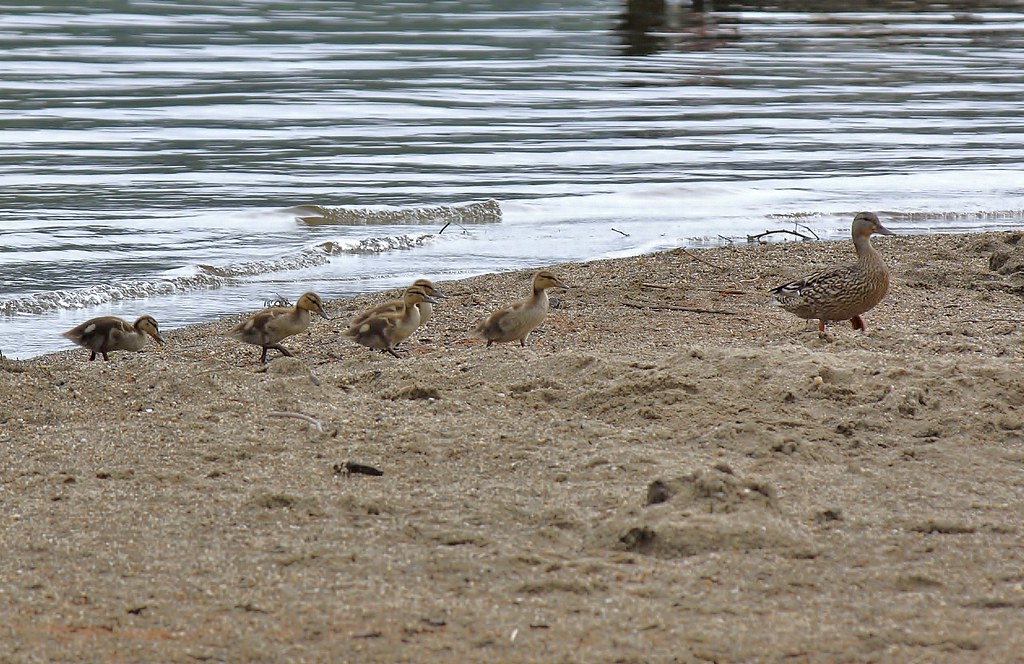
John and I have spent hours tonight trying to identify 1 bird, 1 moth and 1 bug. I began the evening after supper by opening photos from July 10. I am so behind in my editing! I remember July 10. I spent happy hours at the beach at Crystal Lake with the kids. They played while I read and photographed a duck family, a seagull and a jet skier. That night I went outside in the dark and photographed the moths and bugs on the house. And now, tonight, I had to identify these creatures.

The still unidentified seagull.

John was finishing installing the new doors in the sun porch as I was going through bird books and the Internet trying to identify the seagul above. I have never been able to identify a seagul from a book and so I was frustrated before I began my search. My mutterings lured John to the computer. He said how they will interbreed, which makes identification more difficult. And sure enough, the books have said how some individual seagulls are unidentifiable because of interbreeding. Yikes! And juvenile gulls (which I think this is because on a close zoom I see young pin feathers — but that could be meaningless) look different than adults. And first, second and third winter gulls all look different than adults and from each other! John sat at his computer and searched for over an hour. We both agreed that the bills and legs of gulls can help distinguish the species. But that didn't even help. After two hours, we gave up. If you know of a gull ID site, let me know! Please!

Firefly (Family Lampyridae, Genus Photuris)

The bug pictured above was next. I thought it was a beetle and instantly became agitated when no beetles at bugguide.net looked like mine. John looked at the photo and said, "Firefly!" And it was. But which species? According to bugguide, it could have been species Photuris or Photinus. The lighting on my photo is poor and many photos of Photinus look like mine, so identification was more complicated. But John and I counted stripes on the bug's back and I chose to identify my bug as Photuris. Photuris females are violent: "Females are noted to mimic the flash patterns of females of other genera of Lampyridae, especially Photinus. Males are lured in and consumed. They do this for nutrition, perhaps, and also to obtain chemical defenses from other Lampyridae (5) (6), (Eisner et al., 1997)." This identification only took half an hour! I was feeling lucky now — and I should have known better . . .

We came to the photograph of the moth that you see at the top of this post. By now, John was fully into this task with me. We knew the moth was a moth. So I searched for "brown moth with green spots" and for "black moth with green spots." I searched for "green moths." I figured from the silhouette that this was an owlet moth (and I was right!). But there are nearly 21 bizillion species of owlet moths and after a solid hour of viewing photos of owlet moths, I finally sent this photo to bugguide. I got a response within 10 minutes! This is a bristly cutworm moth! Total time spent on this moth: 2 hours.

We knew two other bugs and birds instantly: a caddisfly, a family of Mallards (duh) and a curved-toothed geometer moth (one of my favorite moths). The photos are below. I also found another online site to submit photos to: the North American Moth Photographers Group. They are doing some bizarre research (which I won't discuss here), and John and I spent quite a bit of time reading and looking at the photography. I may participate with that group in the future — if I have any time left over after identifying my bugs and birds!

Mallard ducks (Anas platyrhynchos)

Curved-toothed geometer moth (Eutrapela clemataria)

Caddisfly (Trichoptera)


_/\_/\_

Tuesday, September 14, 2010

Four Sphinx Moths


I haven't spent the time to identify these sphinx moths (just as I didn't identify the bugs earlier). To see the full size photo of each moth, click on the photo and it will open a new tab.


 _/\_/\_

Sunday, June 22, 2008

Love These Antennae


I have no ID for this moth but I love the photograph. Please click on it to view it full-size.
_/\_/\_

Saturday, June 07, 2008

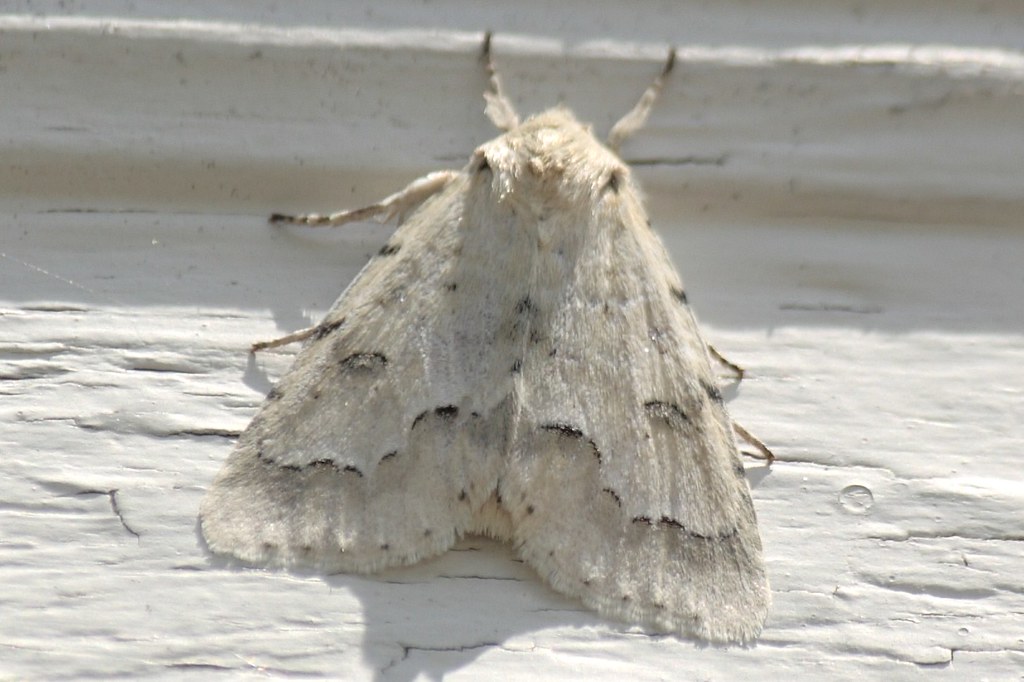
Camera Critters: Satin Moth

from About.com: Insects: Satin Moths:
The Eurasian native Satin Moth, Leucoma salicis, was introduced to North America accidentally in the early 1920s. The original populations in New England and British Columbia gradually spread inland, but predation and parasites seem to be keeping this insect pest largely under control. Satin Moths feed on poplar, aspen, cottonwood, and willow.

The Satin Moth has a unique life cycle with one generation each year. Adult moths mate and lay eggs in the summer months, and caterpillars hatch from those eggs in the late summer and early fall. The tiny caterpillars feed for a short time before they hide in a bark crevice and spin a web for hibernation. The Satin Moth then overwinters in the caterpillar form, an unusual way to survive the cold. In spring, they re-emerge and feed again, this time reaching their full size of nearly 2 inches before pupating in June.
This individual was on my porch screen on Friday night.
Thank you so much for visiting!
To visit more participants,
click the graphic above.

My other Camera Critters post features amazing butterfly and spider photos.

Technorati Tags:
_/\_/\_