Showing posts with label woolly bear caterpillar. Show all posts

Friday, November 19, 2010

Larvae Match-up Part 4

Eastern Tiger Swallowtail Butterfly
Papilio glaucus

Larva (photo: bugguide.net)

Adult (photo: this past summer)

Wheeler Mountain Road  (14)


Giant Leopard Moth
Pyrrharctia isabella

Larva Woolly Bear Caterpillar (photo: December 2006 in garage)

Pyrrharctia isabella (larval form)

Adult (photo: bugguide.net)


Eastern Tent Caterpillar Moth
Malacosoma americanum

Larva (photo: June 2009 in New Hampshire)

Eastern tent caterpillar (Malacosoma americanum) - 13

Adult (photo: bugguide.net)


Cabbage White Butterfly
Pieris rapae

Larva (photo: bugguide.net)

Adult (photo: New Hampshire, summer 2009)

Cabbage White Butterfly (Pieris rapae) - 2


Clouded Sulphur Butterfly
Colias philodice

Larva (photo: bugguide.net)

Adult (photo: New Hampshire, summer 2009)
Better photos from summer 2010 will be posted next week.

clouded sulpher


Owlet Moth
Family Noctuidae

Larva (one representation for this family)
(photo:
bugguide.net)

Adult (photo this past summer)

Owlet Moth


Curve-toothed Geometer Moth
Eutrapela clemataria

Larva (photo: bugguide.net)

Adult (photo: this past summer)

Curved-toothed geometer moth  1


_/\_/\_

Friday, November 27, 2009

My Woolly Bear Winter Prediction

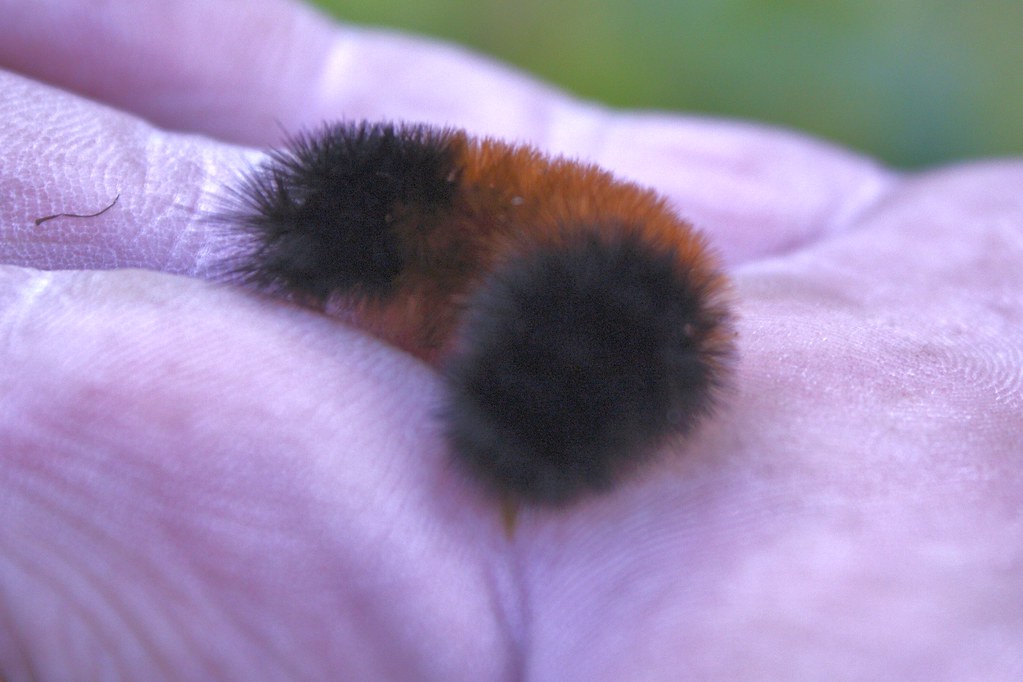
A woolly bear caterpillar, the larval form of
the Isabella tiger moth (Pyrrharctia isabella)


This is my mostly annual winter weather prognostication for 2009-2010: The equal sized bands of the woolly bear caterpillar that we found out in the woods this fall are forecasting a normal winter. Sort of disappointing for me. I wanted to see a good, hard winter for my first New Hampshire winter. The woolly bear became famous because
  • In the fall of 1948, Dr. C. H. Curran, curator of insects at the American Museum of Natural History in New York City, took his wife 40 miles north of the city to Bear Mountain State Park to look at woolly bear caterpillars.
  • Dr. Curran collected as many caterpillars as he could in a day, determined the average number of reddish-brown segments, and forecast the coming winter weather through a reporter friend at The New York Herald Tribune.
  • Dr. Curran's experiment, which he continued over the next eight years, attempted to prove scientifically a weather rule of thumb that was as old as the hills around Bear Mountain. The resulting publicity made the woolly bear the most recognizable caterpillar in North America.

A funny thing: I can't remember ever seeing an Isabella tiger moth. You can see them at bugguide.net. You can also read more scientific information about them there!

Technorati Tags: Del.icio.us Tags: Flickr Tags:

diigo it

_/\_/\_