Showing posts with label Bernd Heinrich. Show all posts

Saturday, April 02, 2011

VIDEO: The Geese of My Beaver Bog


Canada Geese Defend Their Nesting Site
March 31, 2011

Canada geese did not nest here until about three years ago. They would fly through on their way north to Canada. Many ducks did, too. I have photos of mergansers and wood ducks that rested here on their way north. However, once the Canada geese decided to nest here, only mallard ducks have dropped in and/or nested here. I have gotten used to them and now actually enjoy watching the geese court, brood, and finally, raise their chicks. I have even seen their eggs when the mother rearranges herself on the nest.

But before they make a nest, the geese have a lot of work to do. Geese don’t necessarily mate for life. They lose spouses, just like people do, to death and infidelity. They don’t pine away forever if either happens, but they may lose the breeding season and have to wait until the next year. They usually, but not always, return to the same pond each year for breeding.

We had several geese for about three weeks stop in the afternoon and then leave at dawn the next day. But last week, “our” geese returned and stayed. They serenely walk side by side about the beaver bog, occasionally swim, sleep on the ice, and just take it easy. And every year, a solitary male challenges the mated male. This lone male may be a youngster or a widower, But he wants to entice the mated female to be his mate. The mated male will attack the unmated male and drive him off a safe distance. The female may join her partner in attacking the stranger. Eventually, the lonely male will take off and cruise other ponds for women. It could be one hour to a few days before he decides to try his luck somewhere else. The slide show above shows you the attacks that the mated pair makes on a solitary male. On many slides, you can just see the head of the mated male on the left side of the photo as he runs or flies in for his attack.

The other problem that the resident geese have is another couple that wants the same nesting site. The arguments between the two couples are often more violent than the arguments between a mated pair and an interloper male. Males and females will fight and I have even seen them tag team other couples. The male will attack, hands the fight off to the female, and if the strange couple is not scared off, he will go back in. We had a skirmish like this today.

The new geese arrived yesterday. Yesterday they stayed far away from our geese on the other side of the bog in the back pond although at times they would stroll a bit closer to the front pond and our geese would begin to pay attention. The new geese then returned to the back pond without a confrontation.

Today, the new couple tried to come into the pond that our geese are considering for a nest (there is no telling where they will, or if they will, build their nest).. We watched as our geese attacked the newcomers. They were sly. They walked side by side just as the do in peaceful times. But their necks would begin to extend as they got closer to the new geese. And suddenly, our male would run full tilt for the new male. After a few seconds of chasing the other male, our male would break off the attack and step aside. Then our female, who had stayed still during the attack, would run in and chase the other male. Sometimes, as our male chased the new male, our female chased the new female. But either way they decided to attack, our mated geese would reconnoiter after their attack and then extend their necks, bob their heads at each other and repeatedly touch their bills together. This cracked me up. The geese were giving each other high-fives!

If you would like to learn more about the geese in your ponds, read The Geese of Beaver Bog by Bernd Heinrich With some knowledge of goose behavior, you can enjoy observing them much more. Heinrich, my favorite nature writer, is a professor at the University of Vermont. His writing engages you. You won’t put the book down. Heinrich wrote the book after he observed his own geese on his pond for a season or two.

As I mentioned above, this slide show shows the confrontations between a mated pair of geese and a solitary male. The action was taken with a very long lens on an extremely overcast day. The photo quality if poor, but the messages of the geese is clear. This is the first time that I have made a slide show in Lightroom. I have no idea where the first couple of frames flash a bright light. There is no audio track. I hope you enjoy it!

_/\_/\_

Thursday, February 11, 2010

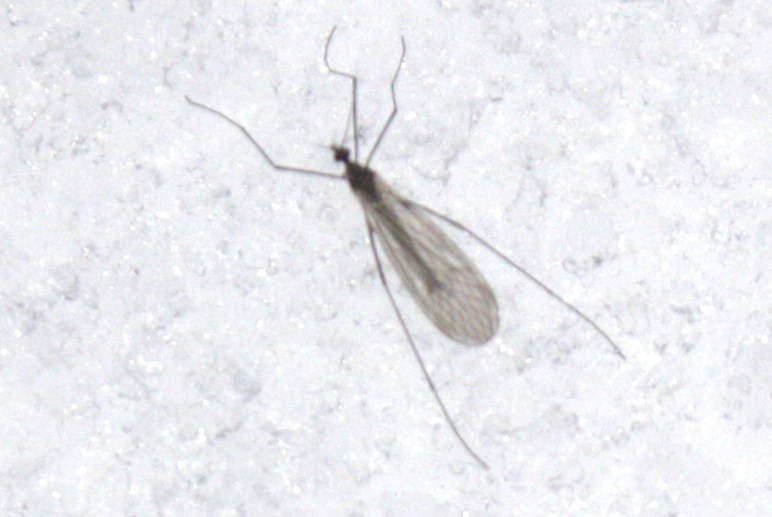
Winter Insect

Yes, they do fly in winter. I don't know what this is. It landed in front of me while I was snowshoeing. I have not submitted this guy to bugguide.net as of yet. I am waiting to see if I can figure it out its identification myself as I read Winter World: The Ingenuity of Animal Survivalby Bernd Heinrich. I have just begun the chapter on insects in winter. Heinrich is one of my favorite nature writers . . . grab the book from the link below if you live in the northern tier of the United States. Read it!


diigo it

_/\_/\_

Wednesday, September 16, 2009

Summer World VI: Digger Wasps

 Summer World: A Season of Bounty page 72:

. . . I thought I saw a light-colored piece of straw about half a foot long “flying” horizontally and then hovering in midair. That caught my attention — I looked closer and saw a black wasp that seemed identical in form to a mud dauber, and it was carrying an object. I jumped up in my excitement, and the wasp was spooked and flew off. The proof eluded me, but it dropped its “prey” onto the porch. I picked it up — definitely a long piece of dry grass!

Expecting the wasp to return, I waited. After about twenty minutes it did return, carrying another piece of grass. This time I was ready with an insect catcher net, and I snagged the wasp along with the grass it carried. The wasp was about 0.6 inch long, and the blade it was carrying was about 2.4 inches long. The wasp looked superficially almost identical to the mud dauber, but its body was black rather than black-blue and its wings were smoky-colored instead of blue-black like the mud dauber's. It was a different species of wasp, which I later identified as Isodontia mexicana. I also learned later that rather than making clay organ-pipe cavities for its nest and filling them with spiders, this wasp lines preexisting cavities with grass and fills them with paralyzed crickets or katydids.

Heinrich’s wife had first noticed the digger wasp (which is the common name for the wasp he describes) carrying a blade of grass but Heinrich, the professional biologist, had dismissed her observation: wasps don’t carry grass.  Heinrich soon learned he was in error, as we read above.

I remembered this section of Summer World: A Season of Bounty as I sat on our porch when a long, brown blade of grass flew near and then went into the tube of our folding chairs. Excited that I, too, saw the wasp, I got the camera, but found that photographing these wasps is difficult. Wingnut and I tried all summer and he finally got the shots of the wasp itself. Now I wish the tubes of the chairs were transparent and I’m thinking of asking John to make a digger wasp house of transparent tubes for next summer.

_/\_/\_

Thursday, July 23, 2009

Summer World V: Woolly Aphids

I have seen these tiny fuzzy white balls floating around every summer of my life — but I never paid attention to them. One sentence in Heinrich's Summer World gave a name to these fascinating and beautiful creatures: "A cottony white fluff ball drifts by on feeble wing beats — it's the migrating form of the woolly alder aphid. I don't know where it's going, but it is of the summer's last generation from wingless parents."

This is my last Summer World post. I hope these have motivated you to buy this book and see the world about us more clearly.


Technorati Tags:
_/\_/\_

Summer World IV: Crane Flies Dance

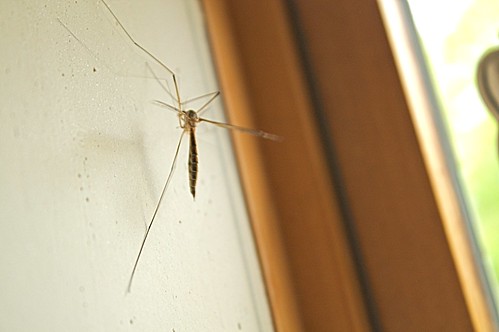
Crane fly (mosquito hawk) from June, 2007 in Barton, Vermont

Dancing crane flies in Wilmot, New Hampshire, June 2009

Do you remember the photograph above of two crane flies enjoying each other's company? There have been many crane flies in the house this summer. That is good; they eat many mosquitoes and with the rains all summer this year, we have many mosquitoes. But in Summer World, Bernd Heinrich gives the life of the crane fly poetry. It was the summer solstice in Maine, 2007. Heinrich explains that while June 21 is the beginning of summer for us, it is the middle of summer for many species of animals. And the day was so lovely that it was sufficient cause for dancing to celebrate the season. Heinrich's description of the crane fly dance describes exactly what happened in the beginning of summer with the crane flies in the bathroom:
Our outhouse is open at the front, and it faces deeply shaded sugar maple woods. The dancers — two or three dozen of them — each have six long, spindly legs. They jitterbug up and down and forward and back in a dark corner just under the roof, and they are worked up to a frenetic speed. Undoubtedly they are expert performers. They ought to be. They've probably been doing one or another version of their act for more than 225 million years, since the Triassic period. And indeed, their performance doesn't disappoint.

Most of the dancers are single, but several have partners to whom they are firmly attached — by their genitals. The members of a pair face in opposite directions, and when — more often than the singles — they come to rest, they dangle with one holding on to the ceiling with its front legs while the other dangles below.
Crane flies are relatives of mosquitoes. They are called crane flies because their legs are so long. Heinrich says that their bodies are 1/3 of an inch long yet their legs are three times longer (1 inch). And if you touch a leg, it could fall off. Dropping legs is a defense against predators. The sexes can be differentiated by the ends of their abdomens. A thicker, pointed abdomen is female and a thinner, blunted abdomen is a male.

The summer dance that Heinrich describes is mostly performed by the boys. Once a boy attracks a girl with his dance, they mate (my first photo) and then they stay together for hours. In his sample, Heinrich's male crane flies outnumbered females by 28:2.

I would so enjoy reading other local observations from other Summer World readers. I will have a couple more of my local observations in the days to come. Meanwhile, click on the book below and read it!


Technorati Tags:
_/\_/\_

Sunday, July 19, 2009

Summer World III: Ant Lions

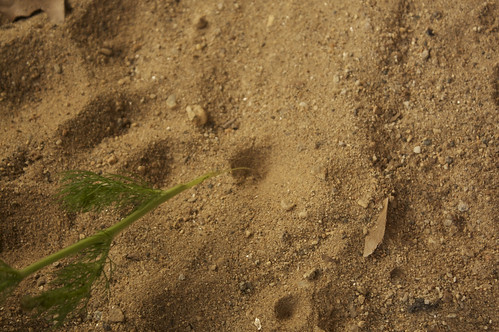
Here in this part of New Hampshire you live in sand — beautiful, soft beach sand. John showed me, quite a few weeks ago, creatures that like to live in the sand — ant lions. You can see the indentations of each ant lion home in these photos. Above, John is tickling an ant lion sand pit in order to get the ant lion to reveal itself. Some of the pits have no inhabitants, so tickling the pit is the only way to find out if it is being lived in. The ant lion thinks that the grass leaf is an ant and jumps out of the bottom of the pit to eat the ant.

Above, John has captured an ant lion. This one was really tiny and difficult to focus on with the Canon XSi. When ants walk into an ant lion's sand pit, they can't often escape. As they crawl out of the pit, the sand keeps them sliding back down until the ant lion gobbles them up.

Ant Lions (or Antlions or Doodlebugs or Doodle Bugs)
(Genus Neuroptera, Family Myrmeleontidae)
Above you can see the tiny ant lion.
It has enormous pinchers in front.

Below: I showed the sand pits to Wingnut, who promptly began feeding ants to the ant lion. It was totally fascinating to see the capture process. We noticed that about half of the ants were able to escape the pit. But half couldn't escape and were eaten. A 50% kill rate is pretty good in Nature. It is very difficult to see the escaping ant in the photo below.

After these activities (when these photos were taken), I happened to read Summer World because Bernd Heinrich's books have taught me so much about where I live. Summer World has a great section on ant lions (pages 193-194). If you live in New England (especially northern New England) you must read this book. You should read it if you live anywhere else:
". . . ant lions . . . are slow-moving predators that catch fast ants. They do this by making pits in lose, dry sand. The pits serve as traps; the ant lions hide buried in sand at the bottom of the traps with only their sharp tonglike pincers exposed; and with these pincers they grab any ant that wanders in. If an ant then starts to scramble up the steep, slippery slope of dry sand, they throw up loose sand that starts a sandslide and brings it back down and into reach.


Technorati Tags:
_/\_/\_

Summer World II: Chipmunks, Zorro and Bot Flies

We had a kill awhile back. Zorro walked in the door with a wounded chipmunk, yowling, and brought it to the bedroom where I was cleaning. It startled me so much to see such a large catch that I screeched and Zorro turned back to the dining room and let the chipmunk go. The little rodent began squealing and running, finally hiding under a buffet table. Unfortunately, it was so severely bitten by Zorro that John had to dispatch it to chipmunk heaven.

John had told me earlier this season about the problem that chipmunks have with bot flies. I had never heard of bot flies in New England before — until I read Summer World. Heinrich writes: "I have also seen bot flies on skinned mice and chipmunks in Maine; relative to the size of their hosts, one of these maggots would be as big as a woodchuck to us."

Bot flies do not bite. They deposit their eggs in the nostrils of caribou in the arctic. When the eggs hatch, they wander around inside the caribou's body and then settle in under the animal's skin as they grow to be adults. Then they pop out of the caribou's skin and drop to the ground so that they can pupate.


_/\_/\_

Monday, July 06, 2009

Summer World i: Sheep Laurel

Sheep Laurel (also called Lambkill) (Kalmia angustifolia)

In a previous post on my Photo a Day Blog, Wildflowers & Berries, I misidentified this Sheep Laurel as Mountain Laurel. I wrote that I wasn't entirely sure it was mountain laurel because of the size and age of the plant. While reading Summer World: A Season of Bounty by Bernd Heinrich, I suddenly came across a mention of swamp laurel. With that clue, John and I were able to identify our laurel as sheep laurel because of its location and growth pattern. Sheep laurel has the identifiable growth seen above. The flowers develop on last year's growth and this year's growth is above the flowers.

The best source of information about this wildflower is at www.fs.fed.us/database/feis/plants/shrub/kalang/all.html.

And now, because of its importance and value, I will shamelessly promote Heinrich's book. The summer world that I am watching is more meaningful to me now after reading this book. Click, buy it, and enjoy a wonderful summer read:


Technorati Tags:
_/\_/\_

Sunday, January 20, 2008

Crafty Green Poet: Domesticated

On October 16, 2007, the geese began to fly south. It was, for me, a sad moment
This photo will open, full-sized, in a new window when clicked.

Crafty Green Poet: Domesticated:

Imprinted at birth by a human,
you never learnt to be what you are.
Flightless and petted, you enjoy comforts
of home and hearth,
insulated from the harsh
rules of nature that made you.

Winter air fills with honking
geese in joyful formation
high in unthinkable sky.
You look up, an ache in your bird’s brain
before waddling indoors
to be hand fed choice grain.

Later you puzzle over dreams
of endless blue and the steady beat of wings.

Book Review: The Geese of Beaver Bog by Bernd Heinrich

On April 22, 2007, I noticed a pair of nesting geese on the beaver ponds across the road. I was disappointed that they choose to nest here because I had been told they were aggressive and would make the ponds their own, chasing out other water fowl. That seemed to be confirmed when I saw that no mallards, wood ducks or mergansers nested here as they had before. I decided that I may as well take advantage of the presence of these birds and photograph their young when they hatched. These photos in this review were taken at 10x zoom.

I saw the three goslings soon after they hatched (but was never able to photograph them), but only for a day or two. The family quickly disappeared. I was concerned that they had been eaten by fox or coyote. Then in July, Wingnut and I went to Crystal Lake State Park to swim and there was my goose family. They had integrated into life at the park and were eating and pooping very well. The goslings were nearly as big as the parents.

The park staff was asking people to not feed the geese, but were ignored. A ranger told me that they had to clean fifty pounds of geese droppings a day and it was becoming tiresome. It was impossible to walk barefoot as we usually do. But the geese were pleasant, not aggressive, and enjoyable to observe, especially since I knew that they were "mine."

I have always wondered how the family got to Crystal Lake, a mile down the road and over at least one beaver dam and a huge falls at the Barton Waterworks. Why did they leave? Was the water at the beaver pond polluted in some way? Did the food supply in the ponds suddenly become scarce? Did the goslings walk or were they carried?

Heinrich wrote the amazingly personal and engaging book, The Geese of Beaver Bog, about his observations of a group of geese from 1997 - 2003. Heinrich is a professor of biology at the University of Vermont. I have read his book Mind of the Raven: Investigations and Adventures with Wolf-Birds (after observing ravens rolling in fresh snow) and have heard him talk about bees and other topics on Vermont Public Radio and National Public Radio.

This book is a wonderful resource for me. Heinrich's experiences with his geese and beaver pond are remarkably similar to mine. We are both in Vermont, so the plants and animals are the same, and the bird populations are similar. Reading this book was like sharing experiences with a friend who doesn't only know the pond, but understands the excitement and sadness that I see here. He would feel as badly as I did when a crow stole a young redwing blackbird. Or when I heard the killing of a deer one night. He would chuckle at the scene of the coyote meeting a beaver face to face on the ice.

Canadian geese are precocial: they are able to be independent after hatching. The goslings are not fed by the parents. They mimic the parent's behavior and quickly learn what wisdom they need to continue surviving. And the parents do take the goslings to other ponds and lakes after hatching. The beaver pond, with its mink, weasels, foxes and coyotes, is not safe for the youngsters. Heinrich's geese walked two miles through cow pastures to a new pond. Mine walked through the woods where there were many dangers from predators that could not be easily seen by the parents.

Geese will try to return to nest where they are born. So I will most likely be seeing geese here for some years to come. Geese pairs do not necessarily mate for life. They tend to be monogamous but life interferes with our plans: mates are killed, or are chased away. I learned about different groups of geese in North America ("races") and about their migration.

We tend to categorize animals as cute, smart, companions, pests, killers, unimportant — there is no end to how we judge which animals are worthy of living. But once we understand their complex behaviors and how they interact, we begin to identify with them and judge them worthy of living on earth with us. We are now concerned about the survival of mountain gorillas, wolves and other animals because of books and movies that personalize their lives. The Geese of Beaver Bog personalized the natural lives of geese for me. It demystified their behaviors, asked questions that I would like answered, and removed the "pest" stigma from them.

I believed geese were nuisances but now that I know them better, I will protect their right to survive in the beaver ponds. I won't be hoping that they never return. I will be re-reading this book in the spring so that I am prepared to better observe, and enjoy, the behaviors of the geese.

All of these photos will open, full-size, in a new window when clicked.


Technorati Tags:
_/\_/\_

Saturday, December 08, 2007

Unplugged Project: Nature: Red Squirrel Tunnels

Red squirrels can be sassy little pests that may move into your attic every winter. They are agressive and noisy. But they are also cute and creative. Once my daughter Amy fixed the bird feeder so that the squirrel couldn't eat the bird seed, it had to eat the seed kicked out by the birds onto the ground. I learned that the squirrel has a maze of tunnels under the snow in order to cross large open areas without being seen. The photos below are of the squirrel activities and show the evidence of tunnels under the snow. I have discovered two reasons why the squirrel would have such intricate tunnels. Look carefully at the photos below. Can you find the tunnel entrances? Can you see evidence of the tunnels under the snow? Can you think of two reasons why red squirrels would build these tunnels? Follow my journey of discovery in the photographs below.


One more fascinating fact about red squirrels discovered by one of my favorite authors, Bernd Heinrich and published in Journal of Mammalogy, Vol. 73, No. 1 (Feb., 1992), pp. 51-54.:
Red squirrels, Tamiasciurus hudsonicus, were observed systematically harvesting sugar and syrup from sugar maple trees (Acer saccharum) in a mixed stand of young hardwood trees in Western Maine. Each tap consisted of a single pair of chisel-like grooves of an apparent single bite that punctured the tree to the sap-bearing xylem. The dripping dilute sap was not harvested. Instead, the squirrels came back later and selectively visited the trees that had been punctured after most of the water from the sap had evaporated. The characteristic tooth marks left by sugaring red squirrels were observed at 22 other sites in Maine and Vermont.
Fascinating.
American Society of Mammologists
All photos will open in a new window when clicked.
Answers to my two questions are in the first comment.

Visit other participants of the Project at Unplug Your Kids or click
Next week's Project: STRING

Technorati tags:
_/\_/\_