Showing posts with label mallard ducks. Show all posts

Saturday, June 10, 2023

Bill & Hillary

Meet Bill & Hillary

In the spring of 2016, during the Clinton and Trump presidential times, I had a classroom counselor whose name was Andrew. He was the best counselor there was in the school, yet he was so young. He was so young, that I had taught him mathematics in fifth grade. We developed a terrific relationship with each other and with years of kids and were known for being able to complete each other's sentences. 

One day, a mated pair of mallards showed up at school and came every day. Andrew and I called them Hillary and Bill. A third male tried to steal Hillary away from Bill, and we named him Donald. But Hillary and Bill stayed together and even came back with their ducklings. 

Andrew has moved on to US Customs now. I don't work full time anymore, and time continues on. Thankfully, nature gives us the same cycles that we can pretty much rely on year after year that blunt the sadness of loss. So I was thrilled to see another Hillary and Bill at school yesterday. They were being fed by Sarah, our executive  secretary. She reminisced also about a pair of white ducks that she used to have on the lake. Each summer they would live wild and each winter they would return to the farm for shelter. When they died, the town posted memorials for them. 

This year, Hillary and Bill are not as wild as the first pair. They even attempted to enter the school! I almost wish they had. But we can't let them. It's a violation of state law to even feed them, let alone allow them to enter.

See you later!

We have eight more days of school. There's a field day, a beach day (if it warms up), an ice cream day, and cleaning up. I'm glad Hillary and Bill will be hanging around.

_/\_/\_

Tuesday, May 10, 2011

Broken Promises

Skunk cabbage (Symplocarpus foetidus) (1 of 6).jpg
Skunk cabbage (Symplocarpus foetidus)

John and I visited the mill ruins on April 28 and I promised myself that I would return to photograph the skunk cabbage before a week was out. It's been 3 weeks and they are too old now. I have read and seen photographs of a stage of skunk cabbage growth that is so gorgeous I wanted to make a special hike to capture it. You can view photographs from Ontario that show this.  And now, writing this, I realize that by April 28 I had already missed the beautiful purple stage. Next year!

Horse Tail (1 of 2).jpg
Field Horsetail Equisetum arvense)

Every single spring, I promise myself to document the life cycle of field horsetail. There is this brown stage and then there is a green stage. I don't understand how horsetail morphs from one stage to the other. This year I shall!

Bluebead Lily fruit (3 of 3).jpg
Fruit of the blue-bead lily (Clintonia borealis)

It took me years to identify this blue fruit in the woods that I saw every summer. Two summers ago we identified it and I promised myself, last summer, that I would find the tiny yellow lily that produces this blue bead. This year!

Interrupted Fern fiddleheads  April 28 2011 (2 of 2).jpg
Interrupted fern fiddleheads (Osmunda claytoniana)

In 2008 I published almost the complete life cycle of the interrupted fern. You can click here to see the series. I promised myself to finish it. I never did. This year!

Dead apple tree in the bog (1 of 1).jpg
Dead apple tree in the beaver bog.

Last summer I promised myself that I would get out into the bog more often to explore. I never did. And I have even more urgent needs to go this year. Hawks were eating birds in the bog near where this tree is. John, using binoculars, said they ate a red-winged blackbird. I worry that they ate the mallard hen because just before the hawk perched on a dead tree and began ripping the bird up, the mallard drake chased the hawk out of the water. It was a violent flight for both of the birds. I have not seen mother duck since that morning. This year, I will go exploring more often!

That's a lot of broken promises. If I were to spend some time going through photographs, I would find more. It's time I fulfilled those promises. This year!

_/\_/\_

Thursday, April 28, 2011

The Mallards

Nesting pair of mallards (9 of 16).jpg

This was different. This year, cleaning up the winter's mess of bird seed under the bird tree, we had this pair of mallards that are nesting in the beaver bog across the road. They came by every morning and every afternoon and scooped up piles of seeds. You can even see grass and dirt on the male's beak in the last photo. The hen was more black and blue than brown and blue as I usually see them. The male's legs were bright orange. He was very protective of his wife and paid attention to my movements in the window. When he saw me, he got between me and his wife. She paid little attention to me at all. The ground under the bird tree is now so clean you would never know there had been feeders there. The ducks, knowing there is no more food, have not returned for the last two days.

Nesting pair of mallards (4 of 16).jpg

Nesting pair of mallards (2 of 16).jpg

_/\_/\_

Sunday, October 17, 2010

Vacation Bible School Part 3: The Ducks

Ducks at Crystal Lake (3)

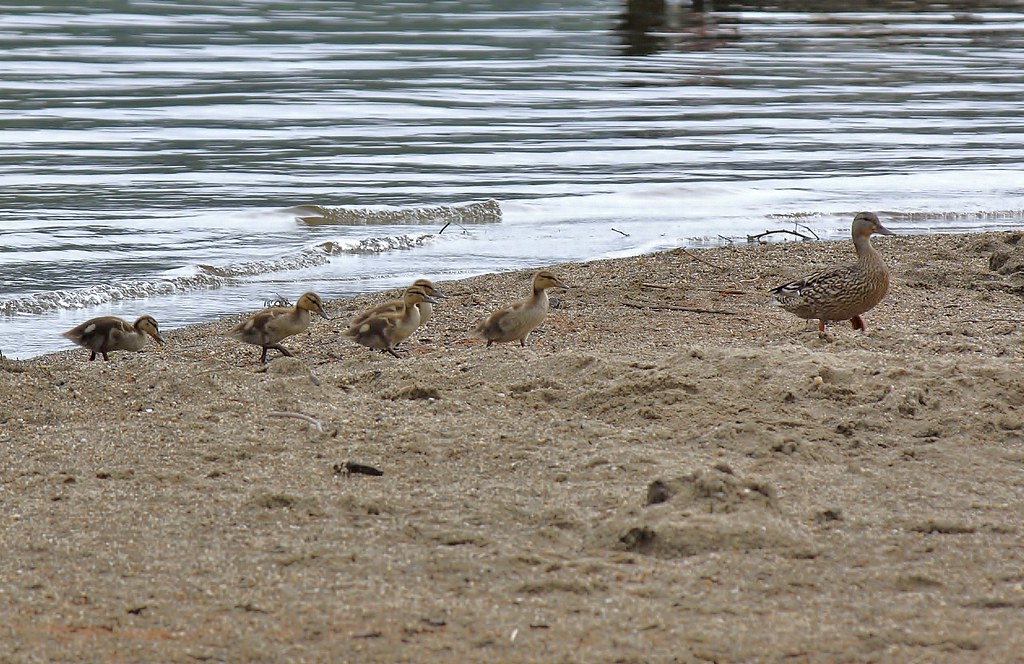
I'm glad that it is October for only one reason: Crystal Lake State Park is closed. The reason I'm glad about this is simply because I am confessing that we fed the ducks. The park rangers are gone now and won't harangue us! There were two duck families at the beach on the day that we went for Vacation Bible School. They were so engaging (even though the mother ducks tried to prevent their ducklings from mingling with people!) that we couldn’t resist feeding them. The mother ducks would also yap at each other and would nip another mom's duckling if it tried to join her brood or eat her duckling's food. These are my favorite duck photographs of the day.

Ducks at Crystal Lake (4)
Ducks at Crystal Lake (5)
Ducks at Crystal Lake (11)
Ducks at Crystal Lake (15)
Ducks at Crystal Lake (19)


_/\_/\_

Friday, October 01, 2010

Problems with Bugs and Birds

Bristly Cutworm Moth (Lacinipolia renigera)

John and I have spent hours tonight trying to identify 1 bird, 1 moth and 1 bug. I began the evening after supper by opening photos from July 10. I am so behind in my editing! I remember July 10. I spent happy hours at the beach at Crystal Lake with the kids. They played while I read and photographed a duck family, a seagull and a jet skier. That night I went outside in the dark and photographed the moths and bugs on the house. And now, tonight, I had to identify these creatures.

The still unidentified seagull.

John was finishing installing the new doors in the sun porch as I was going through bird books and the Internet trying to identify the seagul above. I have never been able to identify a seagul from a book and so I was frustrated before I began my search. My mutterings lured John to the computer. He said how they will interbreed, which makes identification more difficult. And sure enough, the books have said how some individual seagulls are unidentifiable because of interbreeding. Yikes! And juvenile gulls (which I think this is because on a close zoom I see young pin feathers — but that could be meaningless) look different than adults. And first, second and third winter gulls all look different than adults and from each other! John sat at his computer and searched for over an hour. We both agreed that the bills and legs of gulls can help distinguish the species. But that didn't even help. After two hours, we gave up. If you know of a gull ID site, let me know! Please!

Firefly (Family Lampyridae, Genus Photuris)

The bug pictured above was next. I thought it was a beetle and instantly became agitated when no beetles at bugguide.net looked like mine. John looked at the photo and said, "Firefly!" And it was. But which species? According to bugguide, it could have been species Photuris or Photinus. The lighting on my photo is poor and many photos of Photinus look like mine, so identification was more complicated. But John and I counted stripes on the bug's back and I chose to identify my bug as Photuris. Photuris females are violent: "Females are noted to mimic the flash patterns of females of other genera of Lampyridae, especially Photinus. Males are lured in and consumed. They do this for nutrition, perhaps, and also to obtain chemical defenses from other Lampyridae (5) (6), (Eisner et al., 1997)." This identification only took half an hour! I was feeling lucky now — and I should have known better . . .

We came to the photograph of the moth that you see at the top of this post. By now, John was fully into this task with me. We knew the moth was a moth. So I searched for "brown moth with green spots" and for "black moth with green spots." I searched for "green moths." I figured from the silhouette that this was an owlet moth (and I was right!). But there are nearly 21 bizillion species of owlet moths and after a solid hour of viewing photos of owlet moths, I finally sent this photo to bugguide. I got a response within 10 minutes! This is a bristly cutworm moth! Total time spent on this moth: 2 hours.

We knew two other bugs and birds instantly: a caddisfly, a family of Mallards (duh) and a curved-toothed geometer moth (one of my favorite moths). The photos are below. I also found another online site to submit photos to: the North American Moth Photographers Group. They are doing some bizarre research (which I won't discuss here), and John and I spent quite a bit of time reading and looking at the photography. I may participate with that group in the future — if I have any time left over after identifying my bugs and birds!

Mallard ducks (Anas platyrhynchos)

Curved-toothed geometer moth (Eutrapela clemataria)

Caddisfly (Trichoptera)


_/\_/\_

Wednesday, March 24, 2010

Female Mallards

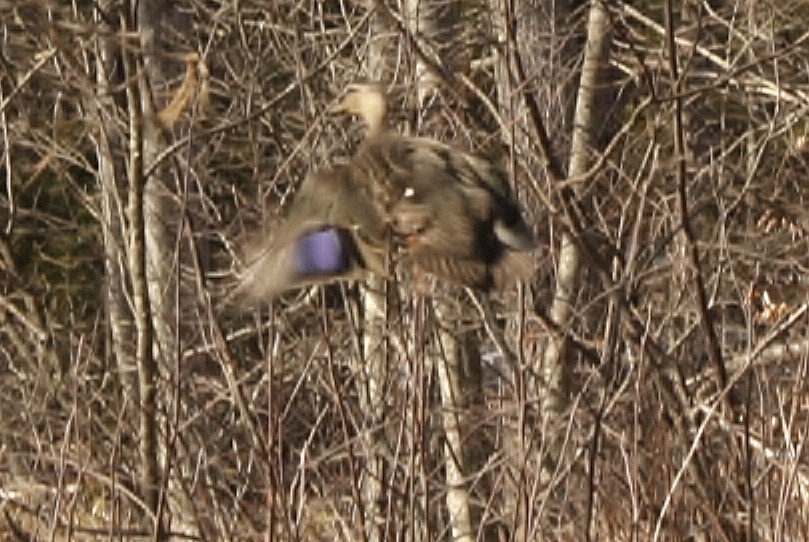
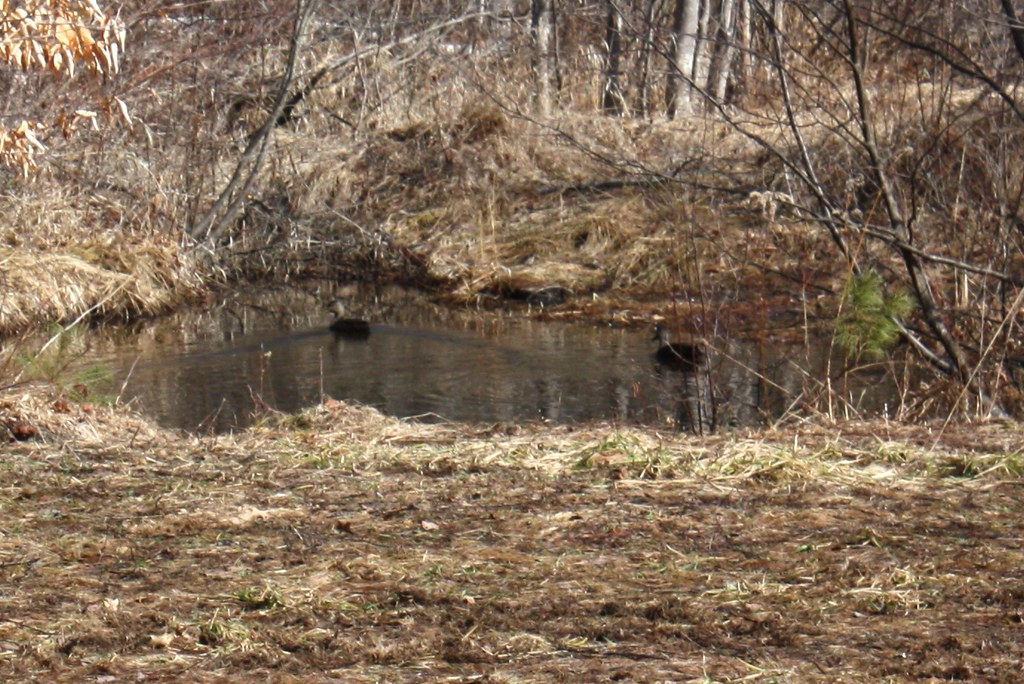
I was walking around here waiting to run some errands and saw two female mallards on the lower pond. I slowly walked around the perimeter of the pond as they watched me. On the other end of the pond they burst out of the water and went into the trees. I managed to get one or two decent shots of them in flight. I really need a longer lens for those times, like here, when the ducks were in the pond and I was far away.
Technorati Tags: Del.icio.us Tags: Flickr Tags:
diigo it
_/\_/\_

Wednesday, June 03, 2009

Bird Day Part 1: Vermont Ducks

I was driving down the road yesterday morning when I saw a lone mallard drake by the side of the road quacking to something either in the ditch or the woods.

I stopped to photograph him and heard more ducks in the woods. There were two more mallards up there, running parallel to the road, quacking to Mallard in the road. They all became more agitated because I stopped but they did not stop.

Finally, the two in the woods came down the small hill, crossed the ditch, and all three ran down the road together to their farm.

The closer they got to the farm, the faster they waddled.

_/\_/\_

Wednesday, March 04, 2009

Cold Ducks

When we were in Montpelier on Monday, I heard quacking on the Winooski River and found these mallards waiting out the storm on ice in the river. Some were covered with a light film of snow while others were swimming. In the top photo you can see the beautiful stone work of the old houses on the river.


_/\_/\_

Monday, May 26, 2008

Odd Shots: Duck Tipping

Three mallard drakes were swimming side by side yesterday. Perfectly synchronized, they all oddly tipped and rose at the same time. I always enjoy watching duck (and geese) feet wave in the air when they tip. But I noticed a couple of other things in these photos . . .

. . . the feet should be held underwater for balance . . .

. . . and just before they tip over, they look as if they are capsizing!

When clicked, these photos will open, full size, in a new window.
Thank you for visiting!
To view more participants, click or the graphic on the left.

_/\_/\_

Saturday, April 19, 2008

Wood Ducks, Mallards and the Heron

Thursday morning was very busy at the beaver bog. A pair of wood ducks flew in as I was photographing mallards and a great blue heron. The male wood duck is dark with the stripes and rufus breast. The female is drab brown but has a white patch over her eyes that you can see in one or two of these photos.


Below you will see photos of the mallards. The male has the emerald green head and a white stripe around his neck. The female, again, is drab brown. Both have purple feathers on the back of their wings.


The mallards were paddling about the area where the great blue heron was preening itself for over an hour. They even climbed up on the hummock that the heron was on. None of the birds seemed to be bothered by the other.

The morning sun was brilliant so it was impossible to get the glare of the sun off of the birds. But it was more important for me to capture these moments than to worry about how perfect I could get the shots.


All photos open in a new window, full-size, when clicked.
_/\_/\_